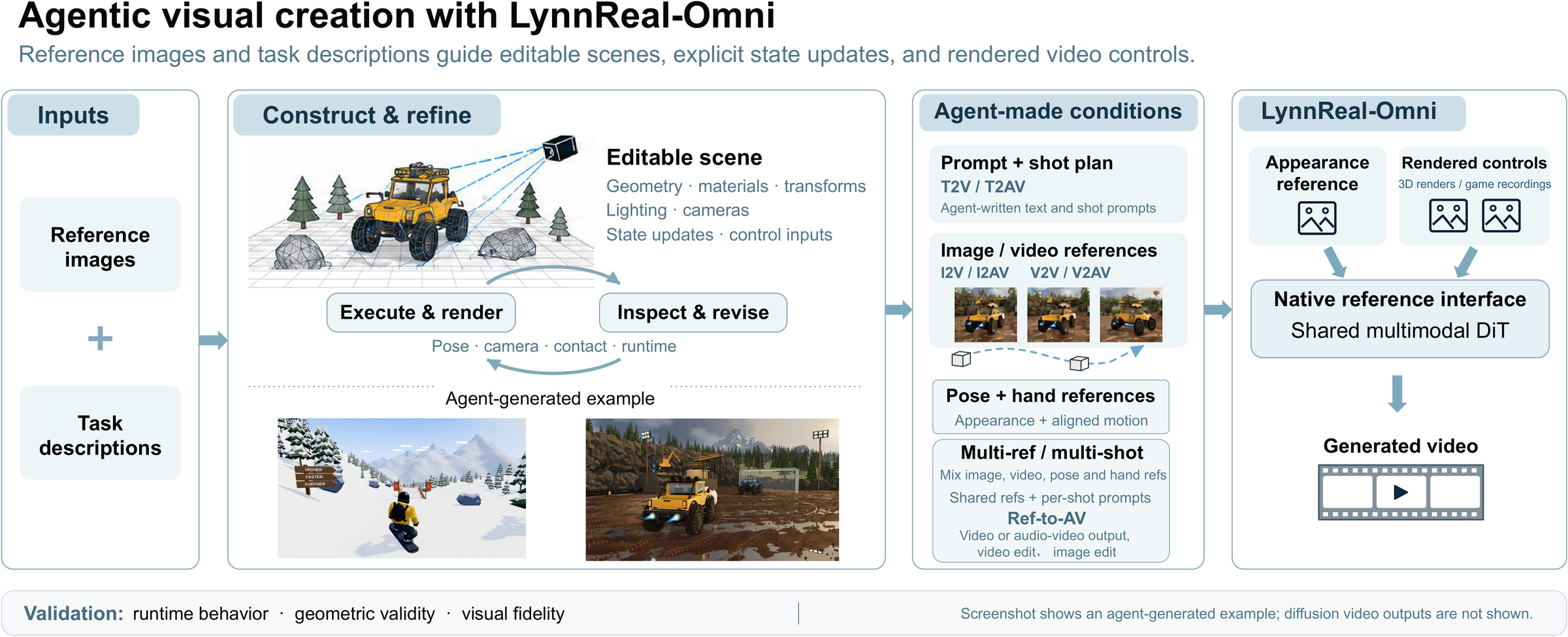
Agent workflows. Image-based scene reconstruction and agent-written low-poly games produce distinct visual-control streams. Prompt refinement, image generation, and first-frame editing provide appearance controls. The video model receives these controls through its native reference interface.
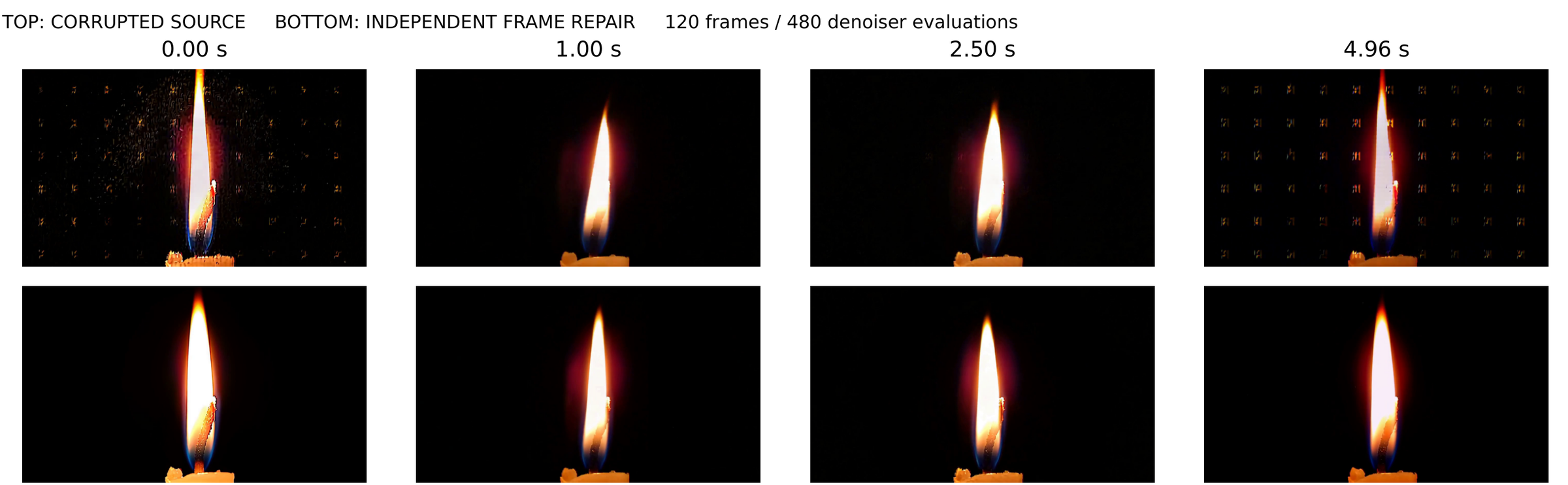
An example of generated-video artifact repair with LynnReal-Omni. Top: corrupted candle video. Bottom: independently repaired frames at identical timestamps, including both endpoints. Full frames are displayed at the same scale. Each source-frame edit uses four denoiser evaluations, for 480 evaluations across this 120-frame example. The accompanying demo plays both complete videos synchronously.
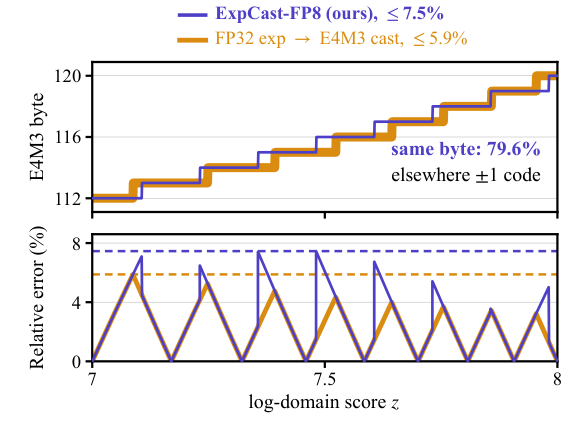
VC-Attention writes the byte the conventional path writes. (a) Both paths take the same log-domain score $z$. The standard path evaluates an FP32 exponential and casts the result to E4M3; VC-Attention replaces both steps with one fused multiply-add, because an E4M3 byte is an affine function of the log of the value it stores. Reading the result as E4M3 costs no instruction: those bits already are the byte the $PV$ matrix multiply consumes. (b) The byte each path writes, and the relative error of the probability it decodes to. The two write the same byte on most of the interval and are one code apart on the rest. Every unit interval of $z$ looks the same, so one is enough.
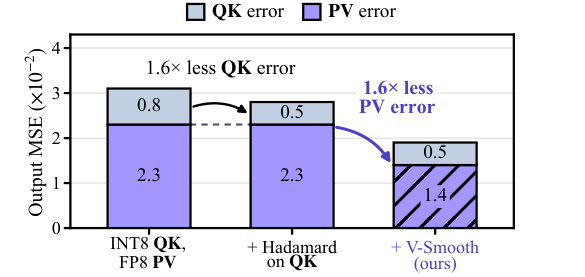
Video diffusion leaves two bottlenecks that QK-centric low-bit attention does not touch. (a) Output error on Wan2.2. A Hadamard rotation of $QK$ shrinks the probability term, but leaves the larger value term exactly where it was: the value quantizer, not the $QK$ quantizer, is what bounds fidelity. (b) Even once both matrix products are low-bit, softmax's FP32 exponentiation and its cast still sit on the critical path between them.
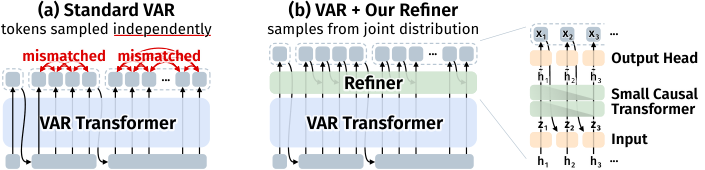
Logit Refiner Overview. (a) The VAR backbone processes all previous scales and produces hidden states for the current scale in a single parallel forward pass, finally sampling from pointwise posteriors in parallel. As sampling is done independently within each scale, this can lead to mismatched tokens, affecting generation quality. (b) Our logit refiner takes these hidden states and samples tokens autoregressively within the scale, conditioning each prediction on previously sampled tokens. The refiner is a lightweight causal transformer, incurring only a small overhead during generation, while significantly improving sample quality.
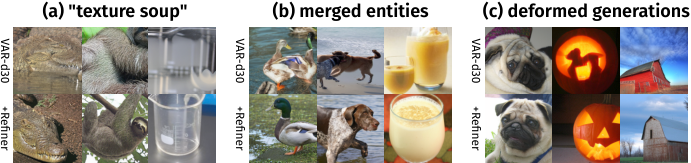
VAR Failure Cases vs. Refiner. Our Logit Refiner can address a range of typical failures of VAR. Each column shows a paired sample (same class, same seed). Top: samples covering various failure modes from VAR-d30. Bottom: with refiner.
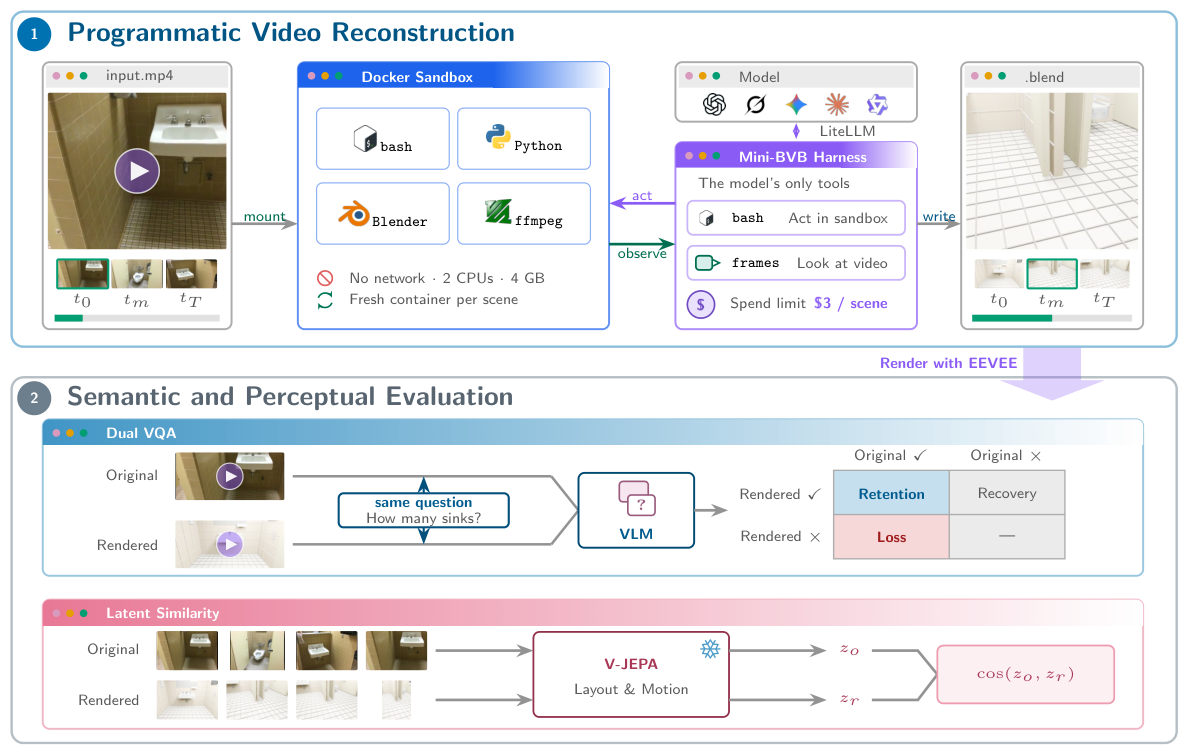
Controlled reconstruction and evaluation. A model alternates between viewing source frames and running Python code in a Docker sandbox under a cost limit, then saves an animated Blend scene. Dual VQA measures how well the rendered video retains answers the judge gets right on the source, and Latent Similarity compares layout and motion using frozen V-JEPA features.
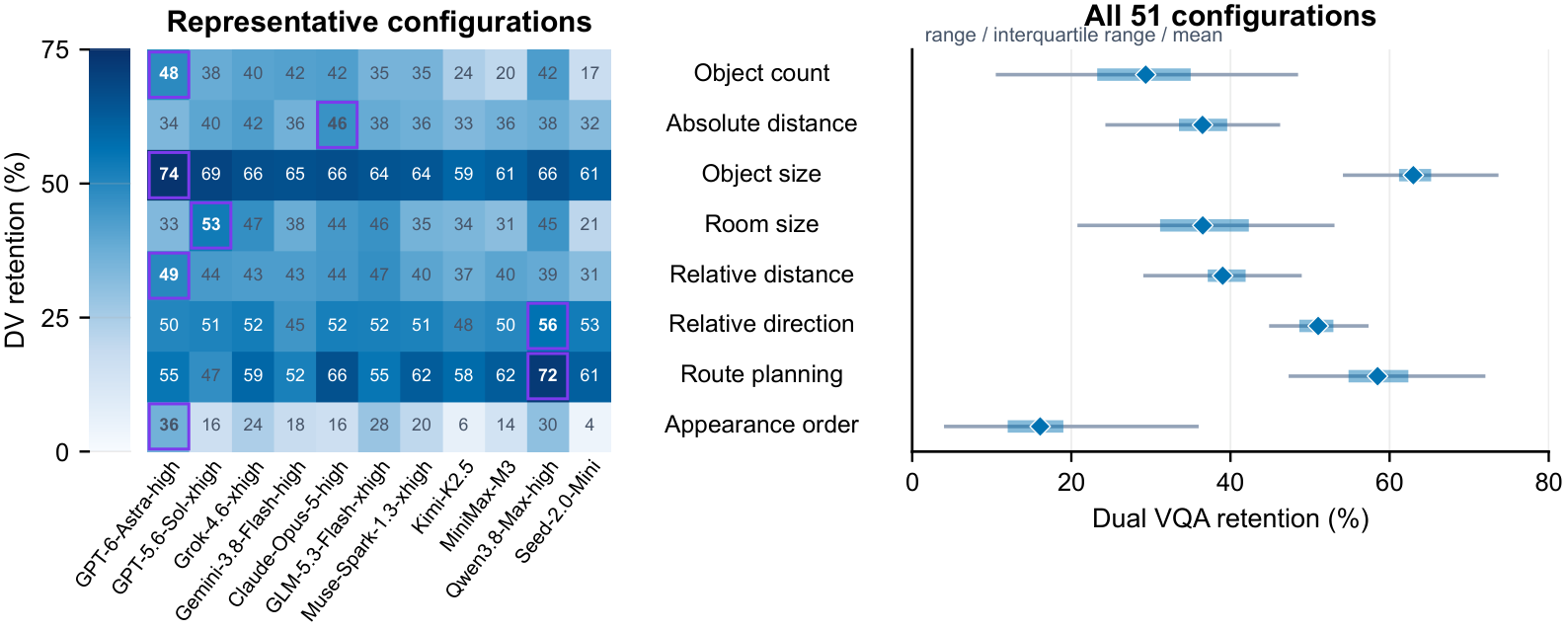
BVB reveals shared task difficulty and model-specific variation. The left panel shows retention across eleven representative configurations. The right panel shows the full range, interquartile range, and mean over all 51 configurations for each task. Purple boxes mark the best shown value in each task.
2D toy manifold distillation setting. From left to right: original teacher, trajectory-based distillation (TD), distribution matching (DM), loss-level mixture of TD and DM, and trajectory-level hybrid distillation (CrossDistill; ours). All models are trained on the same gray data manifold, and each student is trained to convergence. Colored curves denote denoising trajectories of 12 seeds, and black dots denote final generated samples.
Diversity--quality trade-off. For each of three prompts (rows) we sample four independent initial noise seeds (columns) and show the same frame per generated video. AnyFlow and DMD show reduced seed-level variation, while rCM is diverse but lower in visual quality. In these examples, CrossDistill improves the trade-off, maintaining competitive diversity and visual quality.
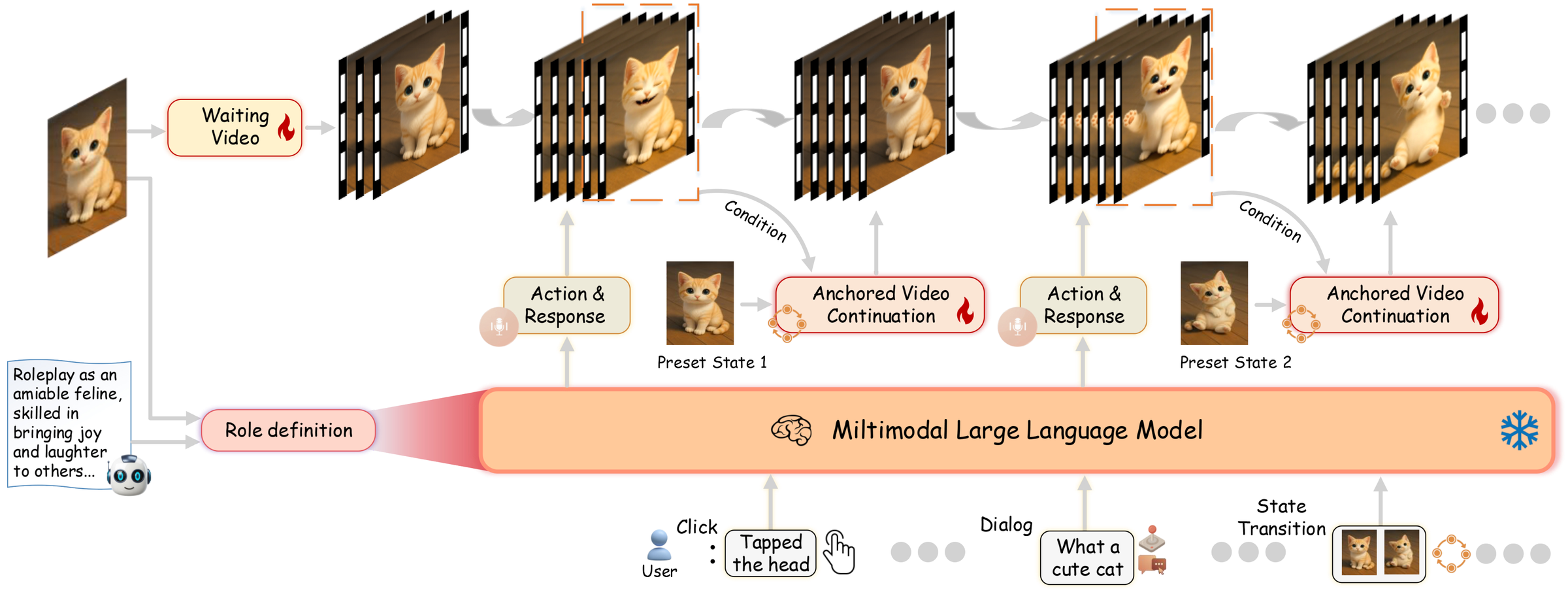
本文贡献:DiVA 用多模态语言模型路由动作和语音响应,再把等待视频、动作视频和两者过渡拆成耦合模块;Anchored Video Continuation根据前一动作返回稳定锚点状态,支持语音与空间点击输入。
Given a text prompt defining the character's role, an MLLM acts as a router, processing user inputs (e.g. clicks and dialogue) and translating them into character responses and behavioral prompts for the audio-text conditional action model. Our video generation component starts with a waiting video, followed by iterative action videos based on the MLLM output. Finally, the anchored video continuation (AVC) module, conditioned on the prior action, targets preset, high-quality anchor frames that represent distinct character states (e.g. sitting or leaning back). Guided by the MLLM state assessment, AVC transitions to the appropriate anchor state. This mechanism smoothly restores the sequence to a stable, high-quality condition and enables expressive transitions between states, significantly expanding the character's motion range.
Qualitative comparison on long-term digital life simulation. Our method successfully generates high-quality, expressive, and drift-free results, accurately performing state transitions (e.g. the 3rd to 4th transition in both examples). In contrast, all baselines suffer from severe drift and fail to execute precise state transitions; for instance, InfiniteTalk's subject only partially stands up in the second example. Notably, all baselines exhibit severe drift in fewer than 10 interaction rounds (marked in the bottom-right of each image), whereas our method remains stable indefinitely. Best viewed zoomed in.
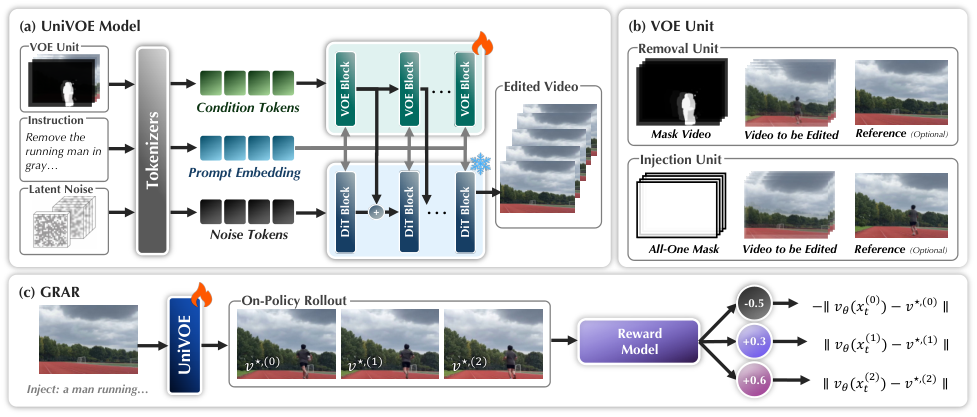
Overview of the Open-UniMo framework. Open-UniMo is trained in two stages with CoT reasoning. In the SFT stage, the model learns CoT-guided bidirectional motion-language mappings for both T2M and M2T tasks. In the GRPO stage, reinforcement learning further refines format compliance and motion-language alignment through multiple reward signals.
Qualitative comparison on Open-MoBench for the T2M task. Compared with existing representative approaches, Open-UniMo generates motions that better capture semantic details and natural dynamics.
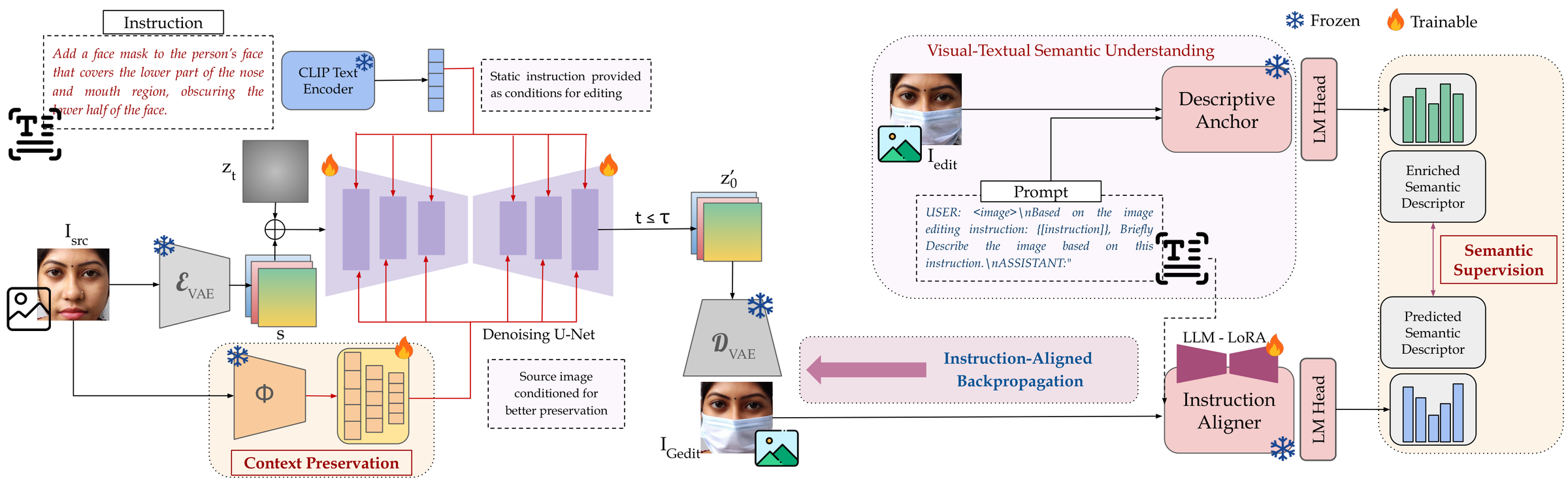
IABEdit enables instruction-based image editing through a semantic-supervised distillation mechanism. A frozen Descriptive Anchor extracts rich guidance from the instruction and ground-truth edit, while an Instruction Aligner learns to align the generated image with this guidance. The alignment is enforced via backpropagation, guiding the diffusion model toward faithful and controllable edits.
Qualitative results on RealEdit dataset showing comparisons across various editing methods. The instruction adherence can be visualized at the fine-grained level. The non-targeted regions remain preserved, showcasing precise instruction-aligned editing generations.
Overview of the DNF-SR framework. (a) The model structure adopts a dual-input design: noisy LR latents ($z_{mix}$) and original LR latents ($z_{LR}$) are concatenated with text tokens (encoded from image captions) and fed into fine-tuned DiT blocks of the Flux-Kontext pretrained model. We employed multiple loss functions to ensure the performance of the model. (b) The post-training process of Negative-aware Feature Fine-Tuning: multiple restored results are generated with different input noises, evaluated by combined full-reference (FR) and no-reference (NR) IQA metrics to obtain reward scores, and divided into positive and negative subsets. By constructing positive and negative optimization directions within both the image and the feature spaces, the quality of the restored images is improved.
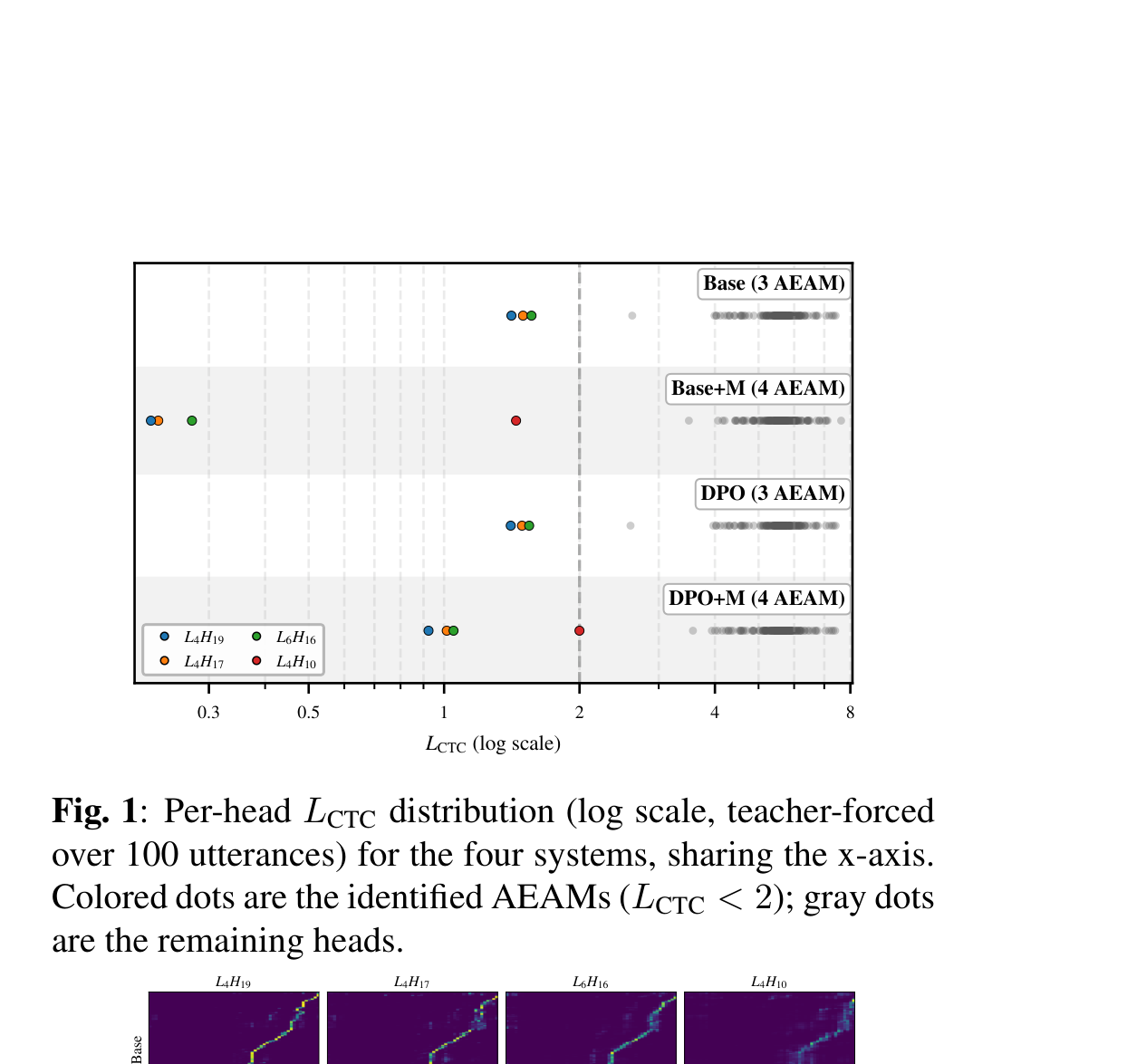
Per-head $L_{CTC}$ distribution (log scale, teacher-forced over 100 utterances) for the four systems, sharing the x-axis. Colored dots are the identified AEAMs ($L_{CTC} < 2$); gray dots are the remaining heads.
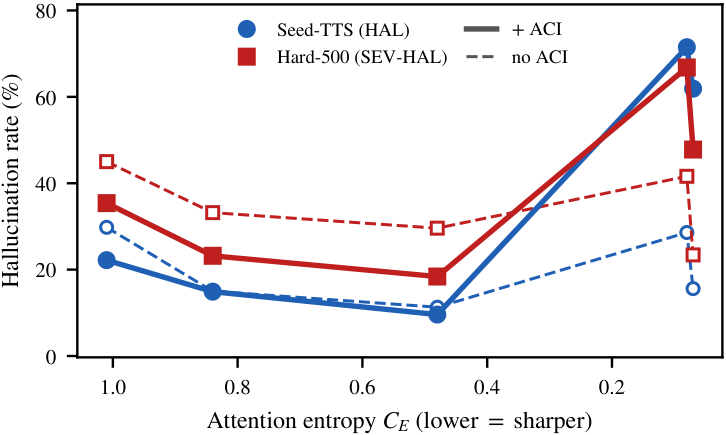
ACI's effect is non-monotone (U-shaped) in attention sharpness, on both an in-domain and a hard out-of-domain set: hallucination vs. free-running entropy $C_E$ for five models. Left to right (soft to sharp): Base ($C_E{=}1.01$), DPO ($0.84$), DPO+M ($0.48$), Base+M ($0.08$), and DPO+M from Base+M ($0.07$). Seed-TTS reports HAL ($n{=}706$); Hard-500 reports SEV-HAL.











评论 (0)