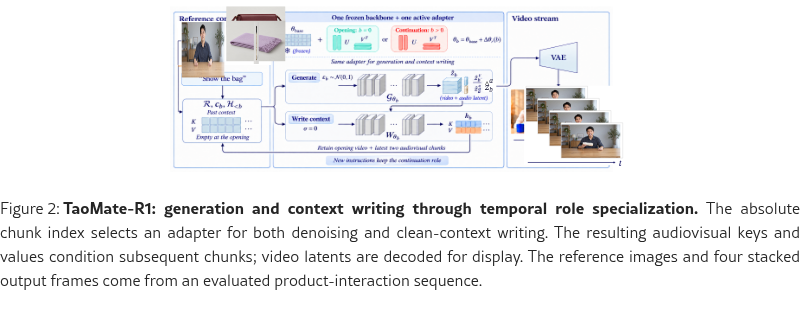
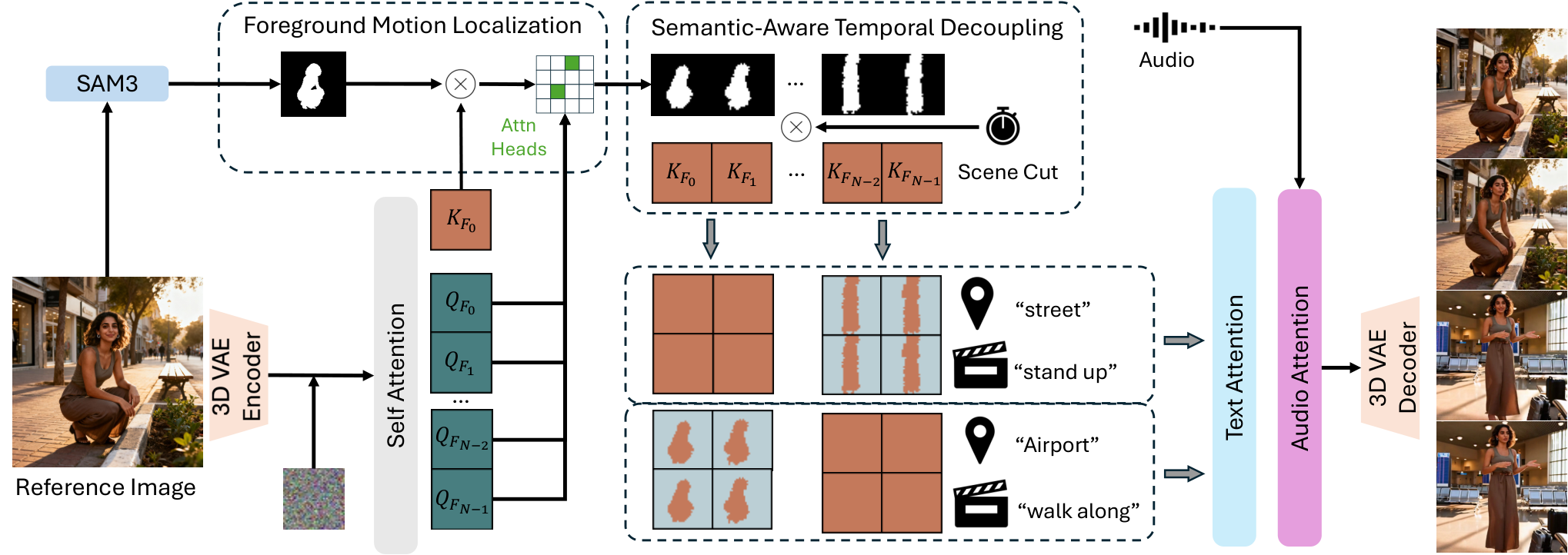
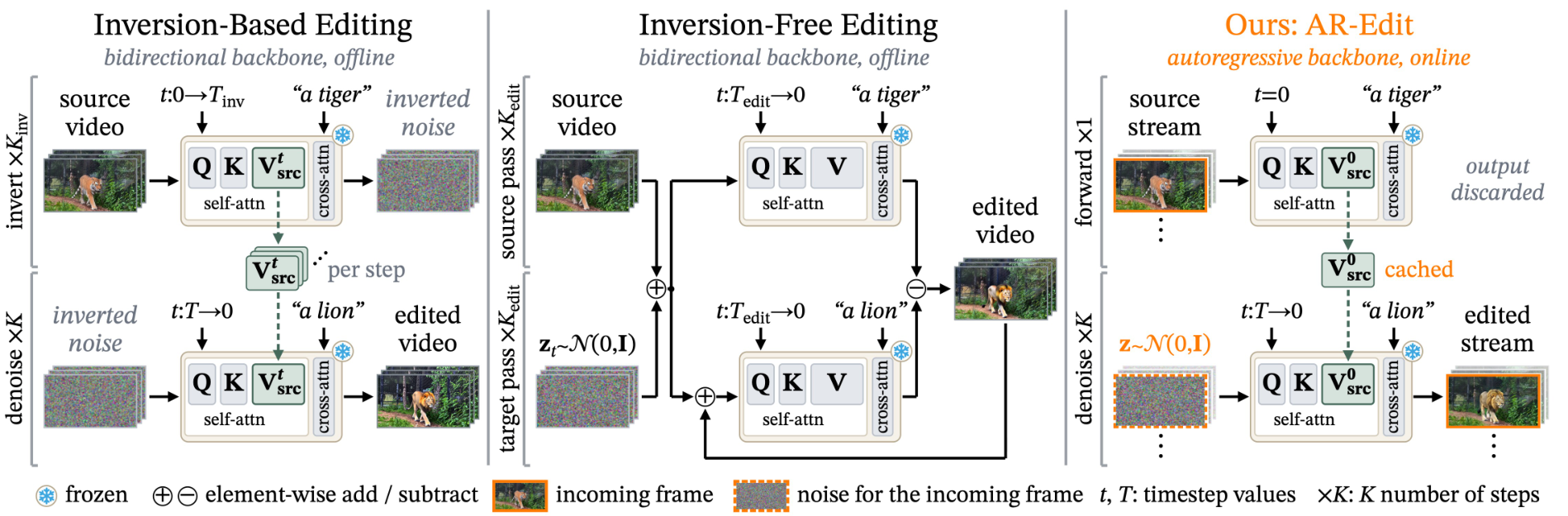
Figure 2: TaoMate-R1: generation and context writing through temporal role specialization. The absolute chunk index selects an adapter for both denoising and clean-context writing. The resulting audiovisual keys and values condition subsequent chunks; video latents are decoded for display. The reference images and four stacked output frames come from an evaluated product-interaction sequence.
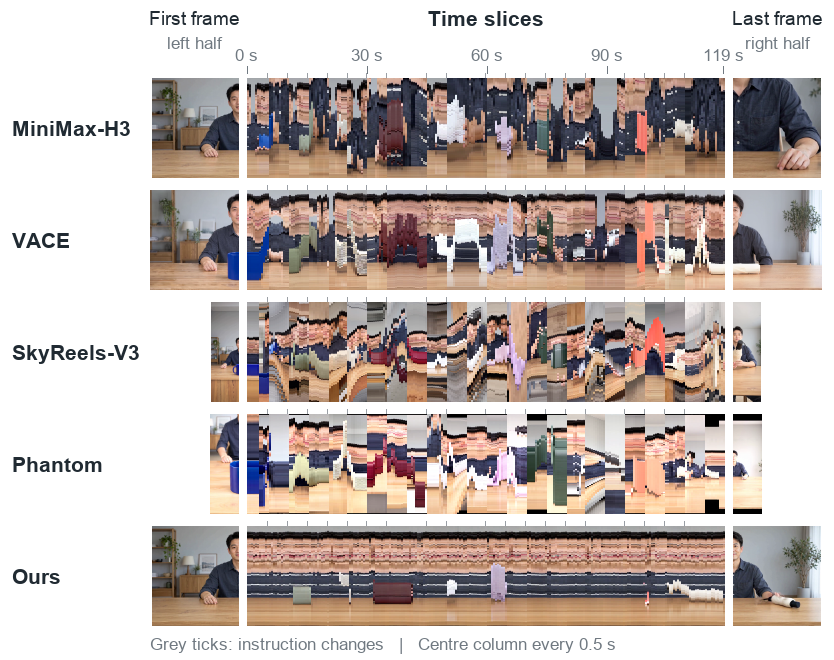
Figure 6: Scene continuity over a two-minute interaction. Each row combines the first frame’s left half, centre columns sampled every 0.5 s, and the last frame’s right half (case 006, 119 s). Grey ticks mark instruction changes; endpoints retain native aspect ratios. The bands contrast composition changes in clip-wise generation with stable presenter and table geometry in the TaoMate-R1 stream.
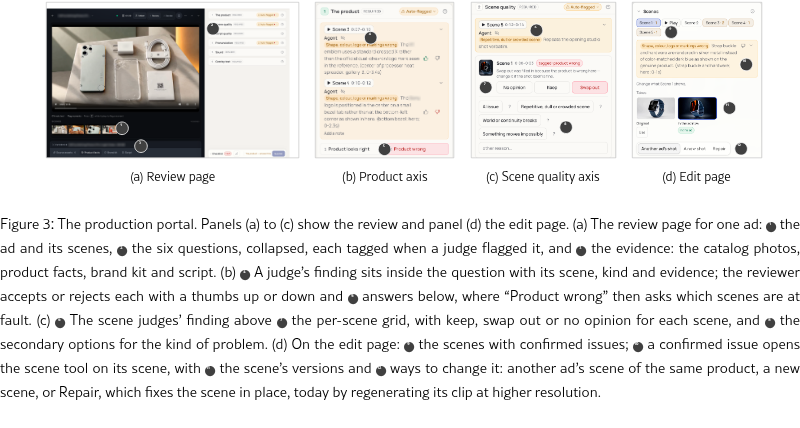
Figure 3 : The production portal. Panels (a) to (c) show the review and panel (d) the edit page. (a) The review page for one ad: 1 the ad and its scenes, 2 the six questions, collapsed, each tagged when a judge flagged it, and 3 the evidence: the catalog photos, product facts, brand kit and script. (b) 4 A judge’s finding sits inside the question with its scene, kind and evidence; the reviewer accepts or rejects each with a thumbs up or down and 5 answers below, where “Product wrong” then asks which scenes are at fault. (c) 6 The scene judges’ finding above 7 the per-scene grid, with keep, swap out or no opinion for each scene, and 8 the secondary options for the kind of problem. (d) On the edit page: 9 the scenes with confirmed issues; 10 a confirmed issue opens the scene tool on its scene, with 11 the scene’s versions and 12 ways to change it: another ad’s scene of the same product, a new scene, or Repair, which fixes the scene in place, today by regenerating its clip at higher resolution.
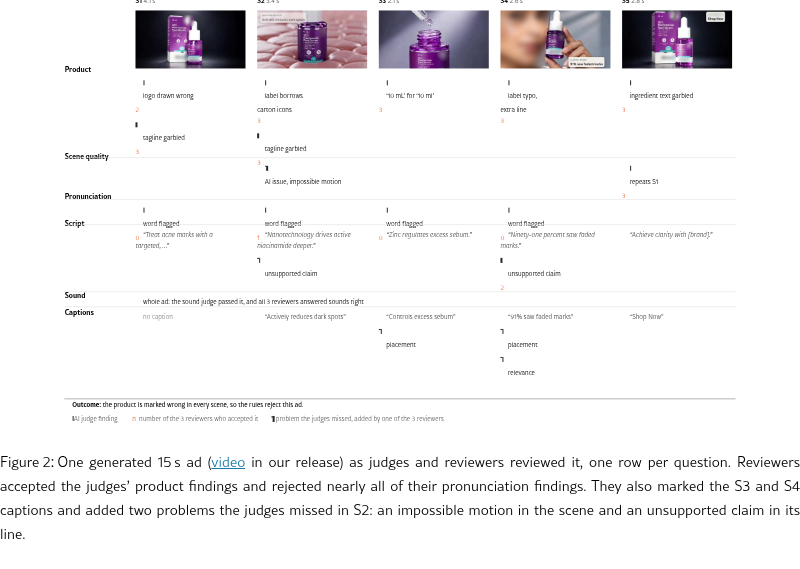
Figure 2 : One generated 15 s ad ( video in our release) as judges and reviewers reviewed it, one row per question. Reviewers accepted the judges’ product findings and rejected nearly all of their pronunciation findings. They also marked the S3 and S4 captions and added two problems the judges missed in S2: an impossible motion in the scene and an unsupported claim in its line.
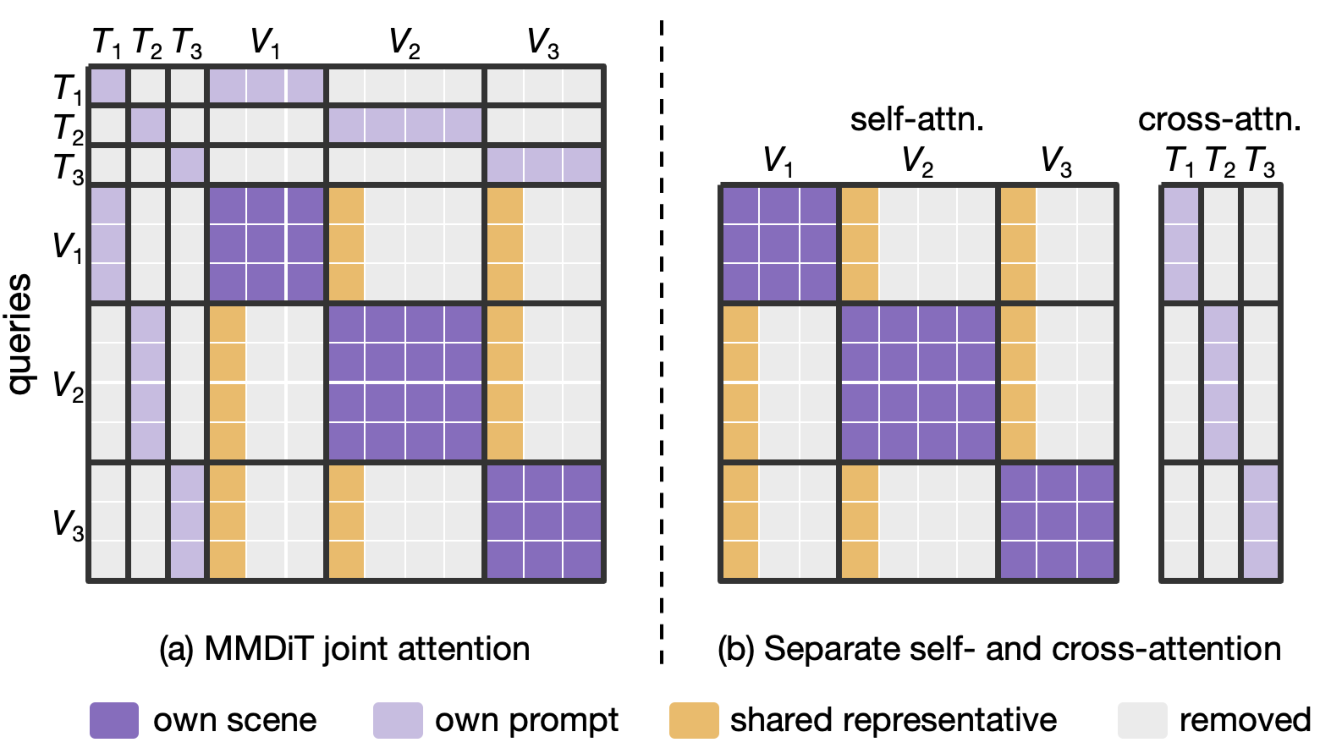
Figure 5: Scene-structured attention across model architectures. Rows denote queries and columns denote keys. Purple denotes scene-local interactions; orange denotes selected foreign video K/V from a shared memory. The example shows one head; text queries remain local.
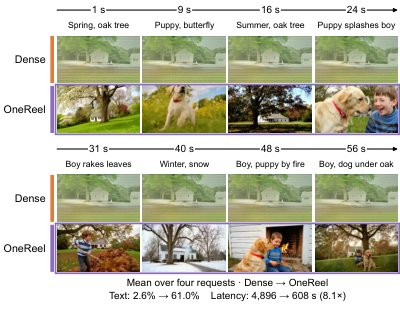
Figure 10: Minute-long generation with HunyuanVideo-1.5. OneReel captures the requested scene changes, while dense generation remains visually repetitive.
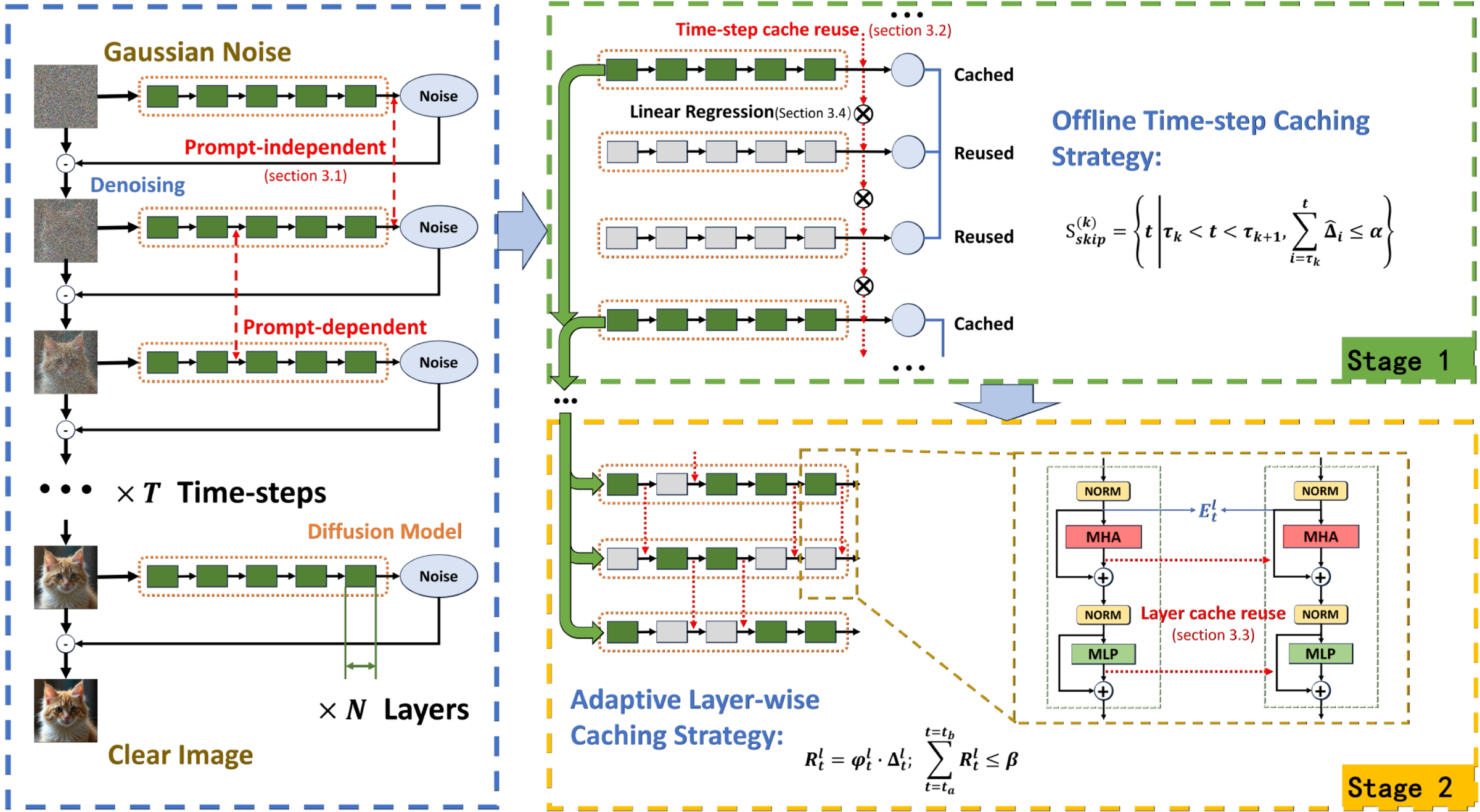
Figure 2 : Overview of the Multi-Granularity Cache (MG-Cache). We design a two-stage strategy to exploit computational redundancy during inference. Stage 1 performs a static offline analysis to identify and preserve critical timesteps based on a timestep feature table [ M ^ t ] [\hat{M}_{t}] constructed from a small batch of calibration dataset. Stage 2 introduces a dynamic layer-wise caching mechanism that computes layer importance scores and input stability to adaptively determine whether to reuse cached features.
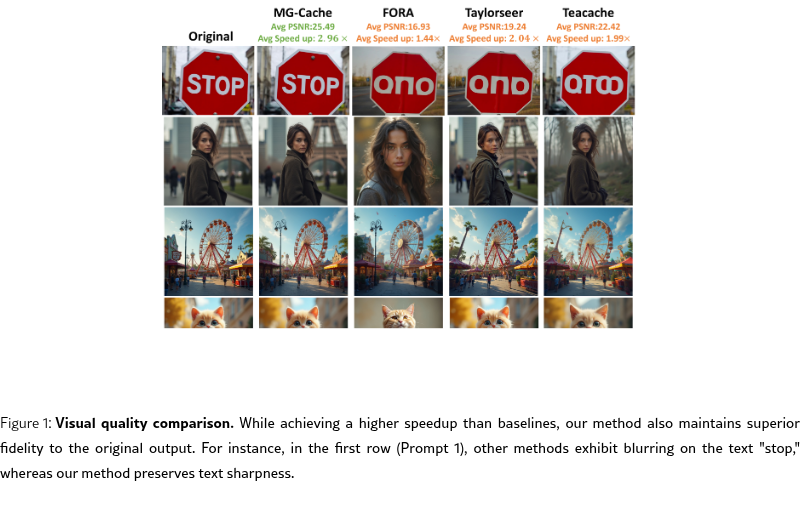
Figure 1 : Visual quality comparison. While achieving a higher speedup than baselines, our method also maintains superior fidelity to the original output. For instance, in the first row (Prompt 1), other methods exhibit blurring on the text "stop," whereas our method preserves text sharpness.
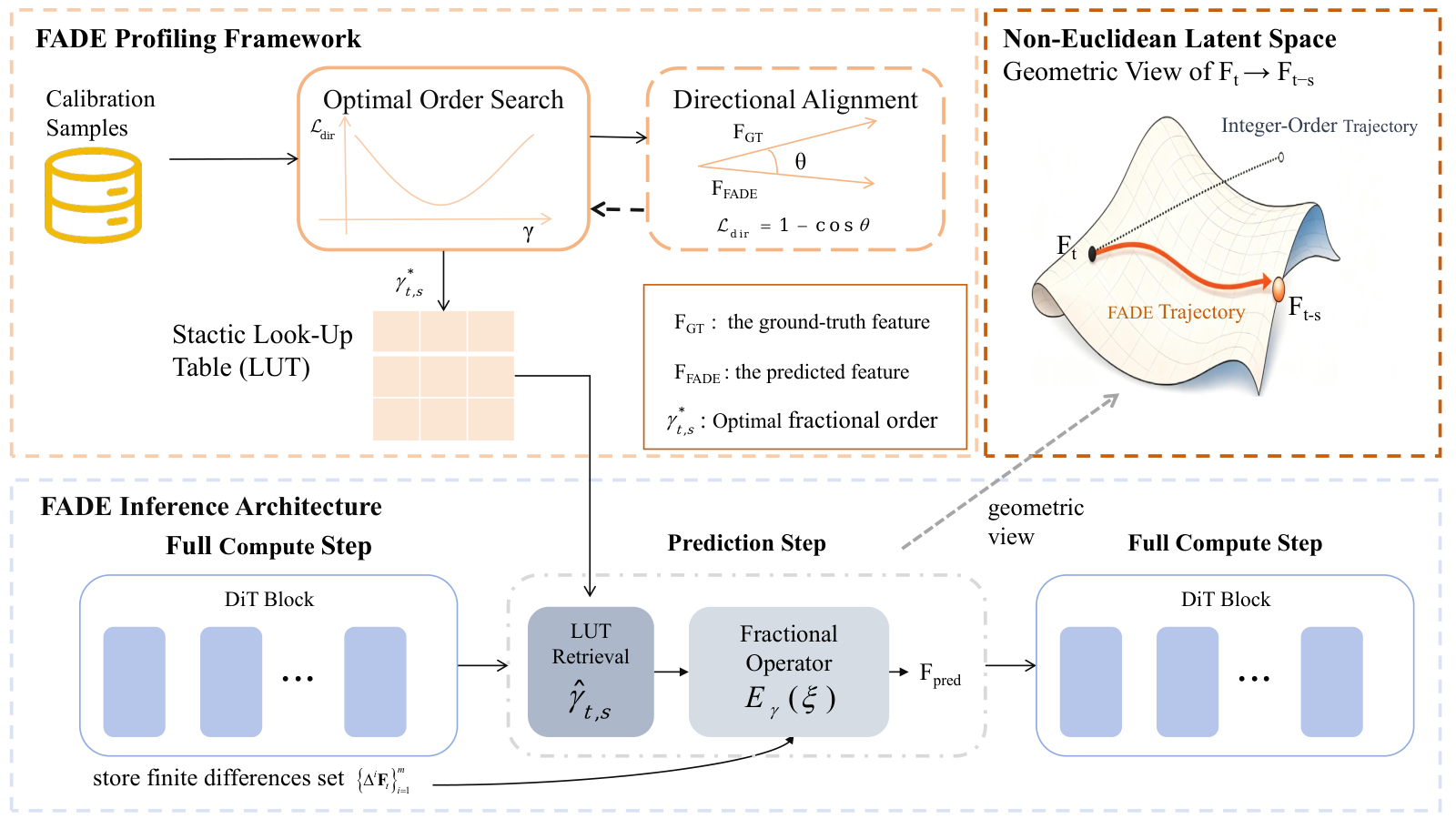
本文贡献:FADE 用 Mittag–Leffler 分数阶算子外推 DiT 中间特征,离线校准最合适的阶数并存入多维查找表;推理时按时空位置取参数,减少被跳过步骤的计算且不微调主干。
Figure 2 : Overall framework of FADE. FADE consists of an offline profiling stage and an online inference stage. The offline stage calibrates and stores the optimal fractional orders in a static LUT, while the online stage alternates between full-compute and prediction steps using LUT-retrieved orders for feature forecasting. The upper-right panel illustrates the geometric contrast between the FADE trajectory and the integer-order trajectory in the latent space.
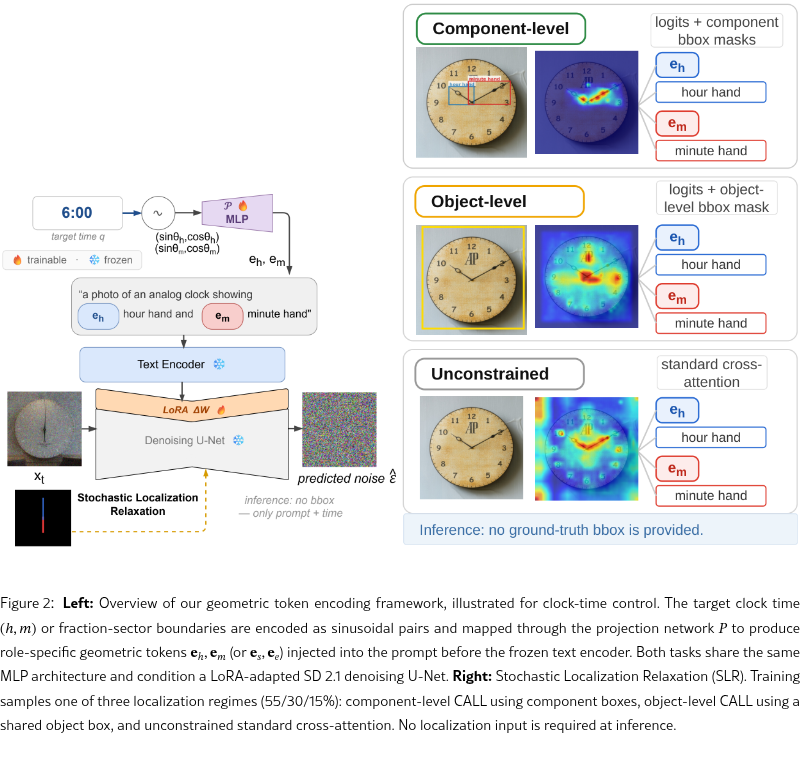
Figure 2 : Left: Overview of our geometric token encoding framework, illustrated for clock-time control. The target clock time ( h , m ) (h,m) or fraction-sector boundaries are encoded as sinusoidal pairs and mapped through the projection network P P to produce role-specific geometric tokens h , m \mathbf{e}_{h},\mathbf{e}_{m} (or s , e \mathbf{e}_{s},\mathbf{e}_{e} ) injected into the prompt before the frozen text encoder. Both tasks share the same MLP architecture and condition a LoRA-adapted SD 2.1 denoising U-Net. Right: Stochastic Localization Relaxation (SLR). Training samples one of three localization regimes (55/30/15%): component-level CALL using component boxes, object-level CALL using a shared object box, and unconstrained standard cross-attention. No localization input is required at inference.
Figure 8 : Qualitative comparison of the original periodic encoding and the augmented encoding with the scalar fraction f f near the angular boundaries. The periodic encoding produces small sectors near 0 ∘ 0^{\circ} but may generate narrow slices even for complete-sector targets ( 360 ∘ 360^{\circ} ), reflecting its endpoint ambiguity. Adding f f distinguishes the endpoints and enables complete-object generation, but can produce oversized sectors for small target angles ( 1 ∘ 1^{\circ} – 5 ∘ 5^{\circ} ). Results are shown for pizza, pie, and cake.
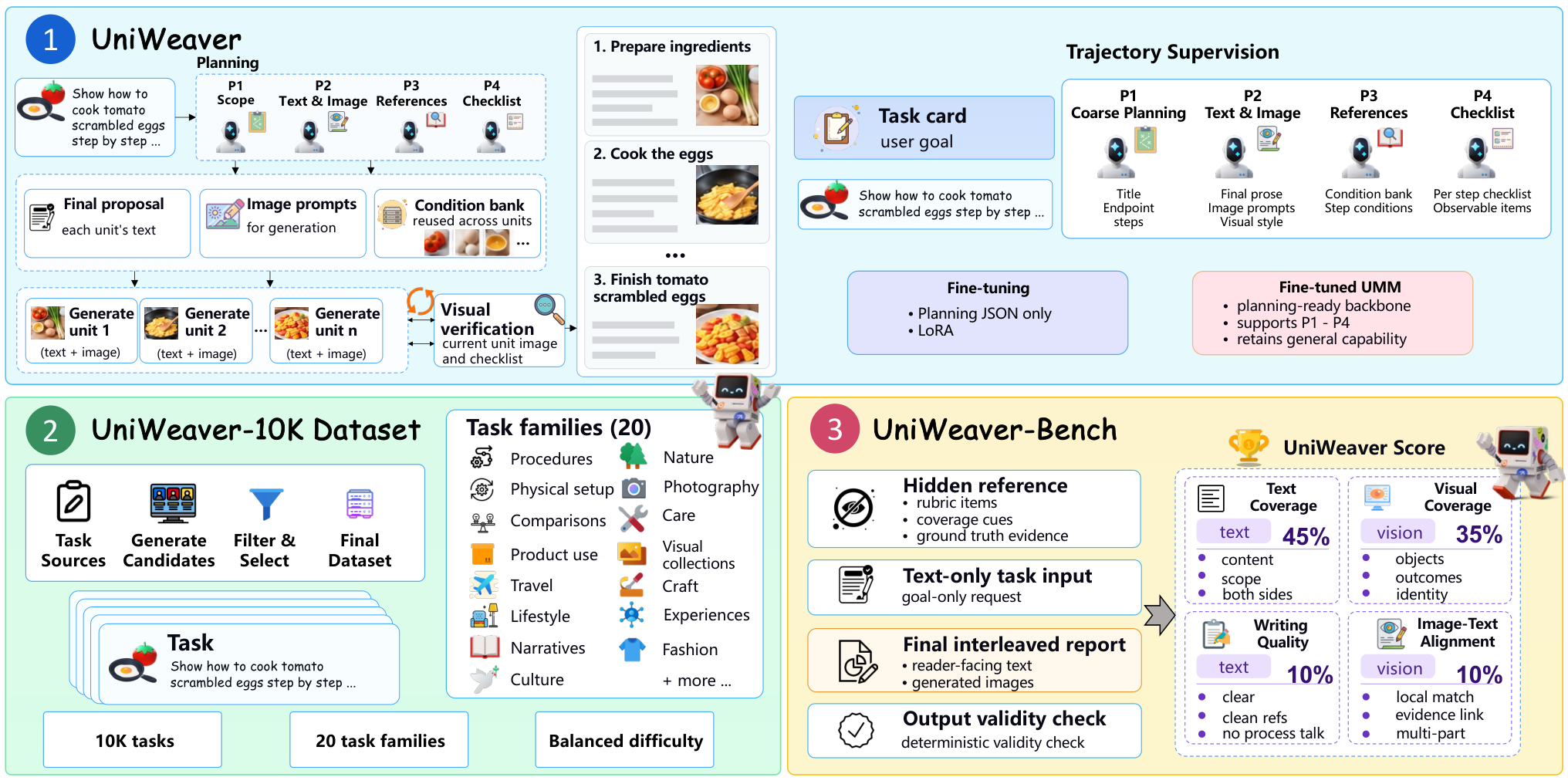
Figure 3: Overview of UniWeaver. ① UniWeaver introduces a structured workflow for interleaved text-image generation, with execution trajectories providing supervision for fine-tuning (Section 3.1 ). ② UniWeaver-10K Dataset provides 10,000 goal-only tasks paired with structured planning trajectories across 20 task families (Section 3.2 ). ③ UniWeaver-Bench systematically evaluates final interleaved outputs on 120 held-out tasks (Section 3.3 ).
Figure 5: Qualitative comparison on two representative tasks. UniWeaver produces more coherent, actionable instructions with task-relevant visuals, while baselines exhibit repetitive content, missing details, or ineffective visual support. Zoom in for better view.
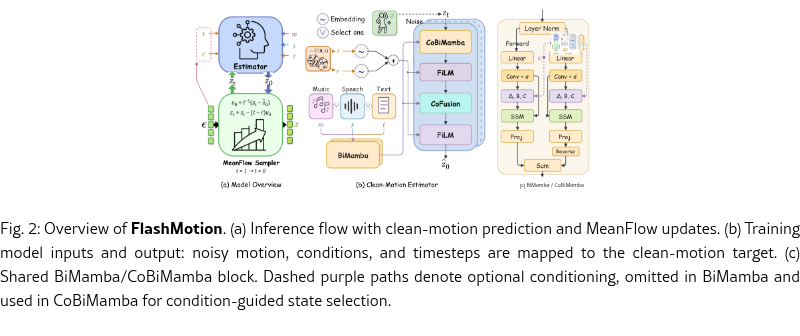
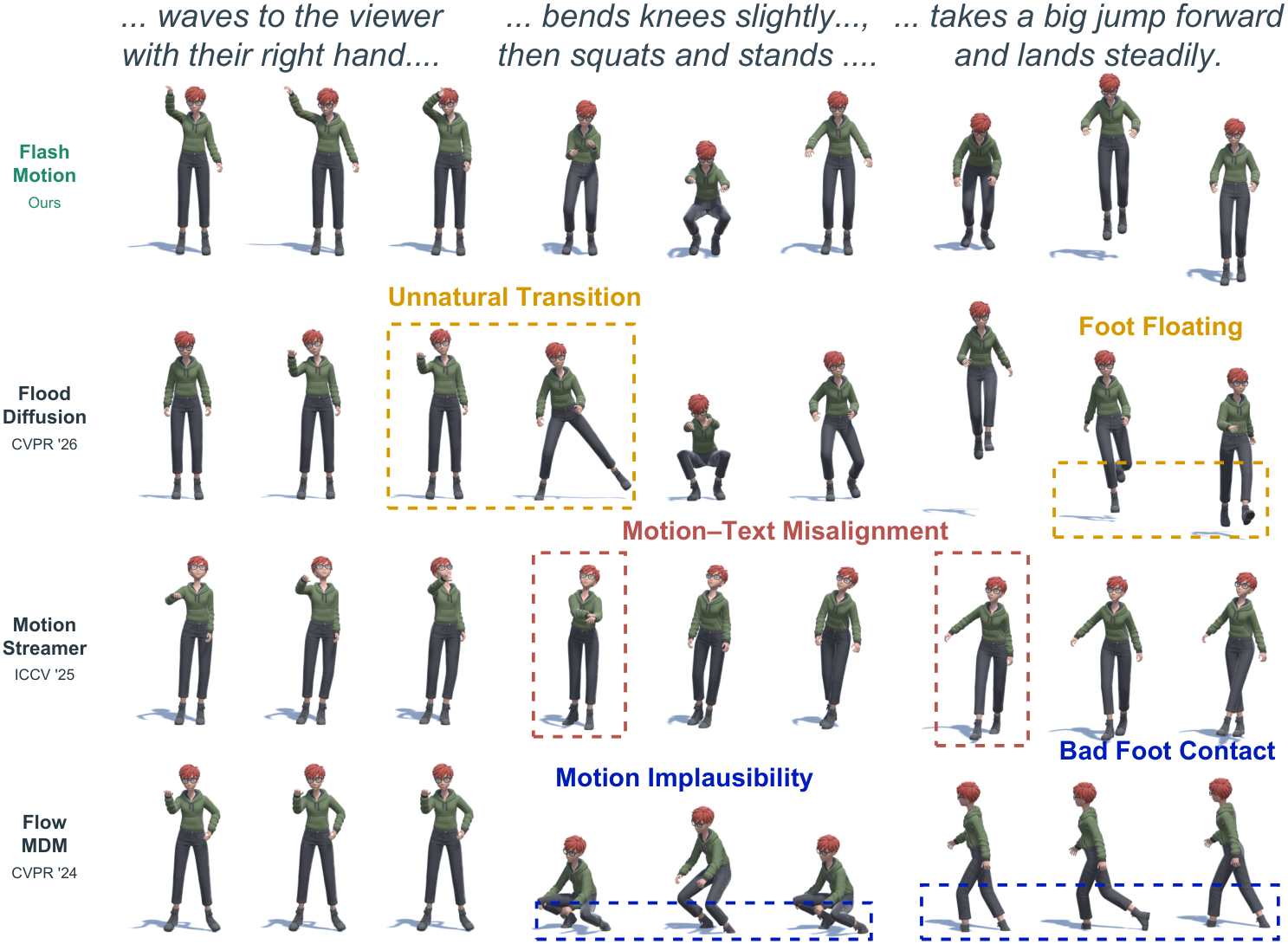
本文贡献:FlashMotion 将带运动学和动力学约束的 3D motion-space MeanFlow 与约 6000 万参数的 BiMamba/CoBiMamba 组合,支持文生动作、音乐生舞蹈和语音生手势;Adaptive Soft mask 用于动作中间段编辑。这里生成的是 3D 运动表示,后续骨骼绑定与渲染另算。
Fig. 2: Overview of FlashMotion . (a) Inference flow with clean-motion prediction and MeanFlow updates. (b) Training model inputs and output: noisy motion, conditions, and timesteps are mapped to the clean-motion target. (c) Shared BiMamba/CoBiMamba block. Dashed purple paths denote optional conditioning, omitted in BiMamba and used in CoBiMamba for condition-guided state selection.
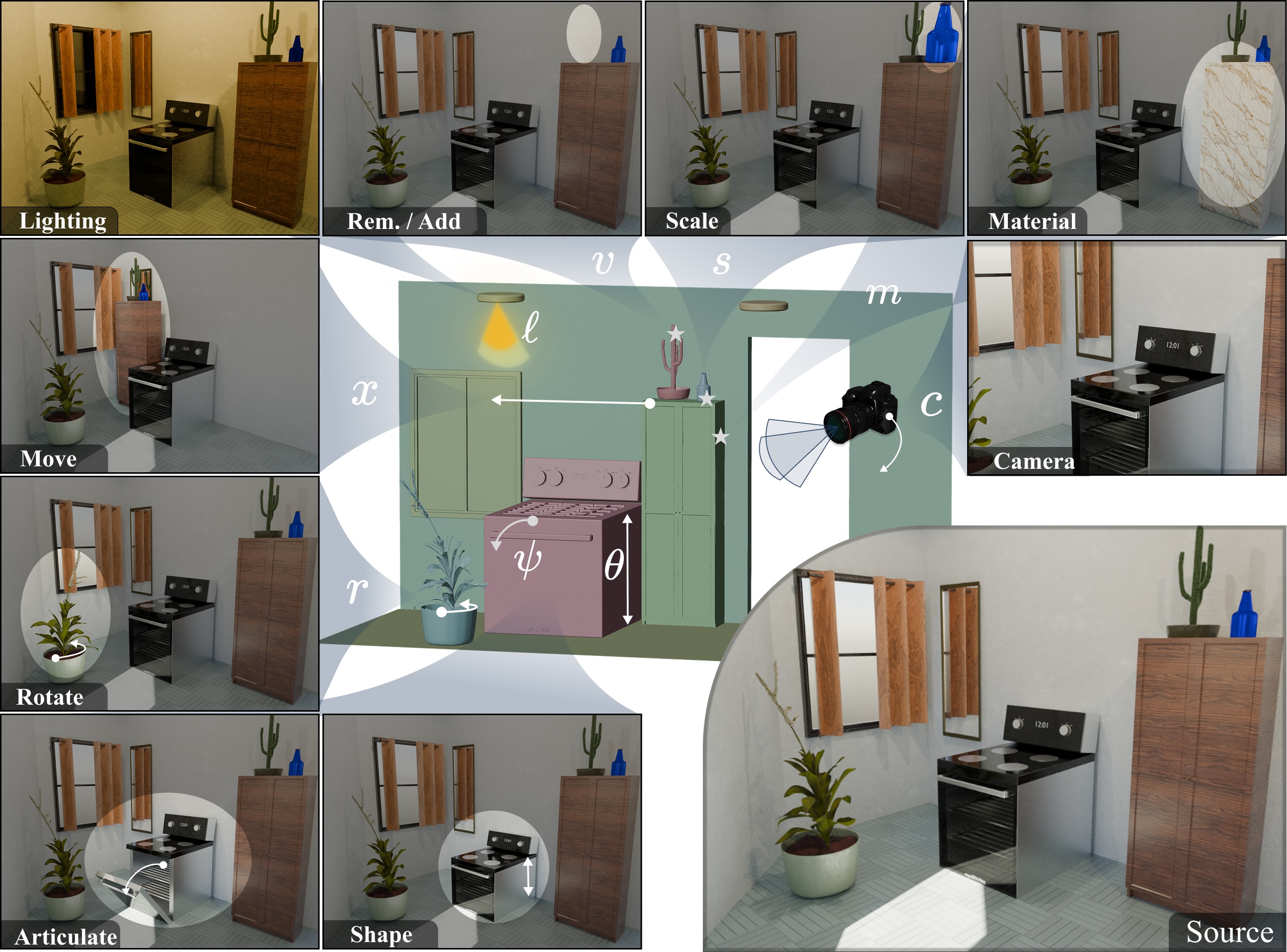
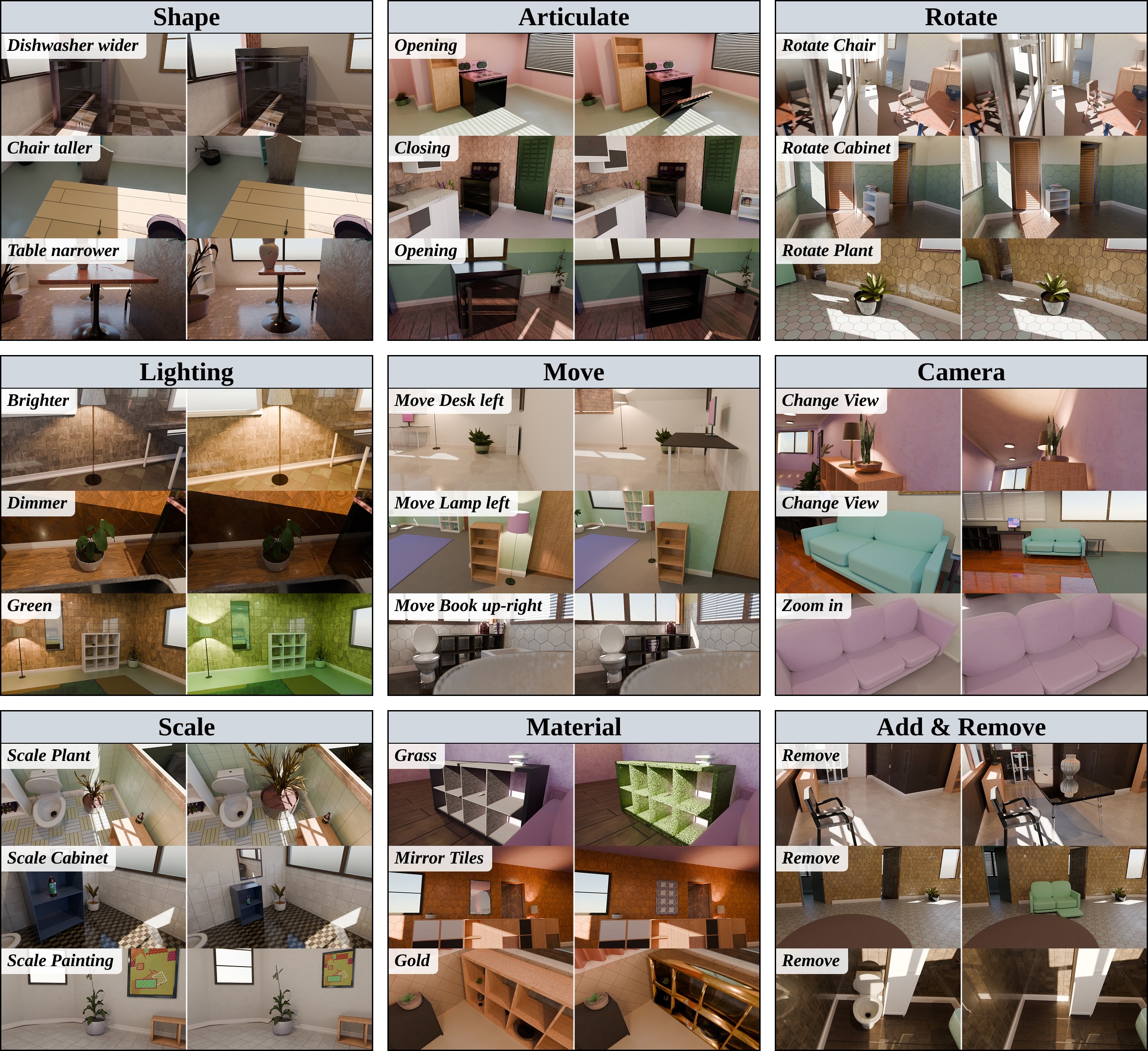
Figure 2: Overview of the nine edit types in EditJudge-Bench . The central inset shows the underlying Blender scene parameter modified by each edit: object position \mathbf , rotation \mathbf{r} , scale \mathbf{s} , shape parameter θ \mathbf{\theta} , articulation joint ψ \mathbf{\psi} , material \mathbf{m} , visibility \mathbf{v} , lighting state \mathbf{l} , and camera state \mathbf{c} . Surrounding images show one rendered edit from the source image per category. Because each edit is a deterministic parameter change, magnitude and direction are known exactly.
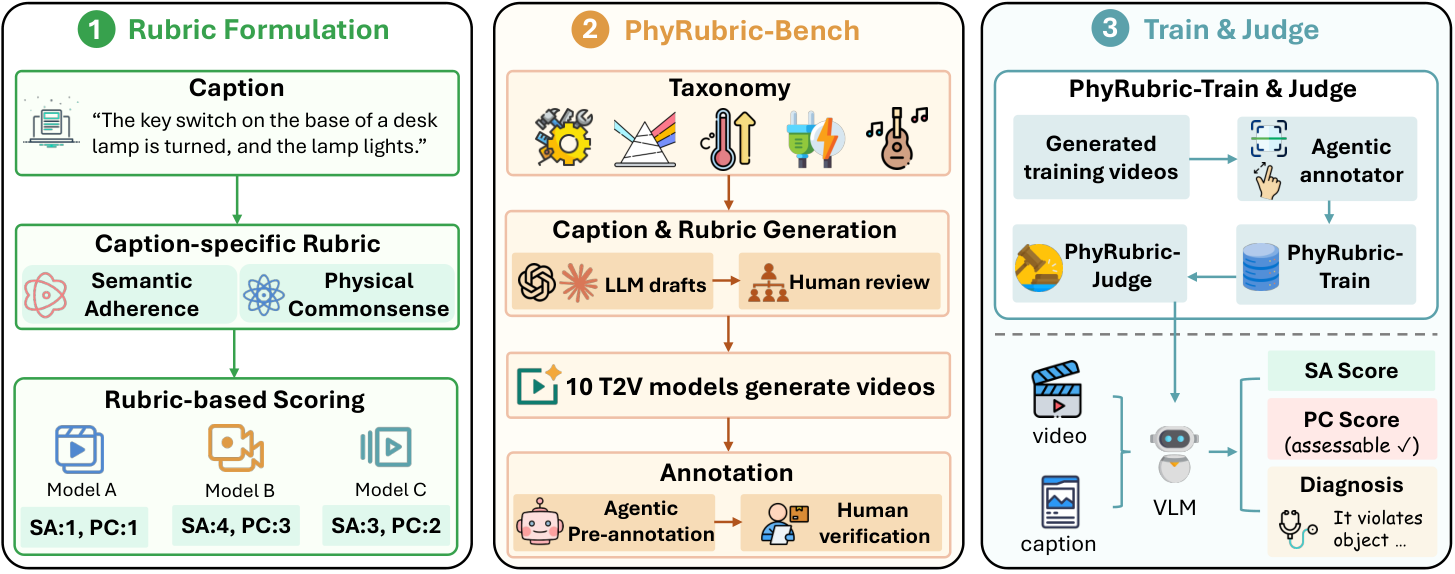
Figure 2 : Overview of PhyRubric. (1) Rubric formulation : each caption is paired with a rubric covering semantic adherence (SA) and physical commonsense (PC), constructed before any video is seen and reused to score videos from all models. (2) PhyRubric-Bench : captions spanning five physical domains and their rubrics are drafted by LLMs and reviewed by humans. Videos from 10 T2V models are pre-annotated by an agent and verified by humans. (3) Train & Judge : an agentic annotator labels training videos to build PhyRubric-Train, on which we train PhyRubric-Judge. Given a video and its caption, the judge outputs an SA score, whether PC is assessable, a PC score, and a diagnosis of the violated expectation with timestamped evidence.
实验效果:在该榜单,JP 是全部视频中 SA 与 PC 都至少 4/5 的比例;Seedance 2.5 平均 JP 44.20%,Veo 3.1 为 36.20%,但并非跨数据集总排名。判官相对真人物理分的 Pearson r 为 0.32,Gemini 4 Argon 为 0.31;两者物理通过判别 AUC 均 0.68,说明自动诊断仍有明显误差。
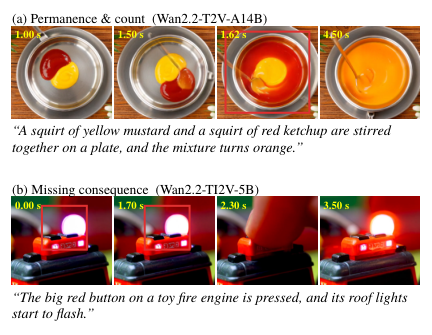
Figure 7 : Two failure cases from PhyRubric-Bench. (a) A small squirt of ketchup becomes a full bowl and the spoon jumps between 1.50 s and 1.62 s. (b) The roof light is lit from the first frame, before the finger reaches the button at 2.30 s.








评论 (0)