RoLA: Rotary-Positioned Low-Rank Linear Attention for Efficient Diffusion Transformers | 北京大学、清华大学、电子科技大学、阿里巴巴等 | arXiv:2609.06712
关键词:视频生成,稀疏注意力,线性注意力,扩散Transformer
前序问题:视频扩散 Transformer 的时空令牌很长,稠密自注意力随序列长度平方增长。稀疏分支可以省计算,却会丢掉维持场景、运动和语义一致性的远程联系;现有低秩全局补偿又难同时保留 3D RoPE 的相对位置结构与可复用的线性摘要。
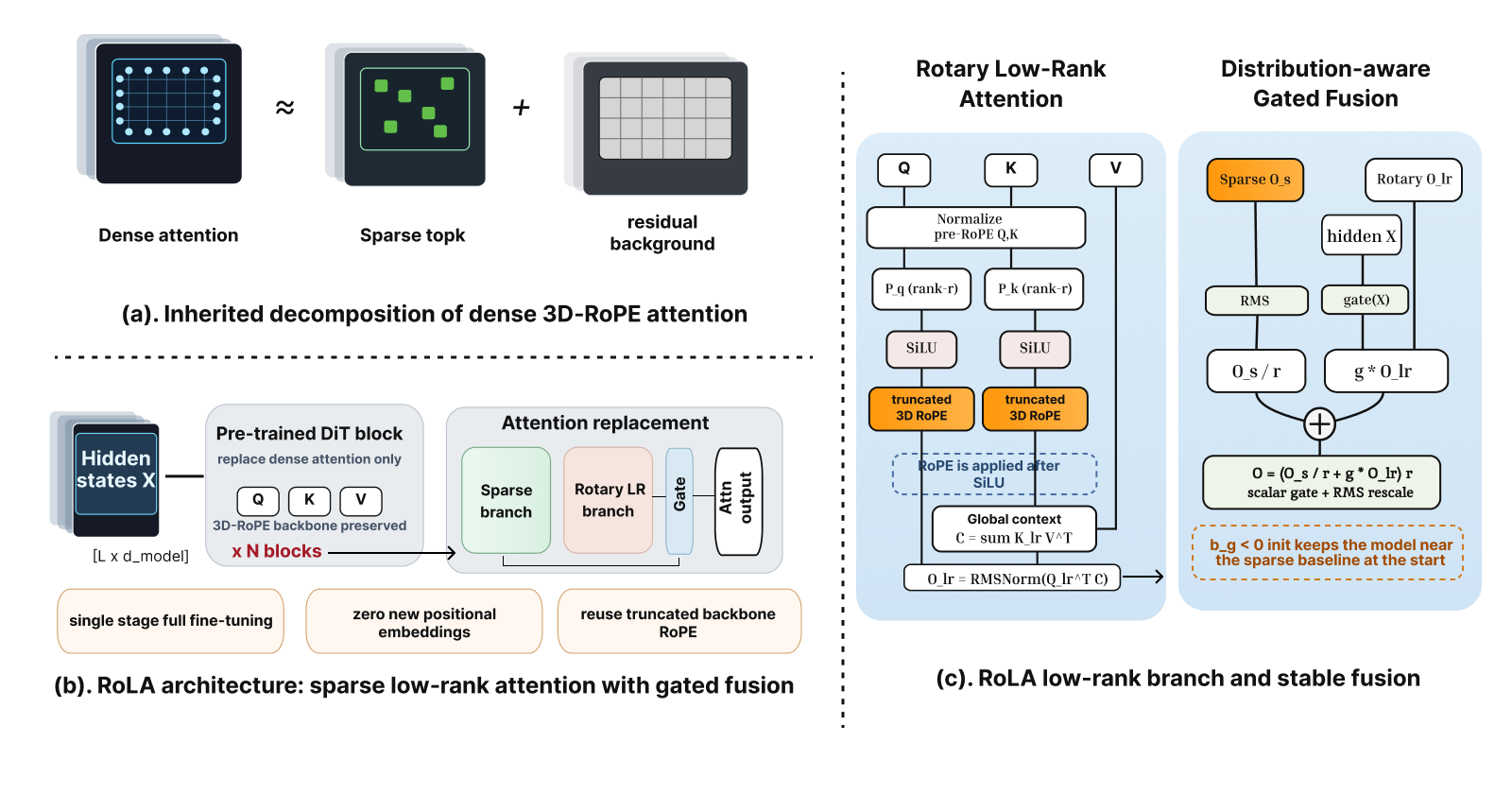
本文贡献:RoLA 将注意力拆成固定稀疏局部分支与低秩全局分支。它先把查询和键投影到低秩空间并通过非线性,再施加截断后的预训练 3D RoPE;这样旋转不会被非线性打乱,全局键值摘要可对所有查询复用。令牌级门控负责把局部尖峰与平滑全局背景重新融合,无需新增位置参数。
Architecture overview of the proposed method. (a) Dense 3D-RoPE attention decomposes into sparse top-$k$ spikes and a residual background. (b) The method replaces dense attention in pre-trained DiT blocks with sparse--low-rank branches and gated fusion, reusing backbone RoPE without additional positional embeddings. The right part shows the rotary low-rank branch and distribution-aware gated fusion.
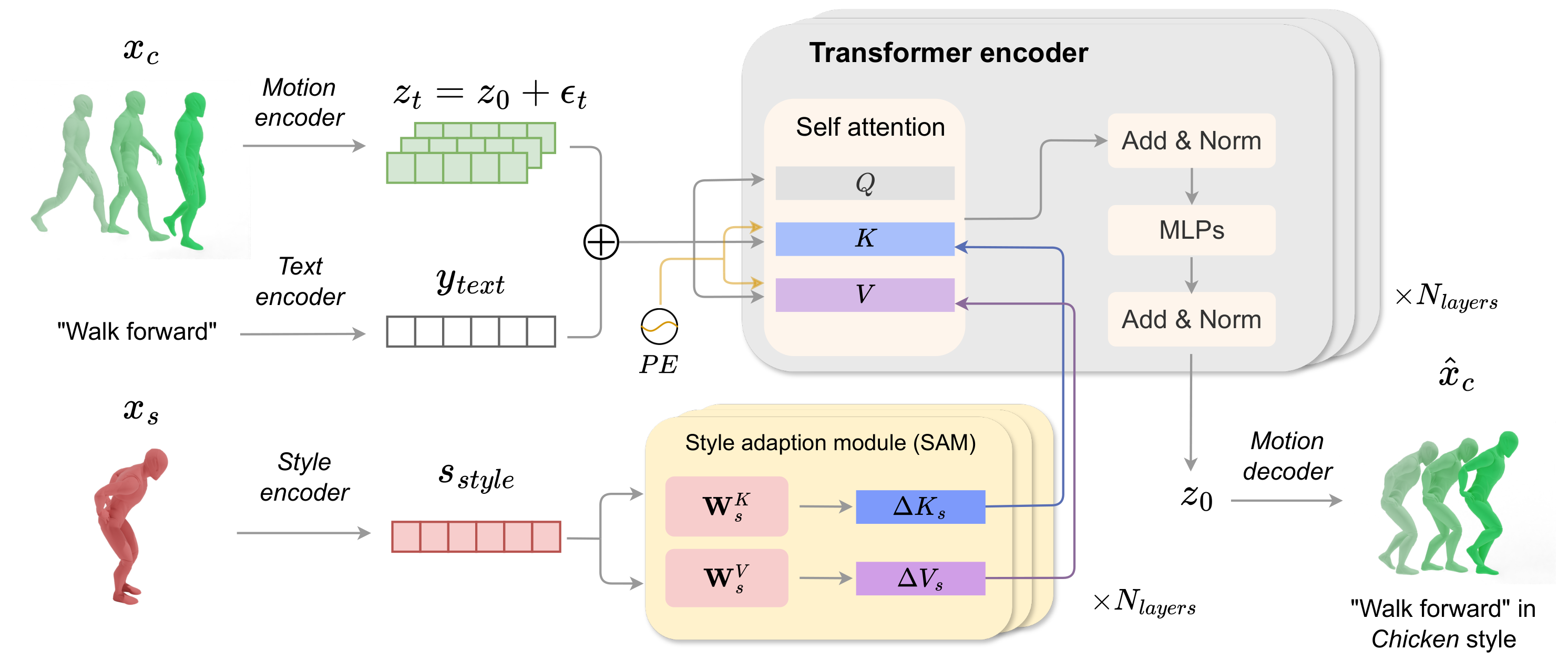
Overview of our style-adapted text-to-motion framework. The input content motion $x_c$ is encoded by a pretrained motion encoder, and Gaussian noise is added to its latent embedding. The text-to-motion (T2M) model (top right) consists of $7$ Transformer encoder layers that take motion, text, and time embeddings as inputs. Each self-attention block incorporates relative positional encoding into the key and value projections. During style finetuning, the T2M backbone is frozen, and only the weight matrices $W_s^{K}$ and $W_s^{V}$ in the Style Adaptation Module (SAM) are trained. SAM encodes a style example $x_s$ and injects its outputs as additive biases to the $K$ and $V$ vectors in the attention layers, guiding the network to preserve the semantics of $x_c$ while reflecting the style of $x_s$.
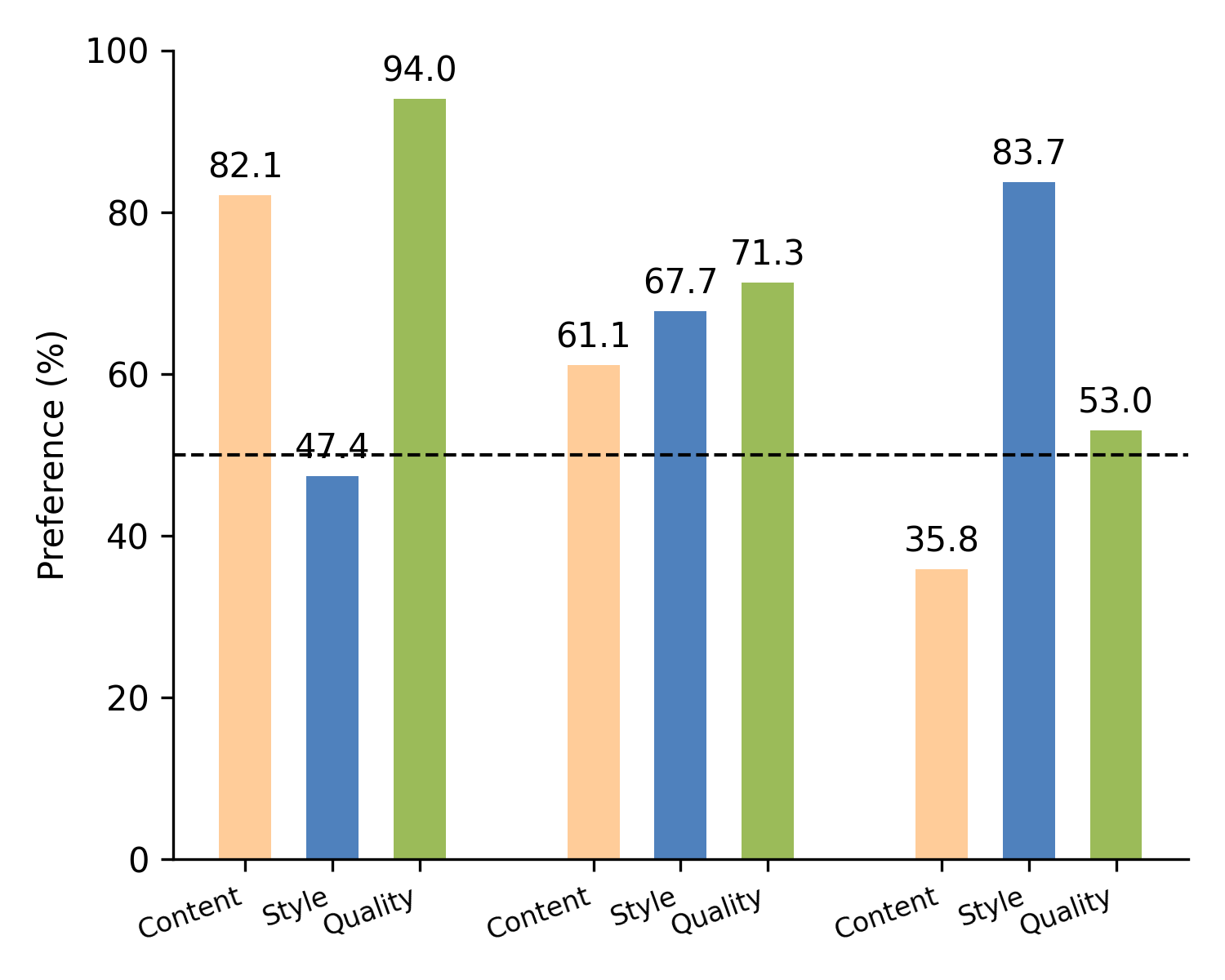
User study results (pairwise preference, % favoring ours). Left: FlexMoGen vs. T2M+MP. Middle: FlexMoGen vs. SMooDi. Right: FlexMoGen vs. LoRA-MDM. Criteria are content preservation, style reflection, and motion quality.
Overview of Motar. (a) An AR motion transformer models causal dependencies over motion latents, with an efficient diffusion head producing continuous-valued latents; a user-written motion caption and the driving audio are fused into a global condition query by a Q-Former projector. (b) Hierarchical conditioning: the global query is injected by full cross-attention for coarse, sequence-level control, while raw audio embeddings are injected by windowed cross-attention for frame-level lip articulation. (c) Decoupled self-forcing distillation: the frozen bidirectional teacher $G$ supervises both branches by distribution matching. Conditioned on motion, it distills $G$ into a block-causal student $G_\phi$; unconditionally, it matches the rendered motion rollout against the distribution of real talking videos.
Qualitative comparison with Wan-based end-to-end methods. For each result we show five frames with the spoken word beneath; the phoneme being articulated is highlighted in red (e.g. the “oo” in “look”), so that lip shape can be checked against the sound at each frame. Our method produces the tightest audio--lip alignment and the sharpest facial detail.
Architecture of RelightFormer. Input modalities (noise, reference images, and an environment map) are first patchified into token sequences, with ray embeddings added to encode stereo geometric priors. Noise and reference tokens are concatenated and processed through two parallel attention pathways: a multi-view self-attention module for intra- and cross-view feature aggregation, and an illumination attention module that dynamically injects lighting cues into spatial features. The outputs of both branches are element-wise summed and passed through an FFN. After the final layer, reference tokens are discarded, and the updated noise tokens are used to predict the flow-matching velocity field. For clarity, VAE encoding and decoding stages are omitted.











评论 (0)