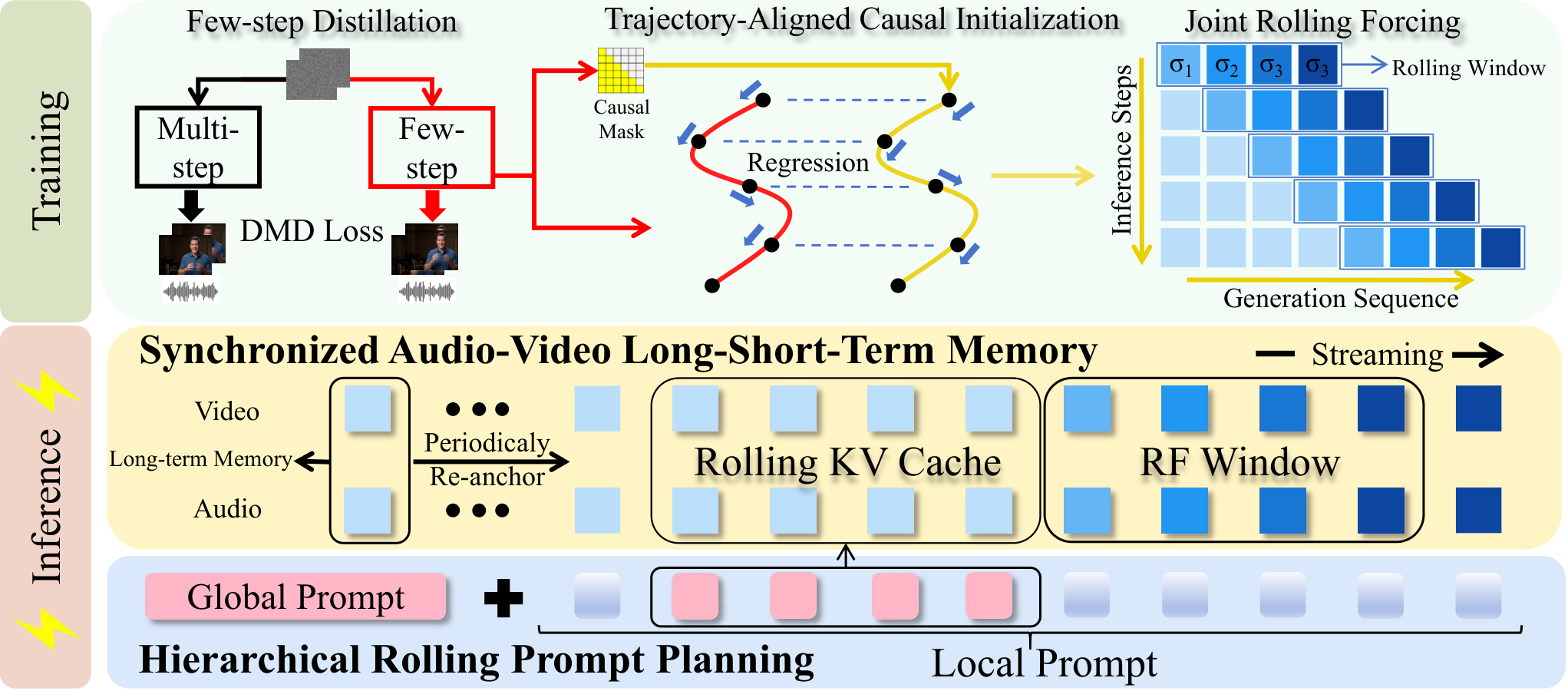
Overview of Omni-LiveAvatar. The proposed progressive autoregressive distillation pipeline converts a large bidirectional audio-video diffusion model into a few-step causal generator without any auxiliary stabilization mechanism (top). At inference, the synchronized audio-video long-short-term memory preserves global consistency while retaining recent context within a bounded memory budget for minute-level streaming inference (middle), and the hierarchical rolling prompt planning organizes global and local prompts for smooth long-form semantic evolution (bottom).
Qualitative comparison of 5-second avatar generation. Omni-LiveAvatar generates realistic and temporally consistent avatars with visual quality comparable to Ovi and LTX-2, whereas OmniForcing exhibits noticeable realism degradation and Hallo-Live suffers from facial and hand artifacts as well as color drift.
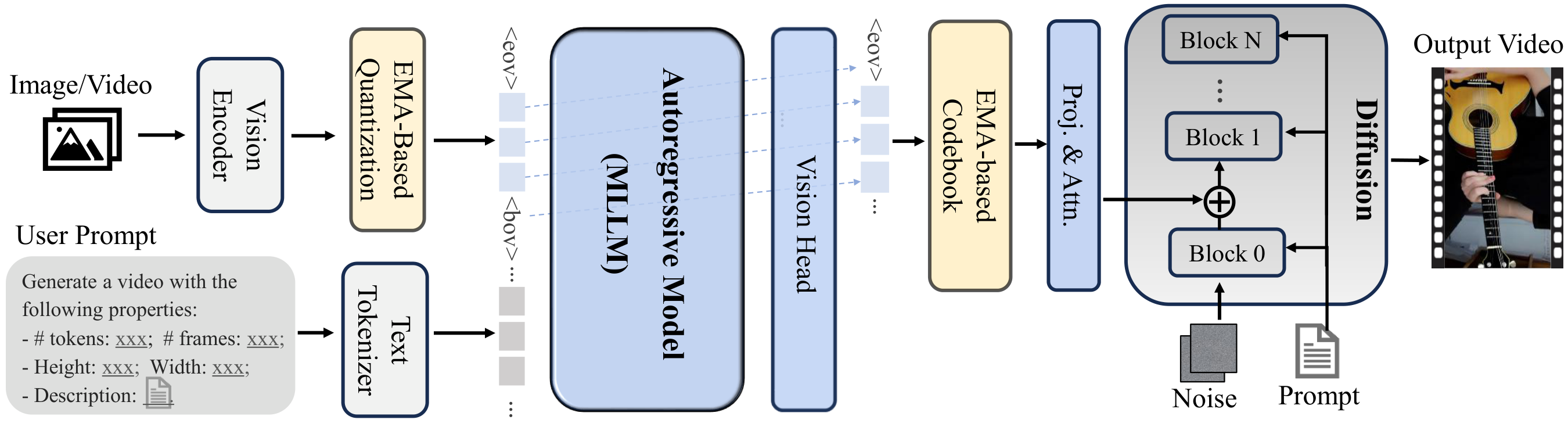
Overview. BiVidGen consists of three main components. First, an EMA-based vision tokenizer provides discrete visual representations. Then, an MLLM predicts semantic visual tokens. Finally, the DiT renders high-fidelity videos conditioned on these planned tokens.
Qualitative Comparisons. MLLM+DiT yields better causal transitions, temporal consistency, and semantic alignment than the DiT-only baseline in these examples.
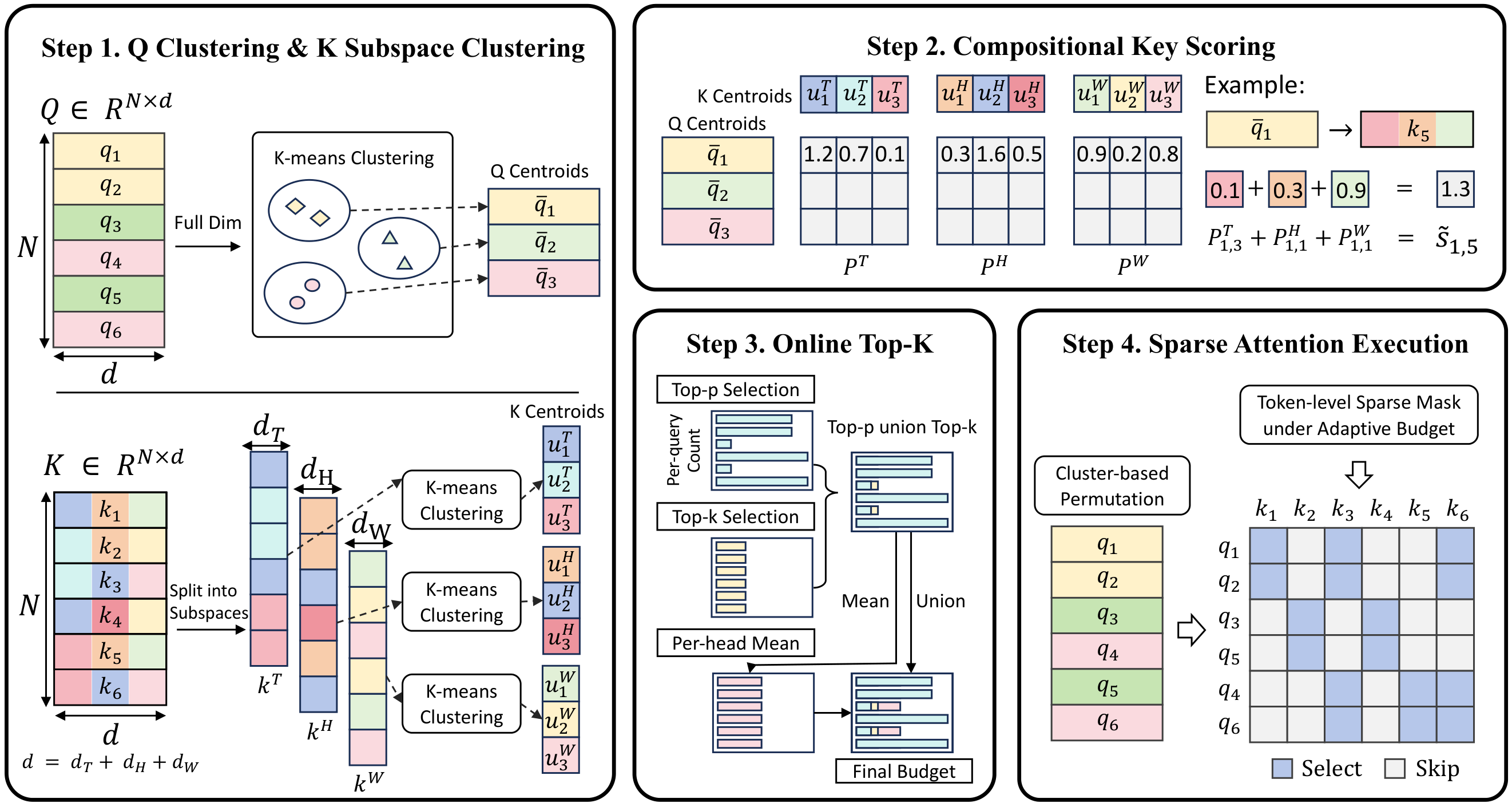
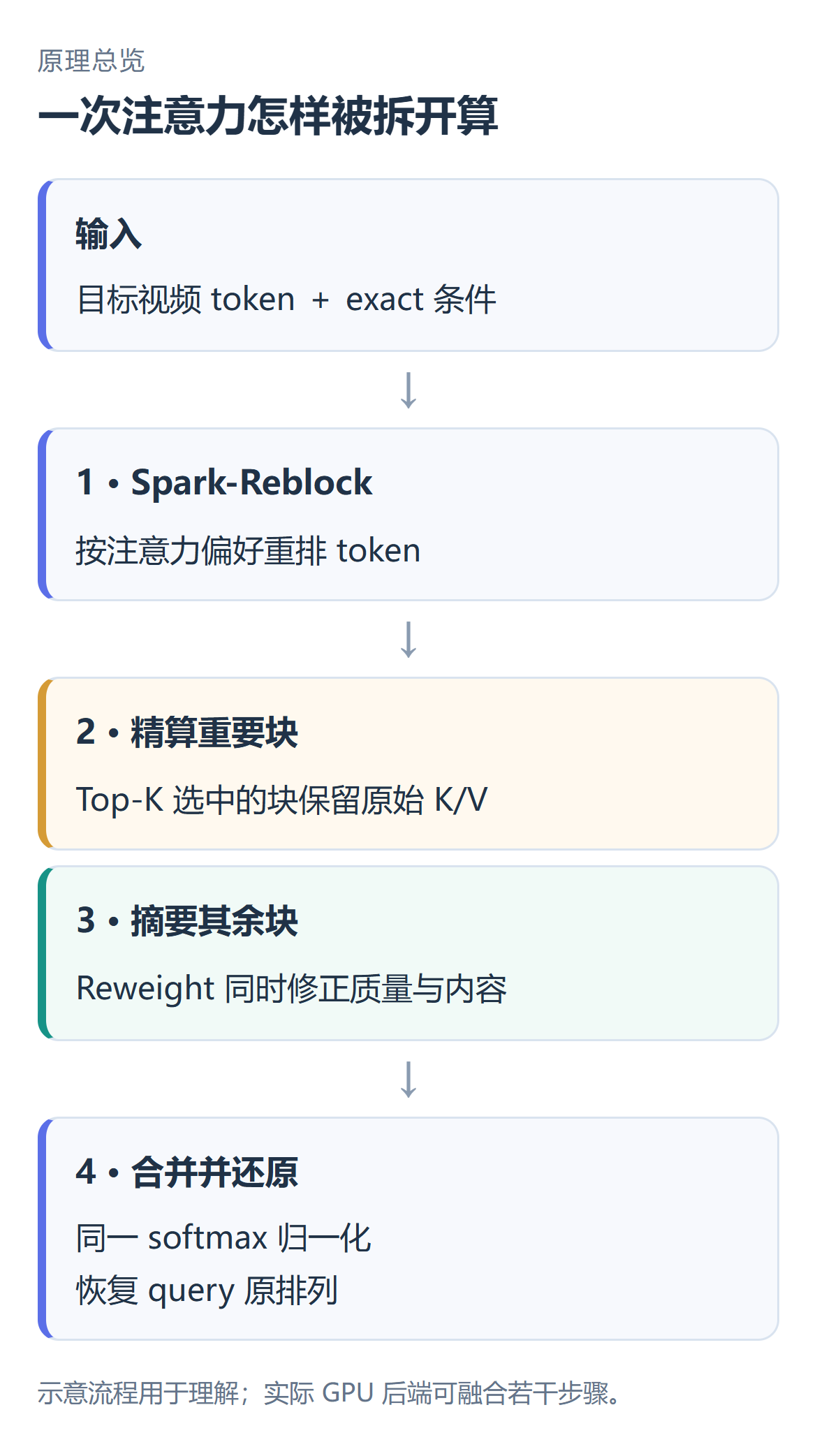
Overview of SCOPE. Queries are clustered in the full feature space, while each post-RoPE key is represented by temporal, height and width subspace assignments. Query-centroid slices score the corresponding subspace centroids to form lookup tables, and indexed summation reconstructs a proxy logit for every key. Hybrid Top-$p$/fixed-Top-$k$ selection produces the initial key counts, from which SCOPE estimates an online per-head Top-$k$ value. Sparse attention is computed using the selected original $K$ and $V$.
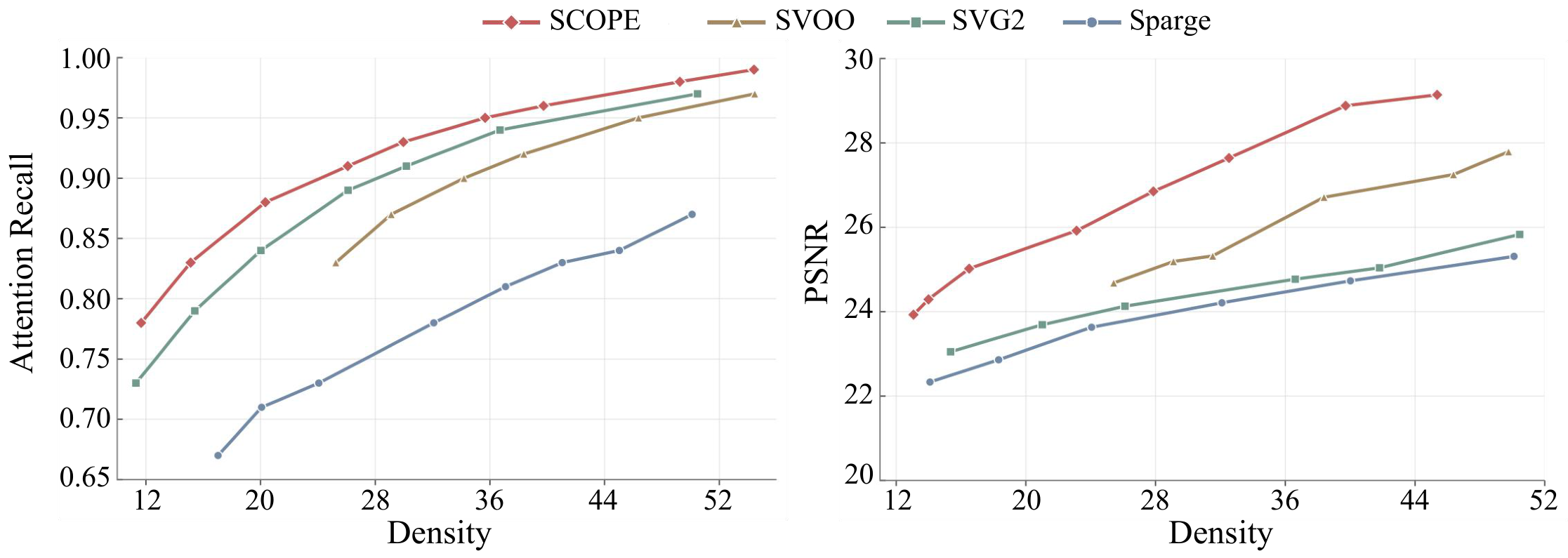
实验效果:在六种模型-任务配置上,SCOPE 在保真度和延迟两个维度上都稳定优于现有免训练基线。720p HunyuanVideo 上端到端加速最高 1.99 倍,同时相对稠密注意力保持 28.46 dB PSNR。
Attention recall and PSNR under matched attention density. SCOPE consistently achieves higher attention recall and PSNR than competing sparse attention methods at the same retained density.
Overview of ForgeWM. (A) Frame-aligned keyboard and mouse controls condition latent chunks. (B) A shared base yields a bidirectional teacher and budget-specialized causal students through four-stage training. (C) Deployment separates low-latency interaction from optional Replay-Time Refinement (Figure~fig:replay-refinement).
Qualitative comparison. Rollouts at frames 0, 25, 51, and 76. Rows show the reference and three models. Controls are annotated once on the reference: each overlay shows dominant WASD and accumulated mouse-look to the next frame; the final frame has no outgoing control overlay. Left/right: daytime forest stream/rainy riverbank at night.
Overall pipeline of CRAFT. The denoising prefix is rolled out without gradients up to the reward step $t^\ast$, where two forward passes are performed: the frozen backbone $f_\text{base}$ produces $\mathbf{v}_\text{base}$, while the LoRA-adapted model $f_\text{LoRA}$ produces $\mathbf{v}_\text{LoRA}$ together with the cross-modal attention sub-blocks $\mathbf{A}_{N2R_k}$, $\mathbf{A}_{N2P_k}$, and $\mathbf{A}_{P_k 2 R_k}$. Following the Where to look principle, $\mathcal{R}_\text{ref}$ and $\mathcal{R}_\text{cons}$ shape noise- and phrase-token attention toward each reference subject (sec:method:attn_rewards); the resulting per-subject mask $\mathbf{m}^\text{noise}_k$ then gates the pixel-level identity reward $\mathcal{R}_\text{id}$ on the VAE-decoded pre-image $\hat{\mathbf{I}}$ (sec:method:pixel). Auxiliary terms $\mathcal{R}_\text{CLIP-T}$, $\mathcal{R}_\text{AES}$, and a velocity-space regularizer $\mathcal{L}_\text{anchor}$ are added for prompt fidelity, aesthetics, and stability (sec:method:loss). A single backward pass updates only the LoRA parameters.
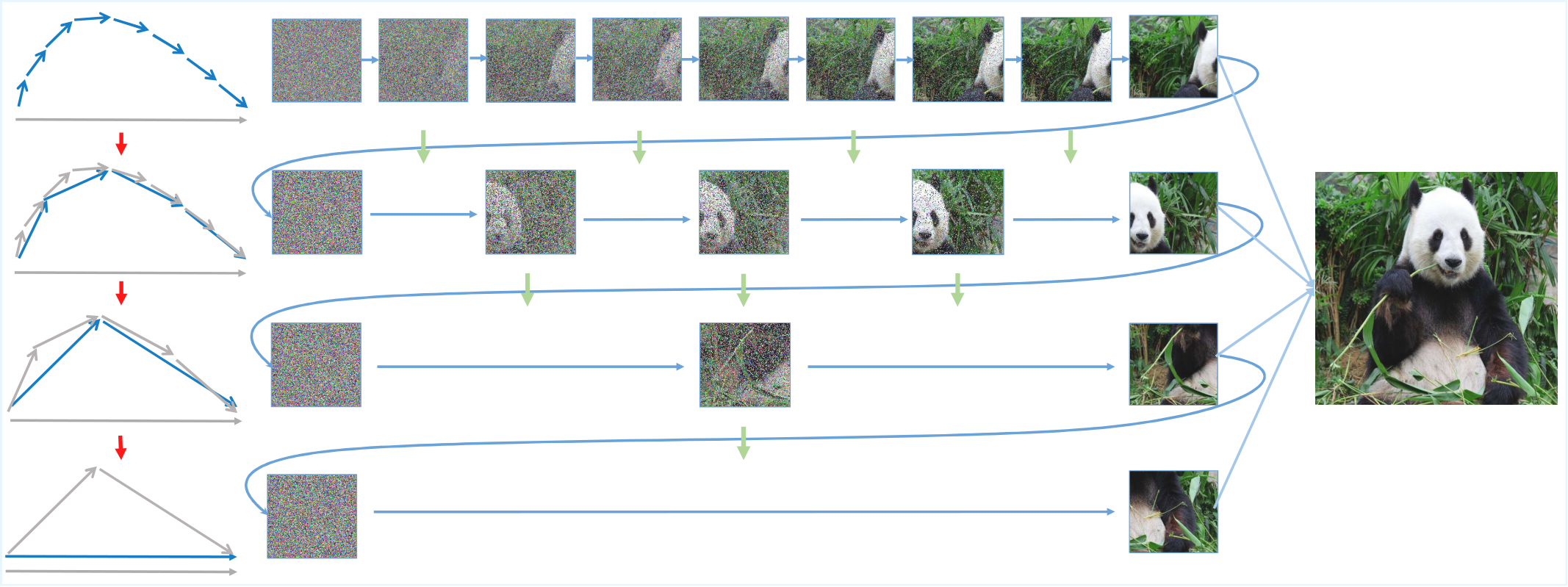
Next Shortcut Prediction in XYZFlow. (Top-Left) Flow diagram showing the generation sequence, where a blue curve represents progressively strengthening constraints. (Top-Right) Visualization of a non-uniform patch-based denoising process: the first image patch undergoes the most denoising steps, while subsequent patches are generated with fewer steps (“shortcuts”). This forms a long autoregressive sequence where the denoising flow from prior patches (green and blue arrows) guides the denoising of subsequent ones.
实验效果:达到 SOTA 性能,相对教师模型实现 7.2 至 8.5 倍加速,同时 FID 保持竞争力。其中 Next Shortcut Prediction 在质量-延迟权衡上优于单纯的模型放大或步数削减两种做法。已被 ICML 2026 接收(16 页 5 图)。
Randomly selected examples of generated images from XYZFlow. XYZFlow shows high-quality generative modeling abilities.
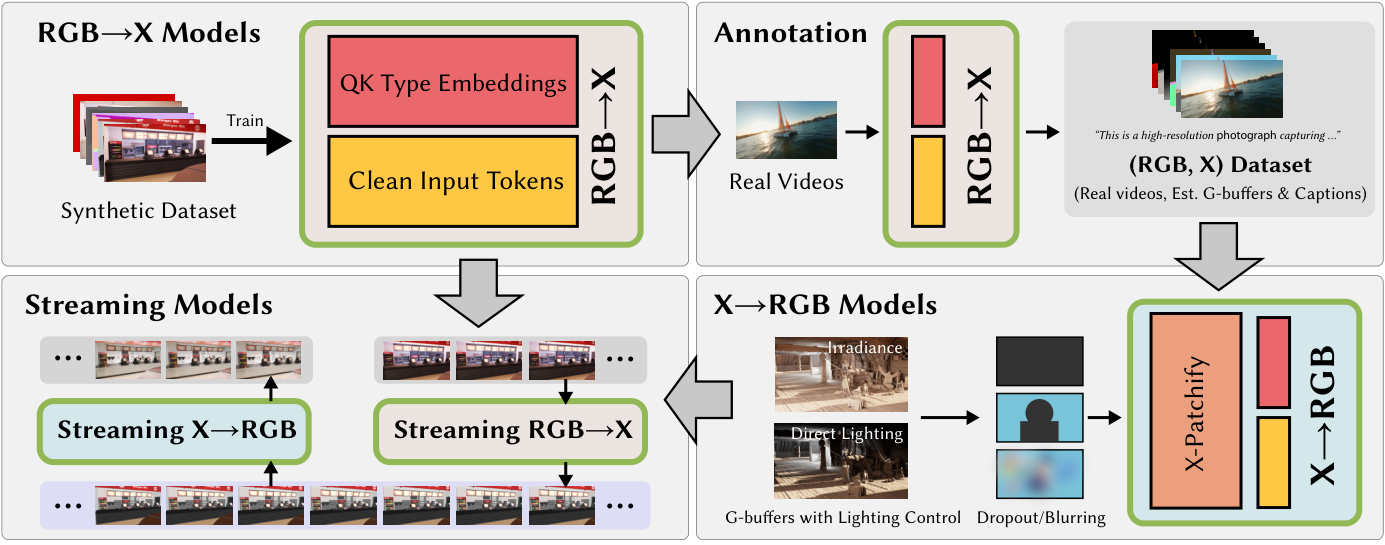
RGBX-Next: Towards Realistic Generative Rendering from G-Buffers | NVIDIA·UCSB·UCSD·MBZUAI | arXiv:2608.13929
前序问题:扩散模型在图像、视频和流式生成上效果已经很好,但和传统 3D 渲染相比,它对生成结果缺乏精确控制。传统渲染管线里你能精确指定几何、材质、光照,改一个参数就得到可预期的变化;扩散模型给的是「大致符合描述」,无法承担需要确定性控制的生产任务。反过来传统渲染又缺少生成模型的真实感先验,物理正确不等于看起来像照片。这两条路各有各的强项,一直没能真正打通。
High-level overview of our paper. We first describe a simple version of image and video models in sec:initial-rgbx, followed by an improved version using our QK type embedding and clean input tokens techniques in sec:improved-rgbx. We estimate G-buffers from real video data with our model in sec:dataset, and train models with X-patchify in sec:xpatchify. We discuss conditioning dropout and lighting control in sec:dropout-blurring,sec:lighting. We introduce streaming extensions of our models in sec:streaming.
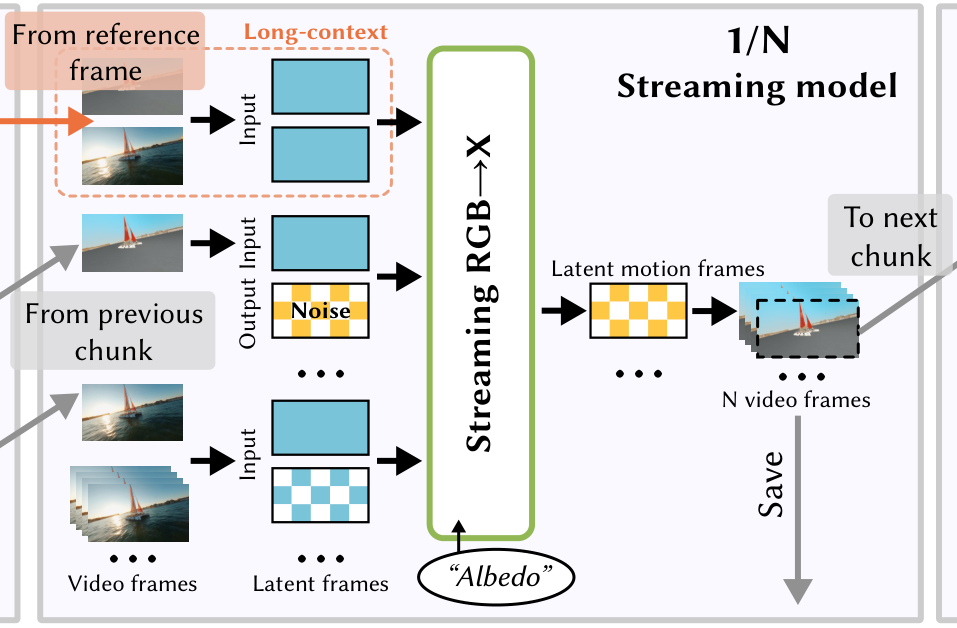
The overall design of our $1/N$ streaming models. For each chunk, the model receives $N$ current input frames and one stitching frame from the previous chunk, whose input and output are already known, then produces the $N$ new output frames through a diffusion process. Optional long-context tokens provide a clean reference frame for long-term memory. For simplicity, the figure illustrates the rgbtox case with albedo as xx.
本文贡献:提出 InstructVVT,基于 DiT 的指令驱动、参考引导的视频试衣框架,推理时完全不需要空间先验。核心是双层参考条件化:一方面由 MLLM(挂可训练 LoRA)经 Connector 推断语义编辑 token,用于目标消歧与结构保持——也就是搞清楚「要换谁的哪件衣服、哪些部分不能动」;另一方面用一条轻量条件化通路把参考服装的细粒度外观显式注入,与源视频 latent 一起拼成多模态 DiT 输入。训练分两阶段:Stage 1 监督微调,Stage 2 用 DiffusionNFT 做强化学习——策略 DiT 采样 K 个候选视频,由冻结的 MLLM 奖励模型打分,经 NFT 损失更新策略并以 EMA 回写,以此对齐标准重建目标无法刻画的试衣偏好(贴合是否自然、褶皱是否合理)。
Overview of our InstructVVT framework. In the supervised training, the source video, reference garment, and instruction are encoded by a frozen MLLM with trainable query tokens $Q_e$, LoRA adapters~lora, and an MLP connector to produce MLLM edit tokens $C_e$. We adopt two embedding layers with identical architecture but independent parameters to encode video cue tokens $X_t$ and reference garment tokens $C_g$, respectively. The MLLM edit tokens $C_e$, video cue tokens $X_t$ and reference garment tokens $C_g$ are injected into each DiT block through cross-attention. The post-training stage applies DiffusionNFT~diffusionnft: a frozen EMA policy samples $K$ videos, a tailored reward model based on MLLM assigns score-token rewards, and the NFT loss updates the trainable DiT.
实验效果:在无约束真实视频上不依赖推理期空间先验即可完成试衣编辑,同时保持源视频的空间结构与时序动态。定性对比覆盖 ViViD、CatV2TON、MagicTryOn、TripVVT、UniVideo 五个基线,在领口结构、腰带细节与裙摆轮廓的保真度上更接近目标服装。论文 23 页 10 图,Dingbao Shao 与 Song Wu 为共同一作,Zili Yi 为通讯作者。
Qualitative comparisons on ViViD-S. The examples show that InstructVVT transfers the reference garment while preserving the source video appearance and temporal structure, complementing the quantitative ViViD-S results in Table~tab:vivid_s.
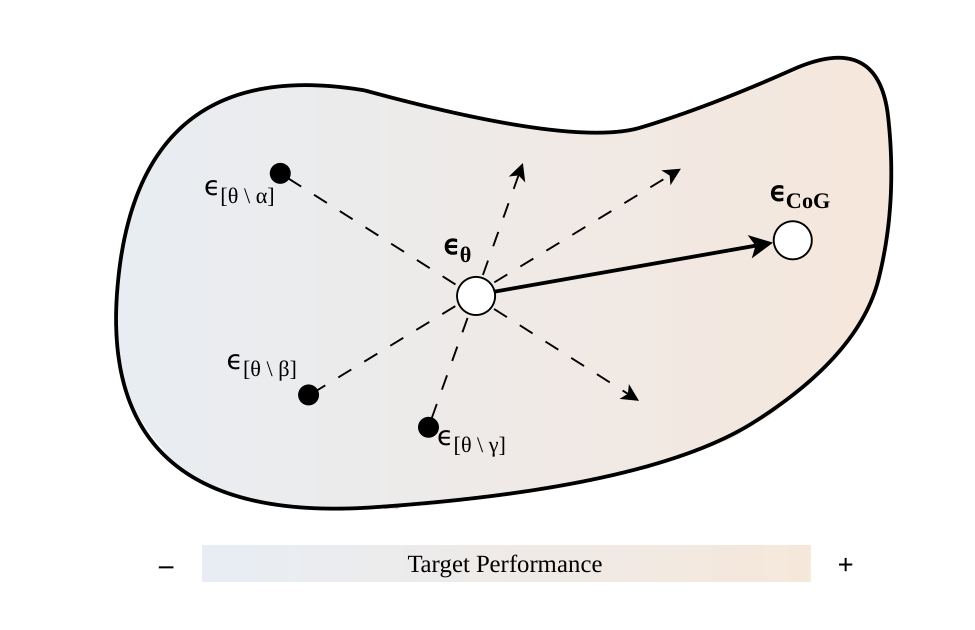
Concept Guidance precisely approximates the target direction by combining per-layer skip predictions using concept-relevant layers ($\alpha,\beta,\gamma$). It computes individual skip-layer noise predictions ($\epsilon_{[\theta\setminus \alpha]}, \epsilon_{[\theta\setminus \beta]}, \epsilon_{[\theta\setminus \gamma]}$) and extrapolates over them to precisely estimate the target direction.
Uncurated Comparison of Classifier-Free Guidance (CFG) ho2022classifier_free_guidance, Naive Skip-Guidance as found in Stable Diffusion 3 huggingfaceSD3, Spatio-Temporal Skip Guidance hyung2025spatiotemporal and Concept Guidance for Aesthetics (FLUX.1-dev).
The overview of CPI-Bench. CPI-Bench decomposed into three distinct dimensions: CPI-General-Bench for comprehensive editing performance, CPI-Practical-Bench for real-world deployment efficacy, and CPI-Intelligent-Bench for reasoning-based editing tasks.
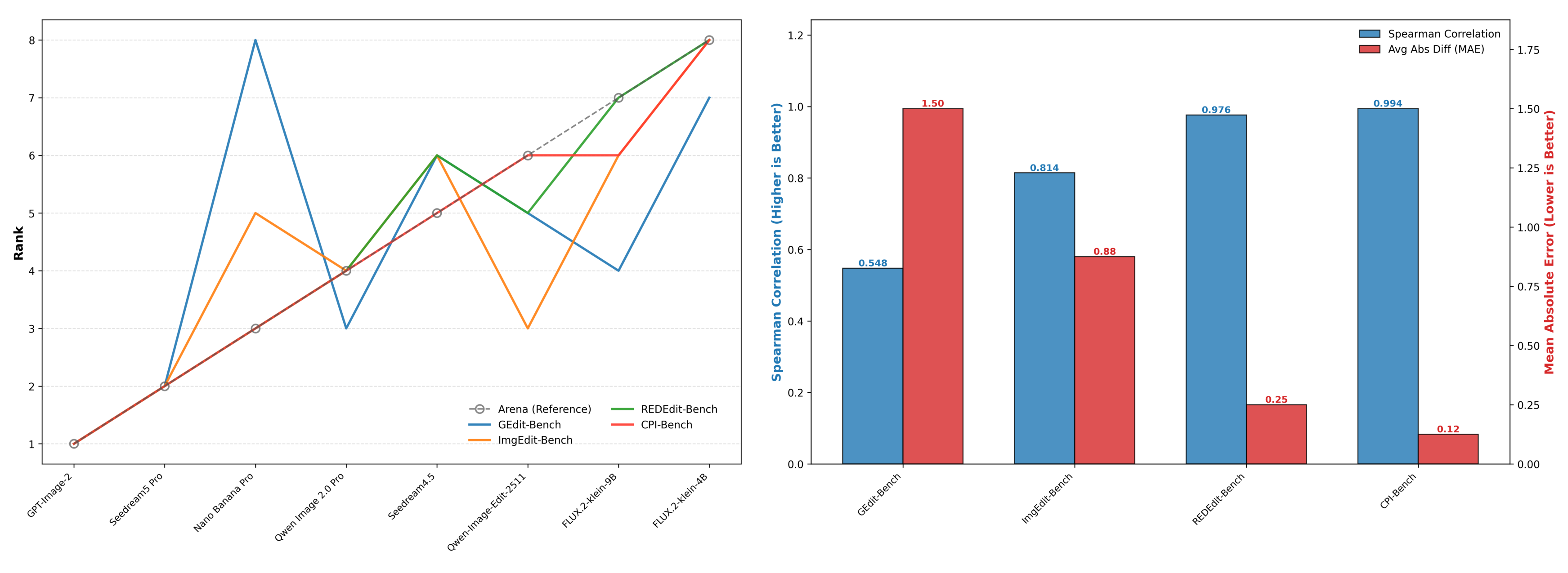
Left: Model ranking trends across benchmarks compared against the Arena Image Edit Leaderboard~lmarena2024leaderboard. CPI-Bench we proposed demonstrates the closest alignment with Arena. Right: Spearman correlation coefficients and Mean Absolute Error (MAE) with Arena rank. CPI-Bench outperforms other benchmarks, achieving the highest correlation and the lowest error margin.














评论 (0)