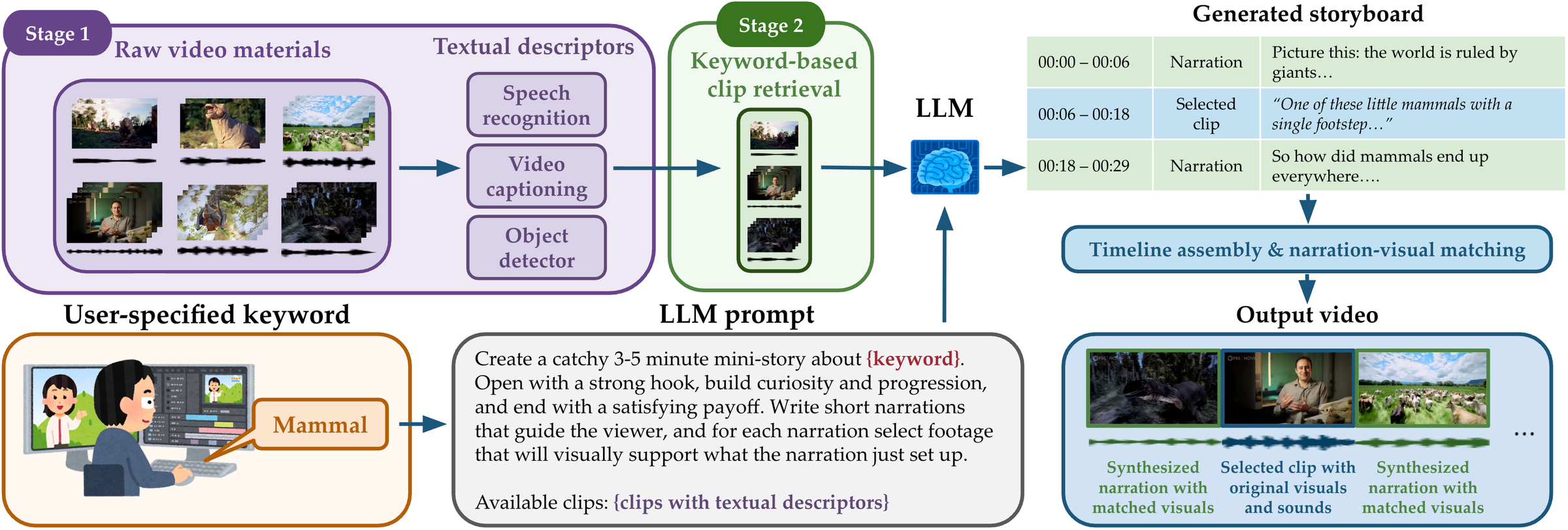
Figure 1: Overview of the proposed Clips2Story-ND pipeline. Given a pool of raw video footage and a user-specified keyword, we first extract textual descriptors from the video clips and retrieve those most relevant to the keyword. We then use an LLM to generate an editable storyboard with connective narration. Finally, we compose the output video by assembling the selected clips and retrieving accompanying visuals for the narration.
Figure 5: Genre-wise comparison of CLIPScore, VTGHLS, OPC, KR-Narration, KR-Frame, and KR-Caption under the scene-level setting. Error bars indicate 95% confidence intervals. Specific numbers can be found in Table 6 .
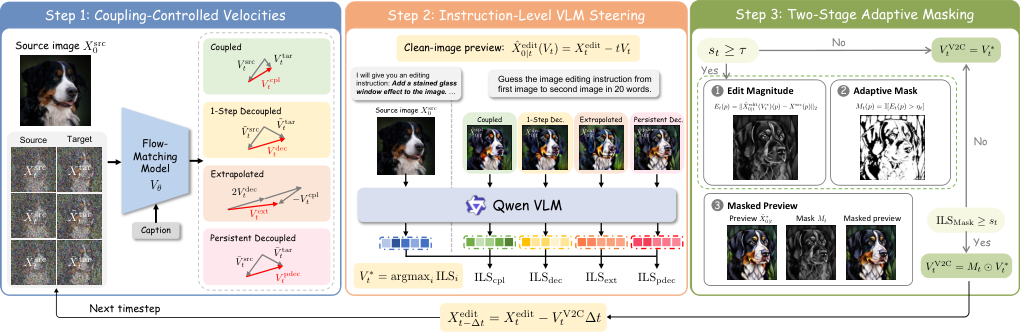
本文贡献:V2C-Edit 在不训练生成主干的条件下构造四种源图耦合程度的速度场。ILS(Instruction-Level Similarity,指令级相似度)比较预估改动与用户指令,选择该步速度;当语义改动足够且局部掩码不损伤 ILS 时,再限制无关区域的更新。实验用 FLUX 与 Stable Diffusion 3。
Figure 3 : Overview of the proposed V2C-Edit pipeline. (1) Coupling-Controlled Velocities: Construct four editing velocities with different coupling behaviors. (2) Instruction-Level VLM Steering: Select the optimal velocity at each timestep using ILS. (3) Two-Stage Adaptive Masking: Apply spatial masking when semantic alignment is sufficient and the masked update maintains ILS. The VLM query templates are provided in Appendix F .
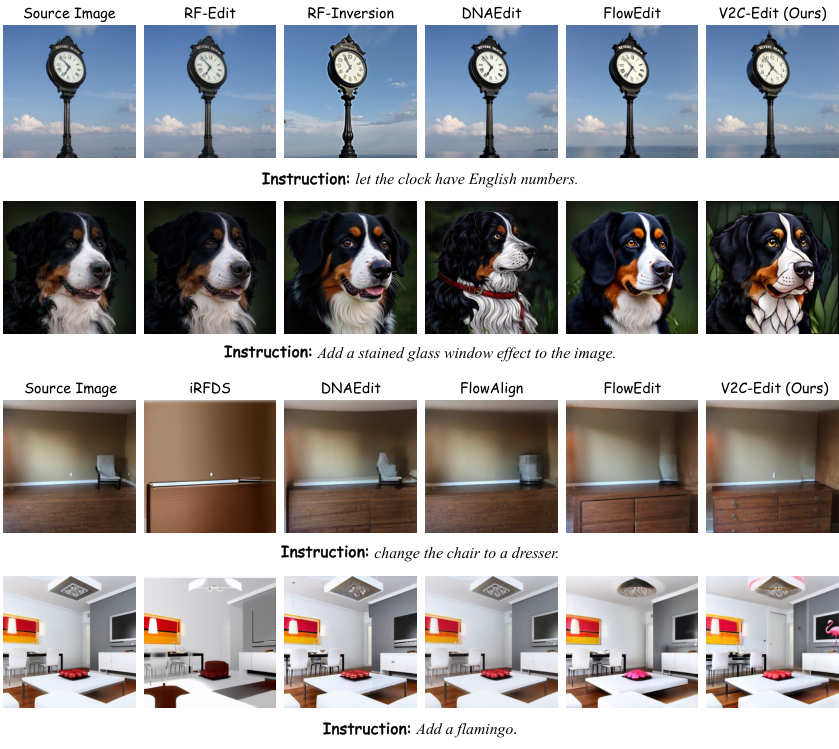
Figure 4 : Qualitative comparisons of text-based image editing methods. Our method achieves the highest fidelity to the editing instruction while maintaining strong background consistency with the source image.
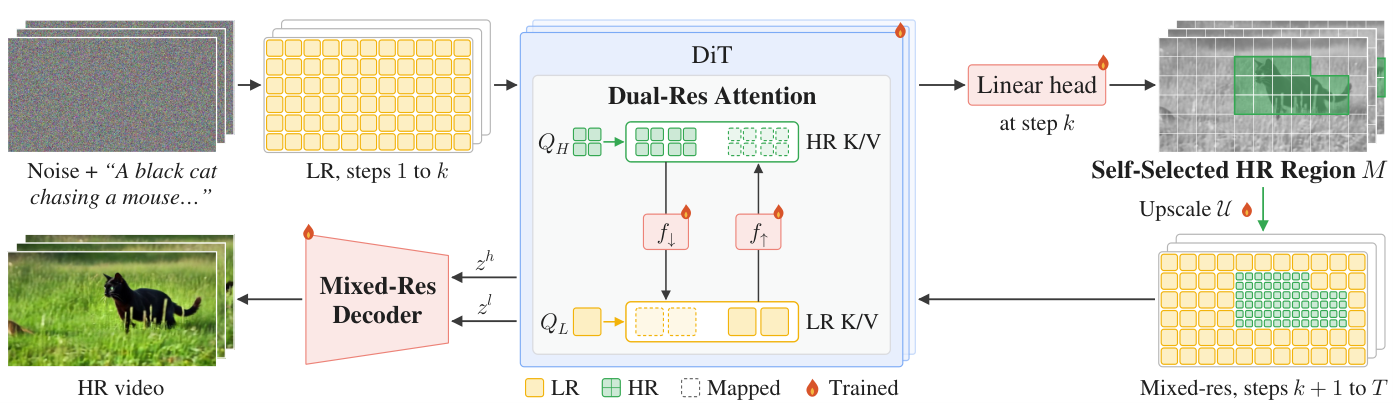
本文贡献:MPEG-Diffusion 先在低分辨率运行前 k 个去噪步,随后线性头从冻结 DiT 特征预测高清区域;双分辨率注意力用线性映射补齐缺少的键值,混合分辨率解码器先融合高低清潜变量,再生成整帧。线性映射、区域头与解码器需训练,不能当作纯免训练加速。
Figure 2 : Overview of MPEG-Diffusion. The first k k of T T steps run at LR. At step k k , a linear head selects the HR region M M (part 2), and the remaining steps denoise M M at HR and the rest at LR. In dual-resolution attention (part 1), each query reads the K/V of its own resolution, with missing entries (dashed) filled from the other resolution by linear maps. The mixed-resolution decoder (part 3) merges the HR and LR latents into one HR video. Flames mark trained parts.
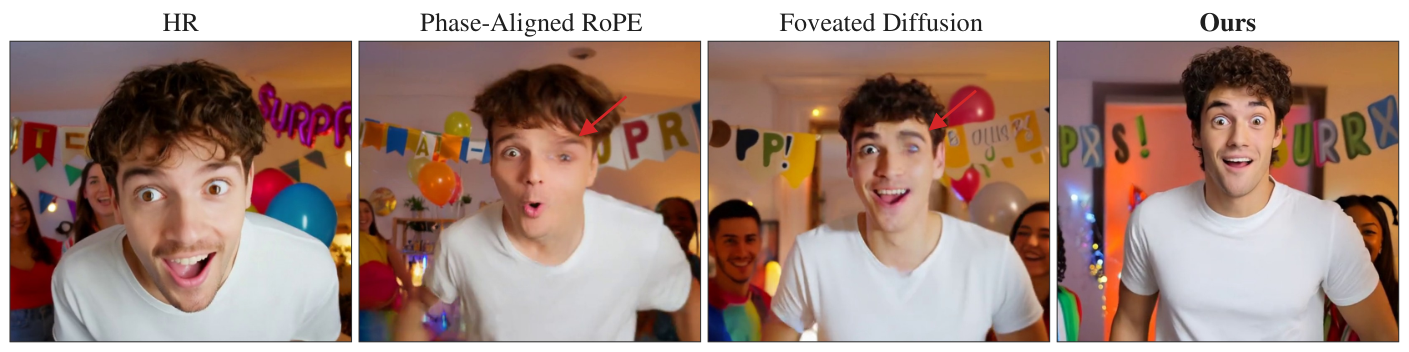
Figure 8 : Qualitative comparison on faces (Wan2.1 14B, k = 25 k=25 , same seed). Prompt: a young man steps into a surprise party. Both baselines show clear artifacts where the HR and LR regions meet, with one eye sharp and the other ghosted (arrows). Ours shows no visible degradation and is close to HR (more examples in Appendix A ).
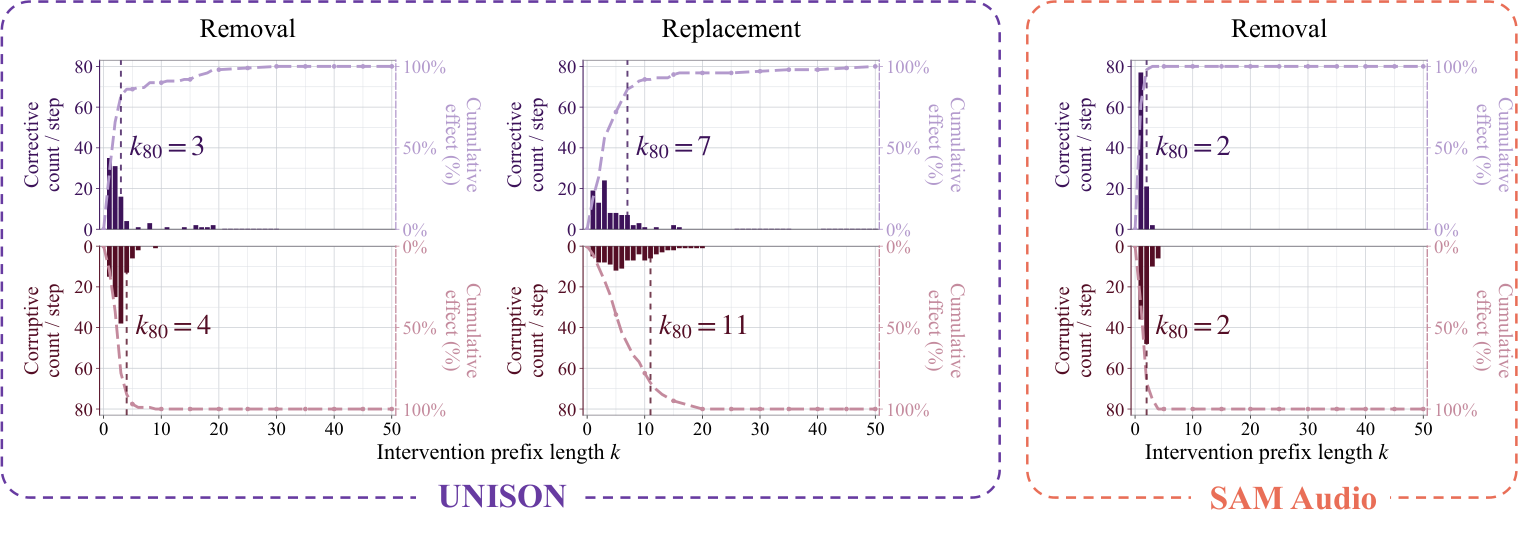
Figure 3 : Bidirectional early-trajectory interventions on source selection. Corrective (top) and corruptive (bottom) prefix interventions are evaluated on 100 validation examples per task. Bars show per-step corrective or corruptive counts, while curves show the corresponding cumulative effects. For each task, k 80 k_{80} denotes the shortest intervention prefix length at which the cumulative effect reaches 80%. Removal consistently exhibits a shorter k 80 k_{80} than replacement.
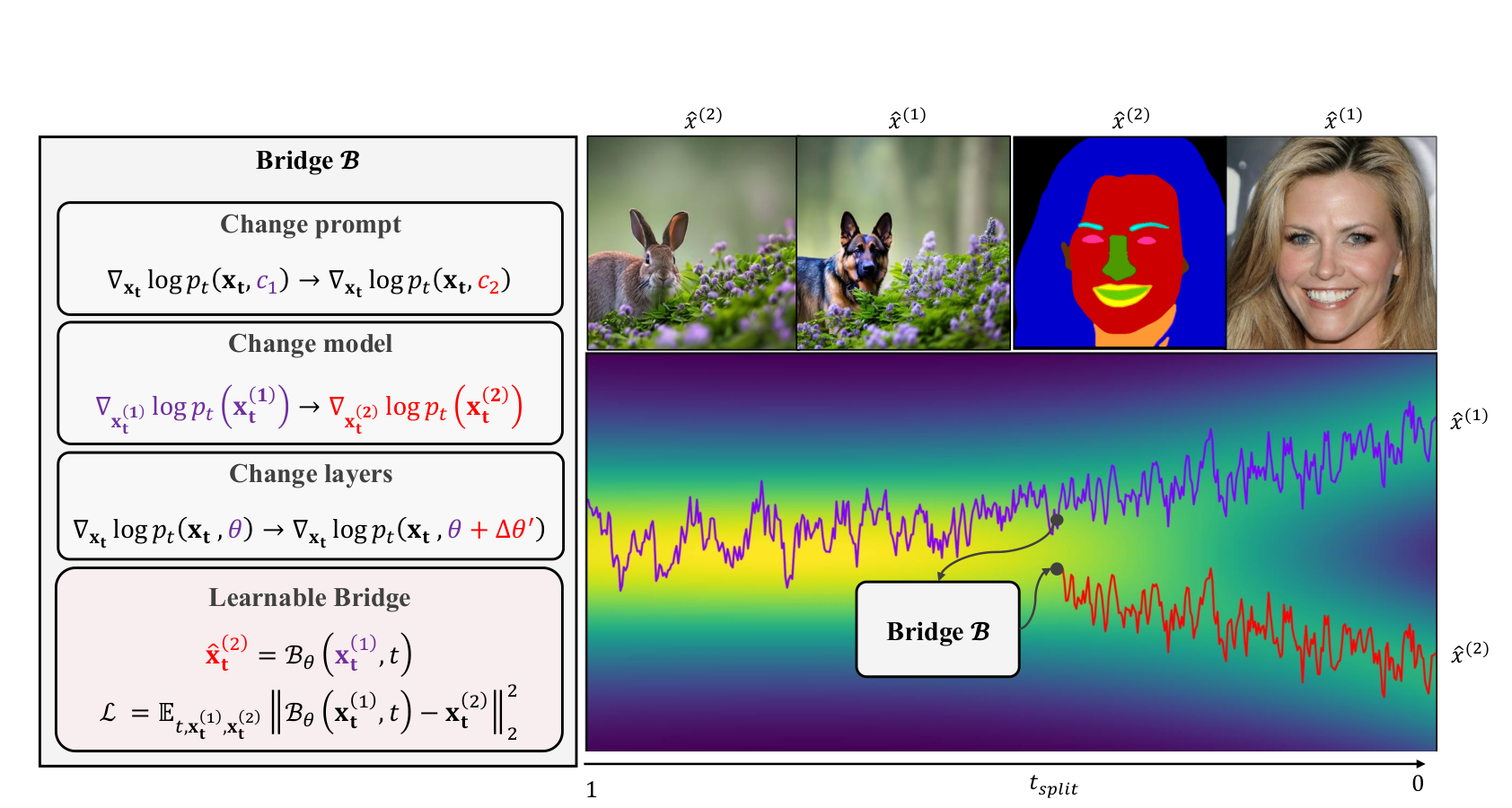
本文贡献:Split and Bridge(SnB)在采样时耦合预训练单模态扩散模型;从共同先验出发,t_split 处经 bridge 修改条件、模型或中间层,再走各自的去噪轨迹。可学习 bridge 增强跨模态映射,不需从头联合训练整套生成器。论文测图像与语义掩码配对,也展示图像编辑和交错协同生成。
Figure 1: SnB leverages pretrained diffusion models by coupling reverse trajectories during sampling. We start from a common state sampled from a prior, then at t s p l i t t_{split} , a bridge module is used to implement a score intervention on the reverse process. This intervention can be through modifying conditioning signals (e.g., prompts), changing diffusion models that estimate the score functions, or changing certain layers in the diffusion models. This flexibility applies SnB in various tasks, like interleaved co-generation (top left pair) and multimodal generation (top right pair). Learnable bridges allows stronger trajectory manipulation in mapping one modality to another.
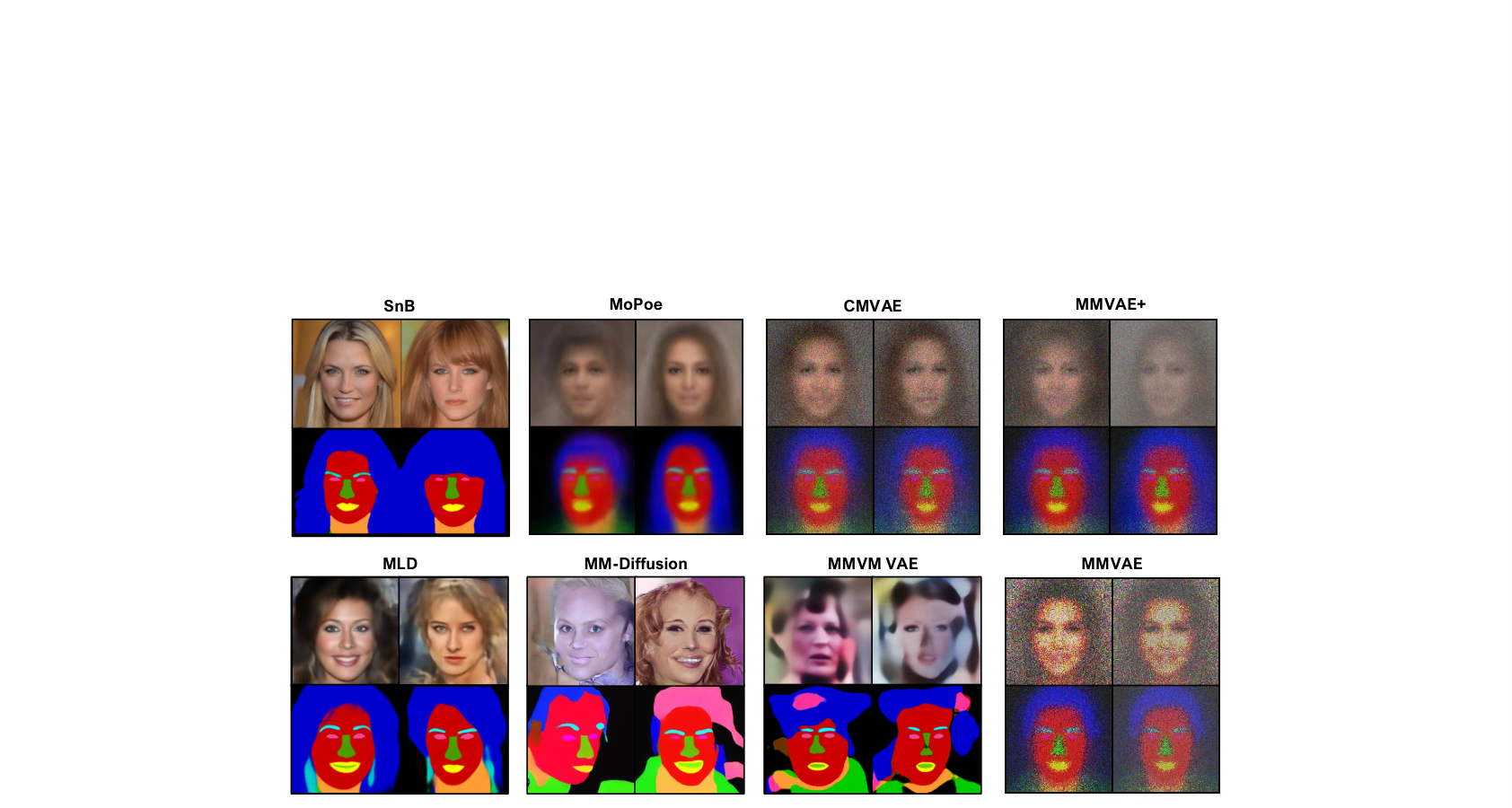
Figure 3: Qualitative comparison of SnB and previous top-down multimodal approaches on CelebAMask-HQ. SnB balances between coherence and quality of generated modality pairs.
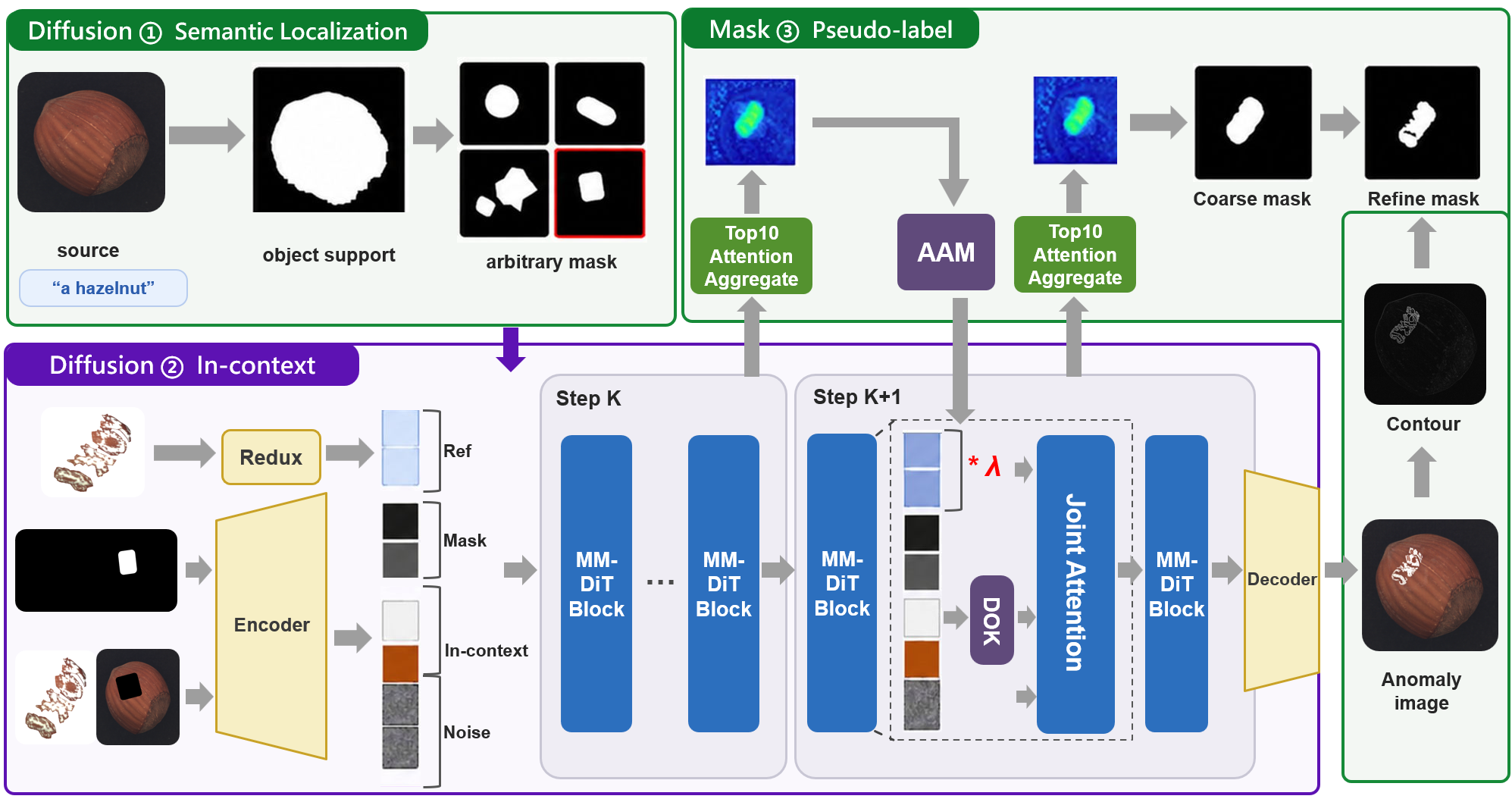
Figure 3 : Overview of the proposed REDiff-AD model. Semantic localization first determines a loose editable region on the target. A frozen in-context MMDiT transfers the masked reference, with AAM strengthening weak anomalies and DOK reducing reference-shape copying. Aggregated target-to-reference attention is then refined into the output pseudo-mask.
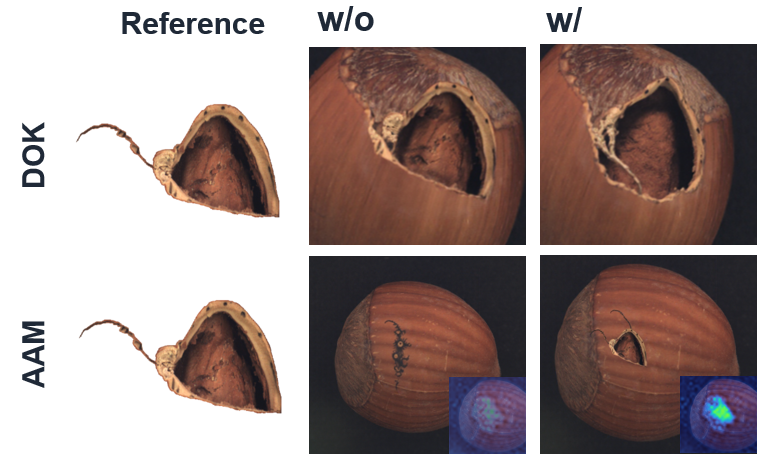
Figure 4 : Qualitative illustration of the effects of DOK and AAM. DOK diversifies the geometry of the defect, while AAM improves the robustness of in-context defect generation.
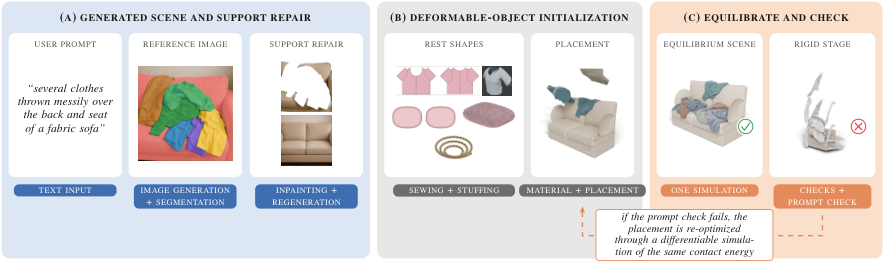
Figure 2 : Overview of SoftPAT3D. Each card shows the state of one prompt at that point of the pipeline, and its label names the step that produced it. (a) The prompt is expanded into a reference image, segmented and lifted as in PAT3D, and the support hidden under each deformable object is inpainted, regenerated and converted into a collision mesh (Sec. 3.4 ). (b) Each deformable object receives a rest shape from its manufacturing process under a size prior (Sec. 3.2 ), a material from the material library and a placement above the part the prompt names (Sec. 3.4 ). (c) One simulation brings the scene to equilibrium under a single contact barrier (Sec. 3.3 ), and the result passes the geometric checks and the prompt check (Sec. 3.5 ); a scene that fails enters placement optimization (Sec. 3.6 ).
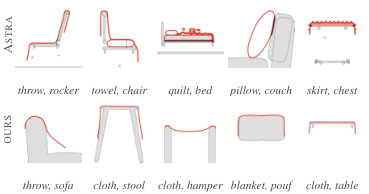
Figure 5 : Vertical sections, cloth in red, furniture in grey, cloth inside the furniture in dark red, and a dashed line where the cloth floats above its support. Top: GPT-6 Astra; the blanket and the towel hang above their seats, the quilt runs through the mattress, the pillow sits inside the backrest, and the skirt ripples in mid-air. Bottom: ours; the cloth rests on the support, wraps its edges and hangs from them.








评论 (0)