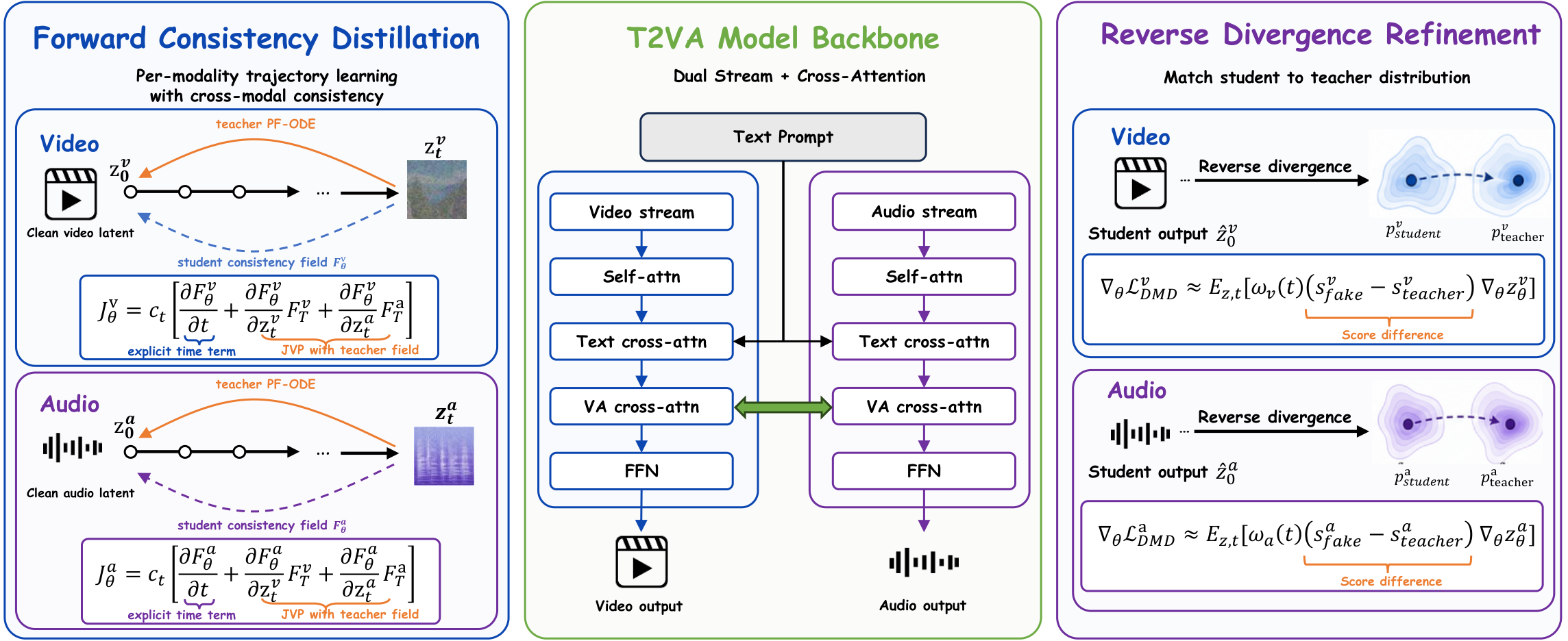
Overview of the proposed Dual-Divergence Distillation framework for T2VA acceleration. The left panel illustrates forward consistency distillation for video and audio modalities, the middle shows the T2VA backbone with cross-modal interaction, and the right panel depicts reverse divergence (distribution matching) refinement.
Robustness and human preference. Low-to-mid query noise and target radii from $0.08$ to $0.40$ remain near the default, while query noise $0.90$ and branch coefficient $10$ fall to $0.2884$ and $0.2961$. Annotators prefer DiffusionOPSD over the base model, FlowGRPO, DiffusionNFT, and ReFL on $64\%$, $71\%$, $90\%$, and $61\%$ of prompts.
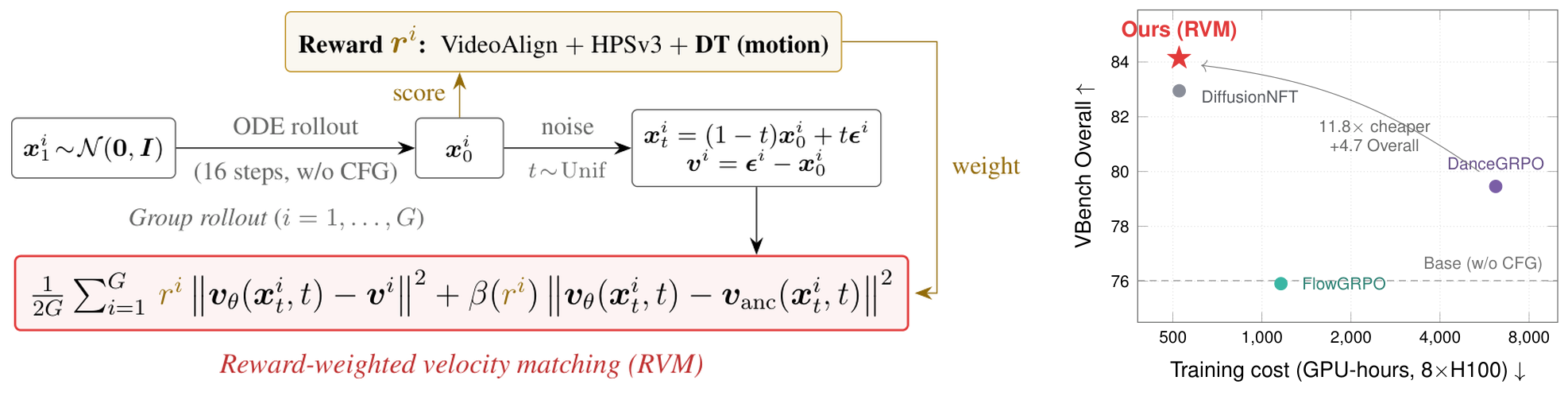
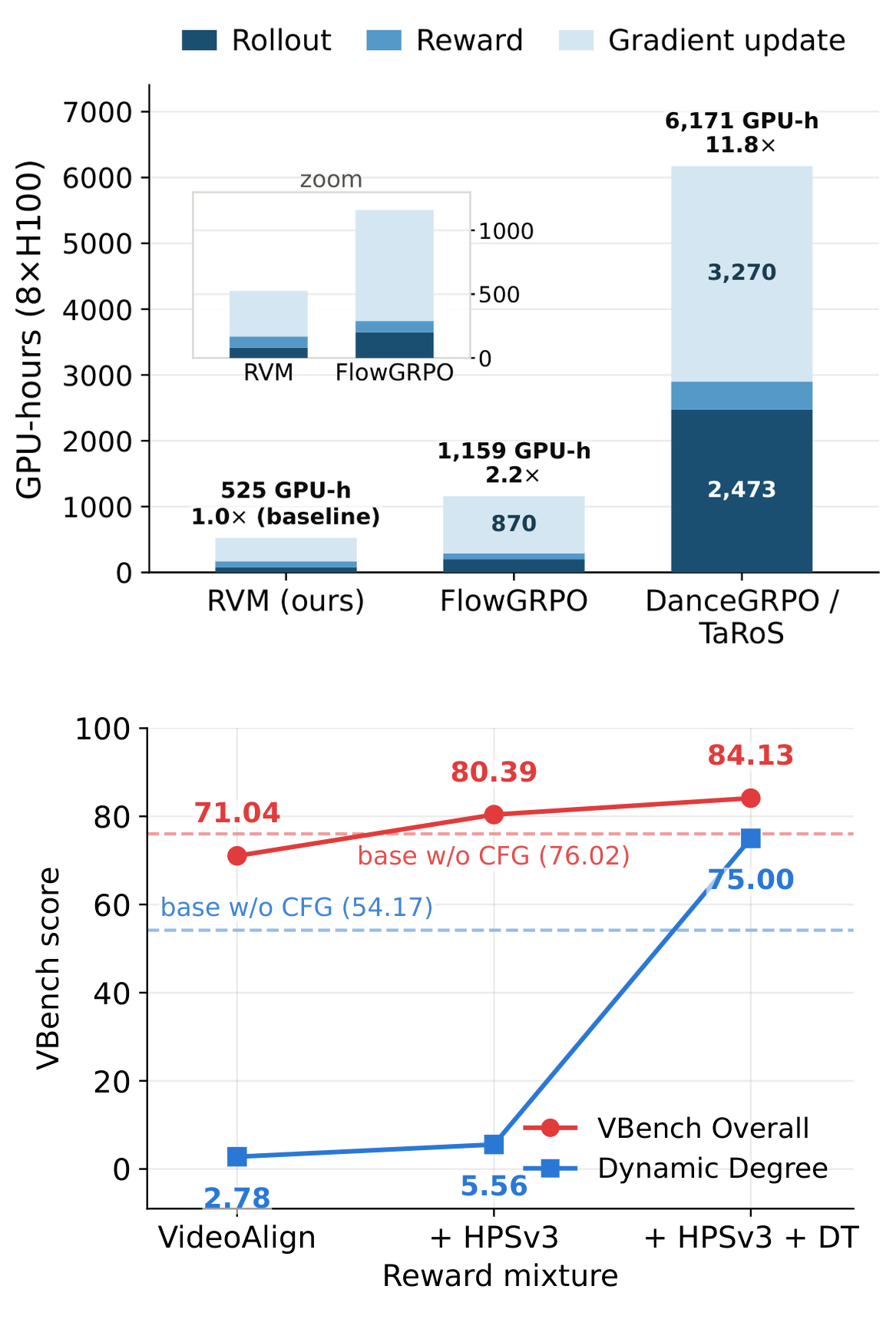
Overview of RVM. Left: RVM fine-tunes Wan2.1-1.3B with a simple reward-weighted velocity-matching loss. Grouped rollouts are scored using public reward models together with our dynamic-tracking (DT) reward, and each generated sample $\bm^i_0$ is noised once to $\bm^i_t$ and regressed toward its velocity target $\bm{v}^i=\bm{\epsilon}^i-\bm^i_0$, with an optional anchor velocity $\bm{v}_{\mathrm{anc}}$ controlling model drift, avoiding trajectory storage and likelihood estimation. Right: on Wan2.1-1.3B, RVM achieves the best VBench Overall score at a fraction of the training cost of trajectory-based methods.
GPU-hour cost comparison on Wan2.1-T2V-1.3B. Training time is decomposed into rollout, reward evaluation, and gradient update. % Note that despite being the cheapest, RVM attains the highest VBench Overall ($84.13$ vs. $75.91$ for FlowGRPO).
FireRedAudio: A General-Purpose Audio Language Model with Decoupled Continuous Representations for Understanding and Generation | 小红书 | arXiv:2608.24168
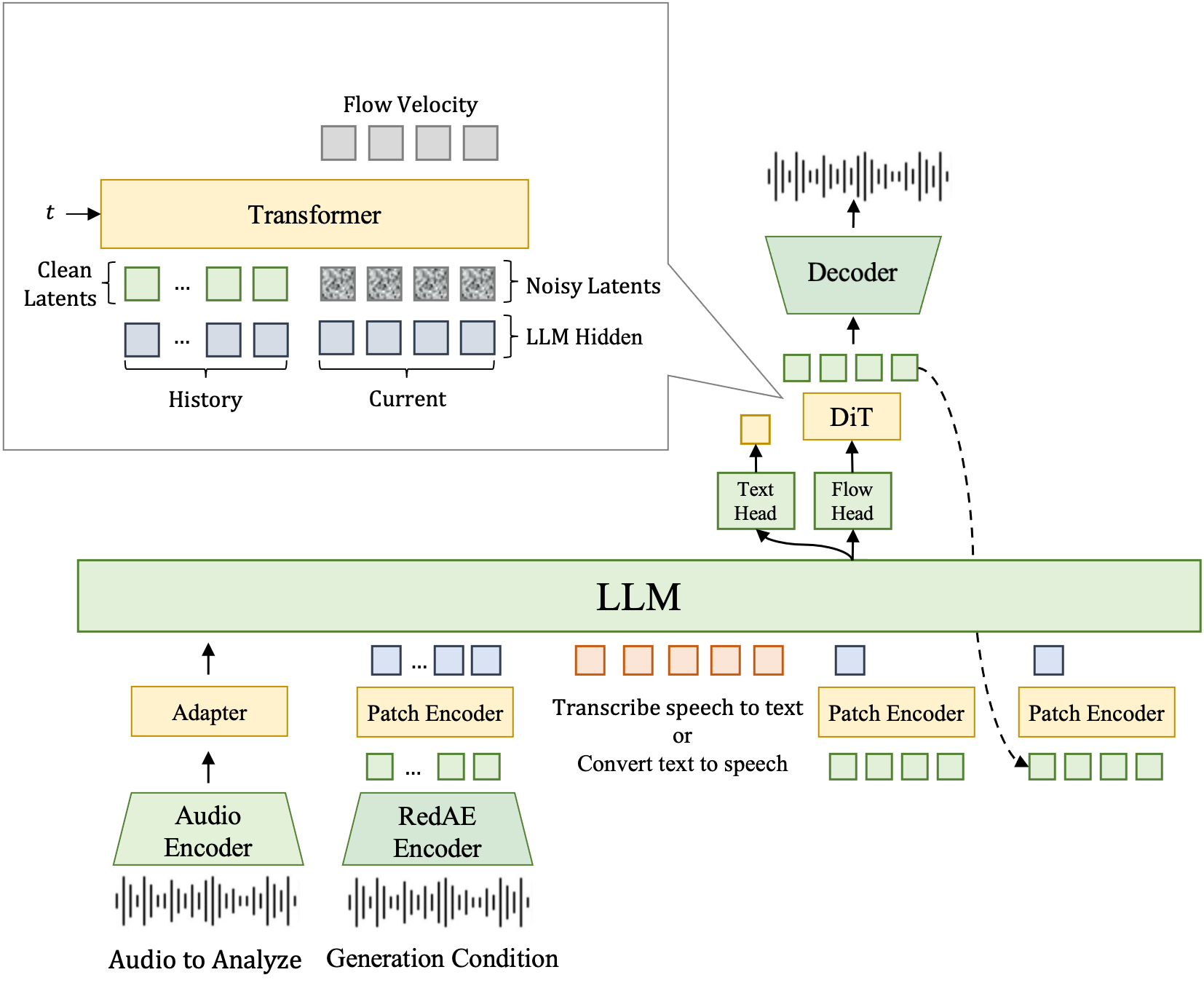
Overview of FireRedAudio. Decoupled continuous pathways encode inputs for understanding and generation. The shared LLM produces text or conditions a DiT to generate RedAE latents, which are decoded into waveforms. The inset illustrates the DiT conditioning for one audio step.
Four representative long-form audio-understanding capabilities: structured organization, long-form summarization, bidirectional retrieval between time and content, and global analysis over evidence distributed across a recording. Our quantitative temporal-grounding evaluation focuses on structured organization.
批判点评:「首个公开披露」这个 claim 叠了三层限定词——publicly disclosed、within a single trainable autoregressive LLM、separate continuous input representations——本质是在一个足够窄的定义里宣称首创,读者要看清边界再决定这个「首个」值多少。9B LLM 的底座是什么、是否从某个开源模型继续训练,摘要完全没提,而这直接决定了工作量、复现难度与结果的归因。「competitive or leading」是典型的选择性表述,缺少与 Qwen-Audio、Step-Audio、Ming-UniAudio 等同类在主流 benchmark 上的逐项数字,读者无从判断领先幅度。一小时长音频理解的量化评测只覆盖「结构化组织」一项,摘要、双向检索、全局分析三项在图里是能力示意(带具体案例的界面示例)而非量化结果,这三项的真实可靠度目前无法评估。解耦两条表征的代价是推理时要同时维护两套编码器,额外的参数量与显存开销没有交代。语音编辑只对比了 Ming-UniAudio-Edit 一个基线,样本偏少。
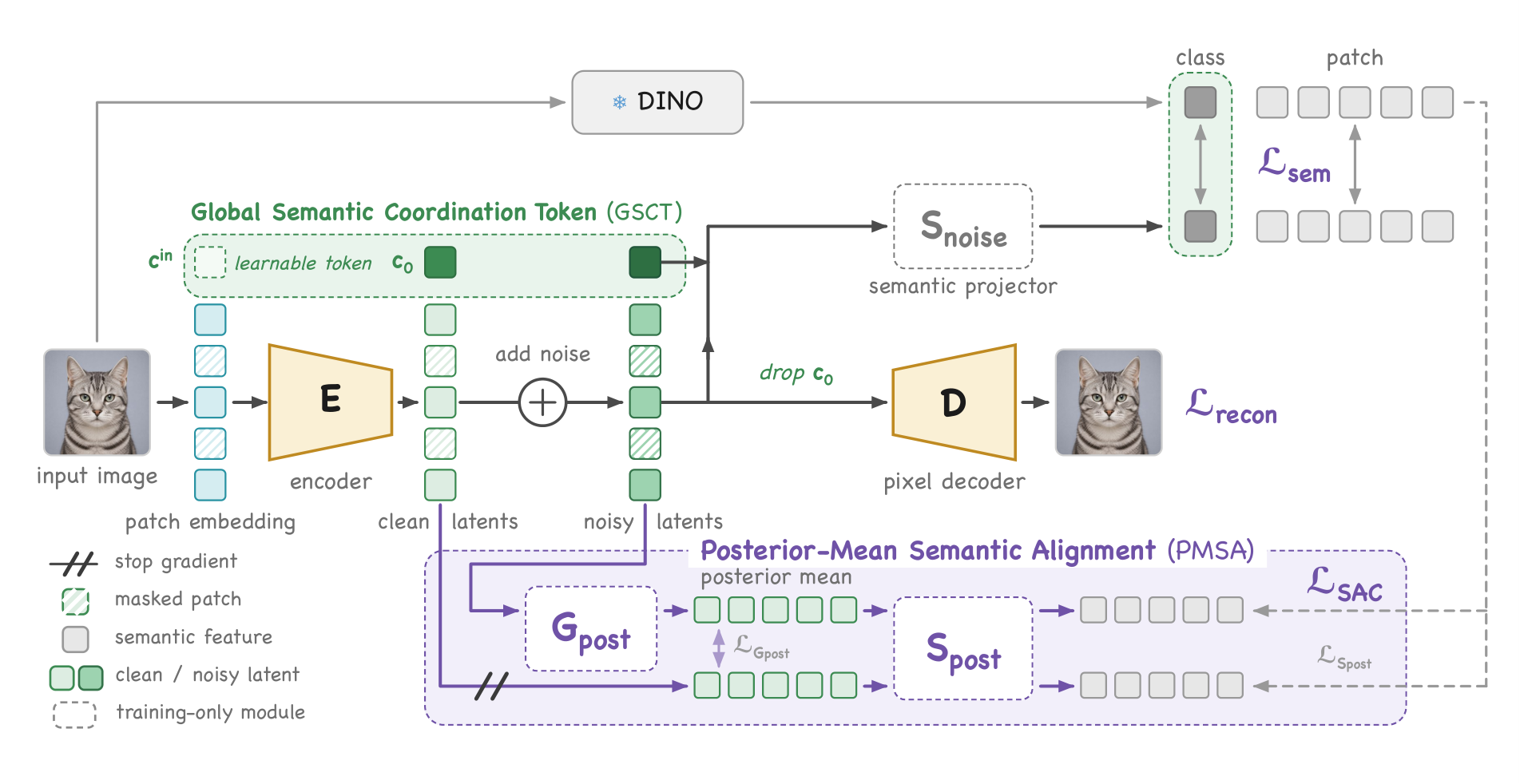
Overall framework of AffineTok. The input image is processed in parallel by a frozen VFM and a trainable tokenizer. Its encoder jointly maps patch embeddings and a prepended learnable GSCT to a global output and clean patch latents (z_0). After (z_0) is noised into (z_t), the resulting global and noisy patch representations receive semantic supervision; the global output is then discarded, while (z_t) is decoded for reconstruction. Along the PMSA path, (G_post) maps (z_t) to a posterior-mean estimate, and (S_post) maps the estimate to semantics. Only clean patch latents are retained downstream.
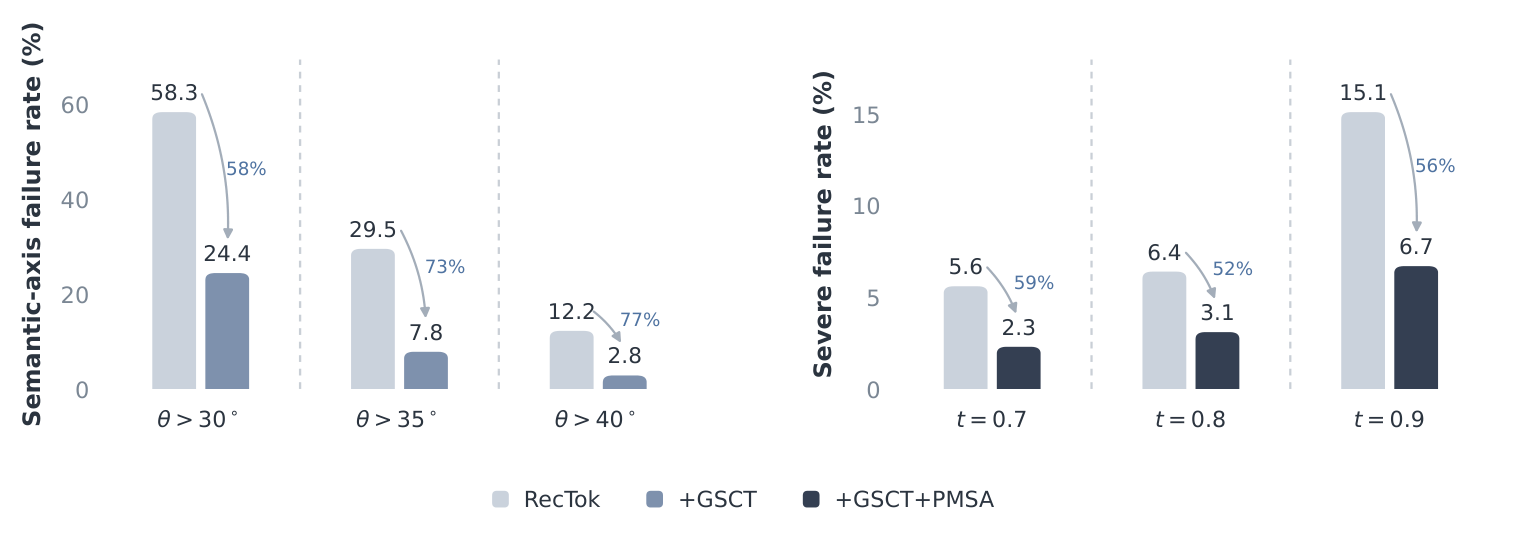
Targeted semantic probes for GSCT and PMSA (lower is better). Left: Cross-split semantic-axis inconsistency rates for RecTok and +GSCT across three angular thresholds. Right: Top-10 semantic retrieval miss rates for RecTok and +GSCT+PMSA under three severe noise levels.
Overall architecture of KATok. A video is divided into spatio-temporal patches and encoded into continuous latent tokens. The adaptive token selector predicts per-token keep probabilities via Gumbel–Softmax relaxation, producing a soft token-drop mask shared with the decoder attention for consistent token selection. The decoder reconstructs the input via learnable query tokens by attending to the masked latent tokens, forming an end-to-end differentiable pipeline for adaptive token selection.
Token scaling with video size. As spatial and temporal resolution increase, our method achieves progressively higher compression ratios, demonstrating efficient scalability across input sizes. In contrast, OmniTokenizer maintains a fixed compression ratio, and ElasticTok remains nearly flat. (Conventions and compression ratio definition follow Table.)
前序问题:高保真的图生 3D 需要一个同时刻画几何与外观的 3D 表示。而要支持重打光、并且能接进标准渲染管线,这个表示必须包含 PBR 模态——albedo、metallic-roughness 与表面法线。现实是主流生成式 3D 表示往往只产出「把光照烘死在外观里」的结果:单看渲染图挺漂亮,一旦塞进游戏引擎或影视管线换个环境光就露馅,因为模型从未把材质与光照分离。
Overview of Luce. (Top) Representation and SLatVAE. Given a 3D PBR asset, here a Toys4K sample, we render multiview images and fit per-modality Gaussian splats (albedo, metallic-roughness, normals) on a sparse voxel grid. A structured latent VAE (SLatVAE) encodes this representation into a compact, diffusible latent and decodes it back to PBR Gaussians. (Bottom) Generation pipeline. Given a single input image, a sparse-structure flow first predicts the sparse voxel layout. Conditioned on multi-layer DINOv2 features, SLatFlow then generates a PBR Gaussian latent at each active voxel. The structured latent decodes into relightable PBR Gaussians and also serves as input to the mesh decoder, which yields textured meshes with tangent-space normal maps and a complete PBR material set.
PBR shaded rendering. The decoded PBR modalities (albedo, metallic-roughness, normals) enable shaded rendering under novel environment maps via standard PBR compositing (Eq.), without mesh extraction or UV unwrapping. We compare our deferred PBR renderer on the GS fit against the textured mesh rendered with Blender EEVEE as a reference; the environment maps are listed in Appendix.
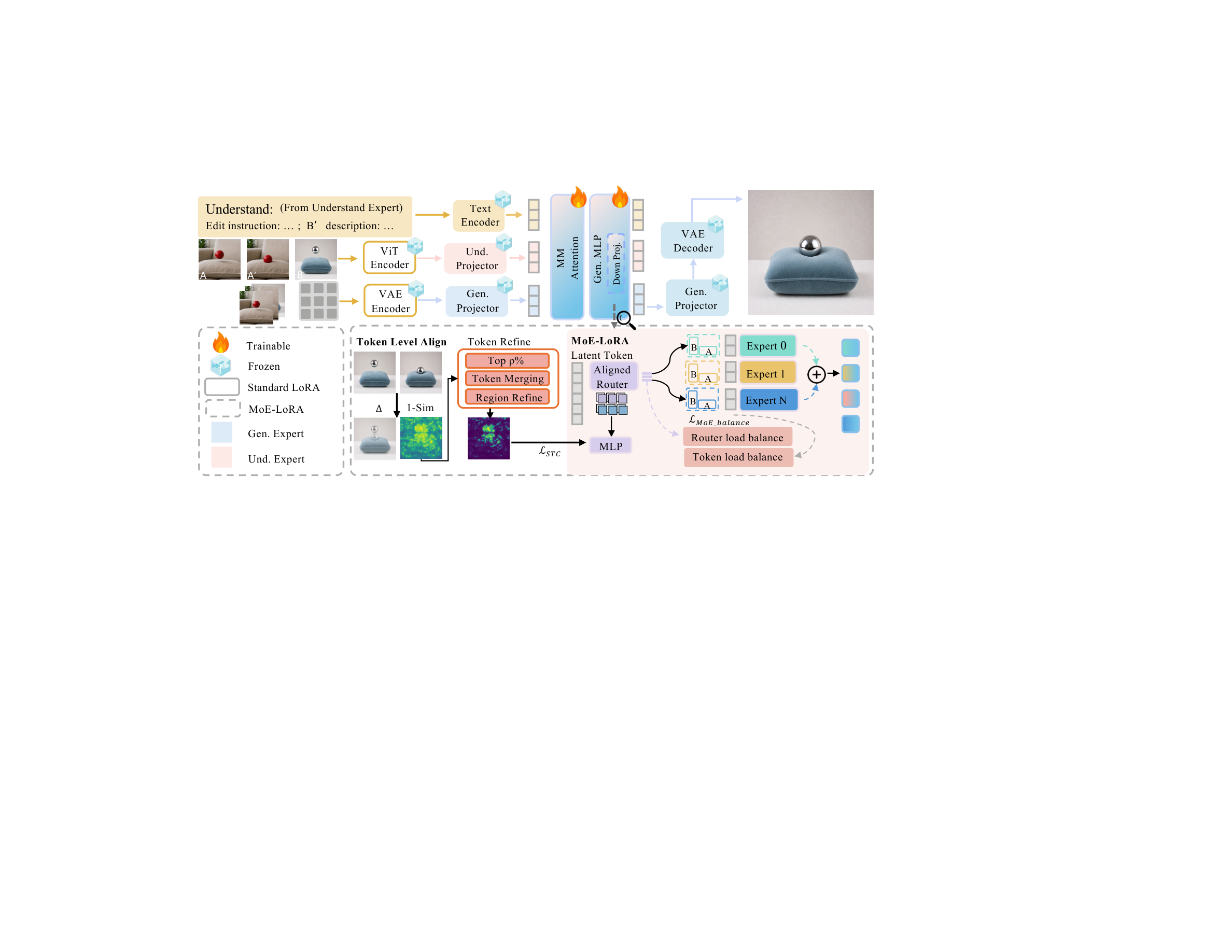
Overview of TransPhy on BAGEL. The understanding and generation pathways encode the exemplar--query context; ViT-derived transition evidence aligns token-level routing, while MoE-LoRA experts render the inferred physical rule.
Overview of G2WEngine, a scalable data engine that transforms in-the-wild gameplay videos into world-model-ready data through HUD asset extraction, temporally coherent UI synthesis, and downstream support for HUD understanding, removal, and clean gameplay generation.
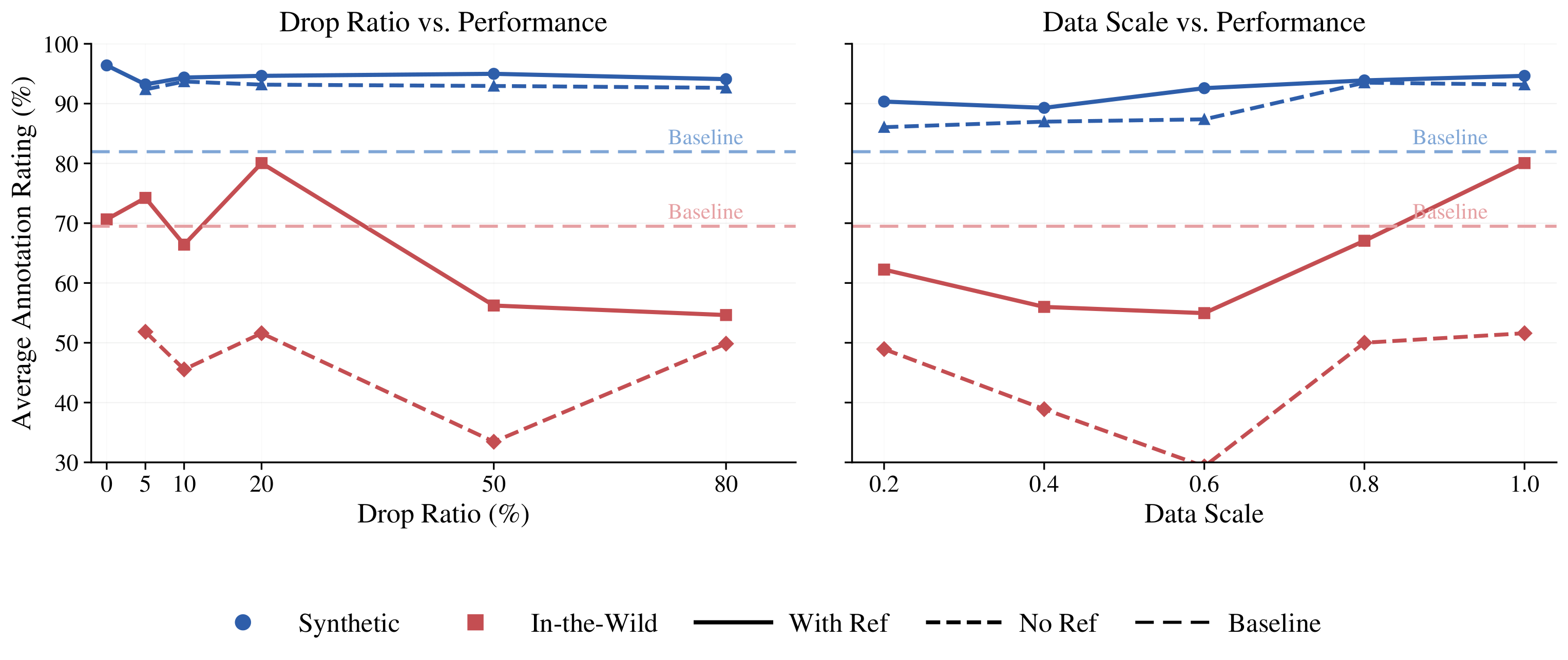
实验效果:受控 pilot 实验中,用去 UI 录屏训练的世界模型整体 VideoReward 比用带 UI 数据训练的高 6.83%——这是整篇工作的因果论断落点。UI 移除评测上,GameCleaner 在合成视频上平均 AAR 达 95.36,超过最强的时序 mask 基线 57.3%;野外片段上取得最佳 AAR 80.05,背景保持度 99.8。消融给出两条实用曲线:数据规模方面,野外评测下带参考图的表现从 0.2 规模的约 62 分升到全量的约 79.5 分,且曲线尚未收敛,说明继续加数据仍有空间;参考图 drop ratio 方面,野外表现在 20% 附近最好(约 79.8),过高(50%、80%)反而掉到 56、55 附近,而合成集上的表现则对 drop ratio 几乎不敏感(一直在 93~96)——这个合成/野外的分歧本身就是提示。
Ablation study of data scaling and reference drop ratio during training. We find out that larger and more diverse dataset show generalizable result on in-the-wild evaluation and have not converge yet.
LAION-BVD: A 10-Million-Hour Open Video Dataset for Multimodal Pre-training | 图宾根大学与图宾根 AI 中心、LAION、于利希超算中心(JSC, FZJ)、Wynd Labs、马普智能系统研究所与 ELLIS Institute Tübingen、慕尼黑工业大学 MCML | arXiv:2608.24845
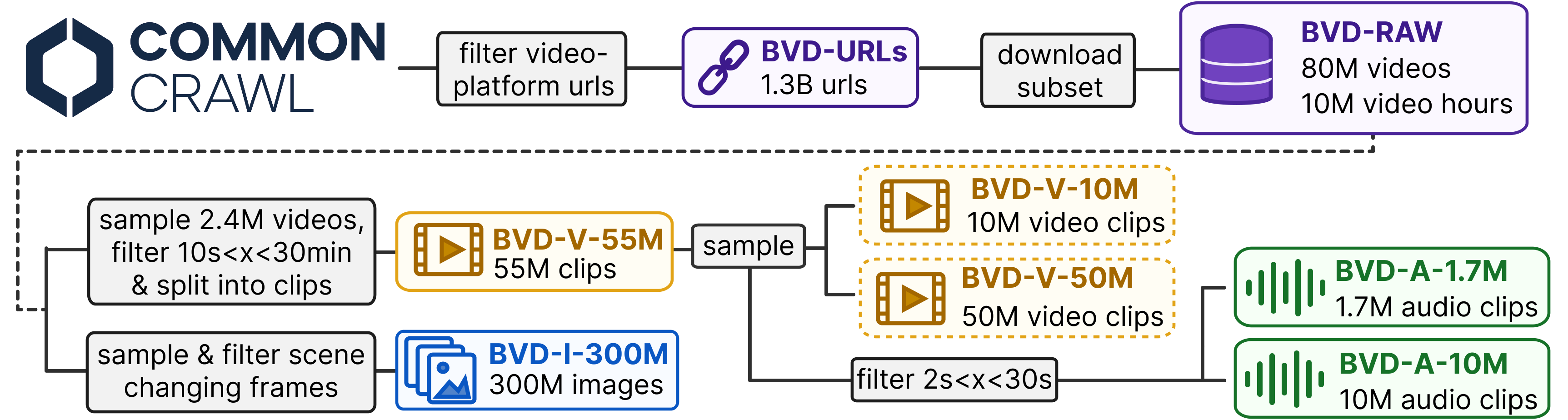
LAION-BVD data curation pipeline. We source data from CommonCrawl and filter for platform-specific video URLs, resulting in 1.3B high-quality video candidates. Out of these, we successfully downloaded 10M video hours using a distributed infrastructure from which we create the BVD-* subsets.
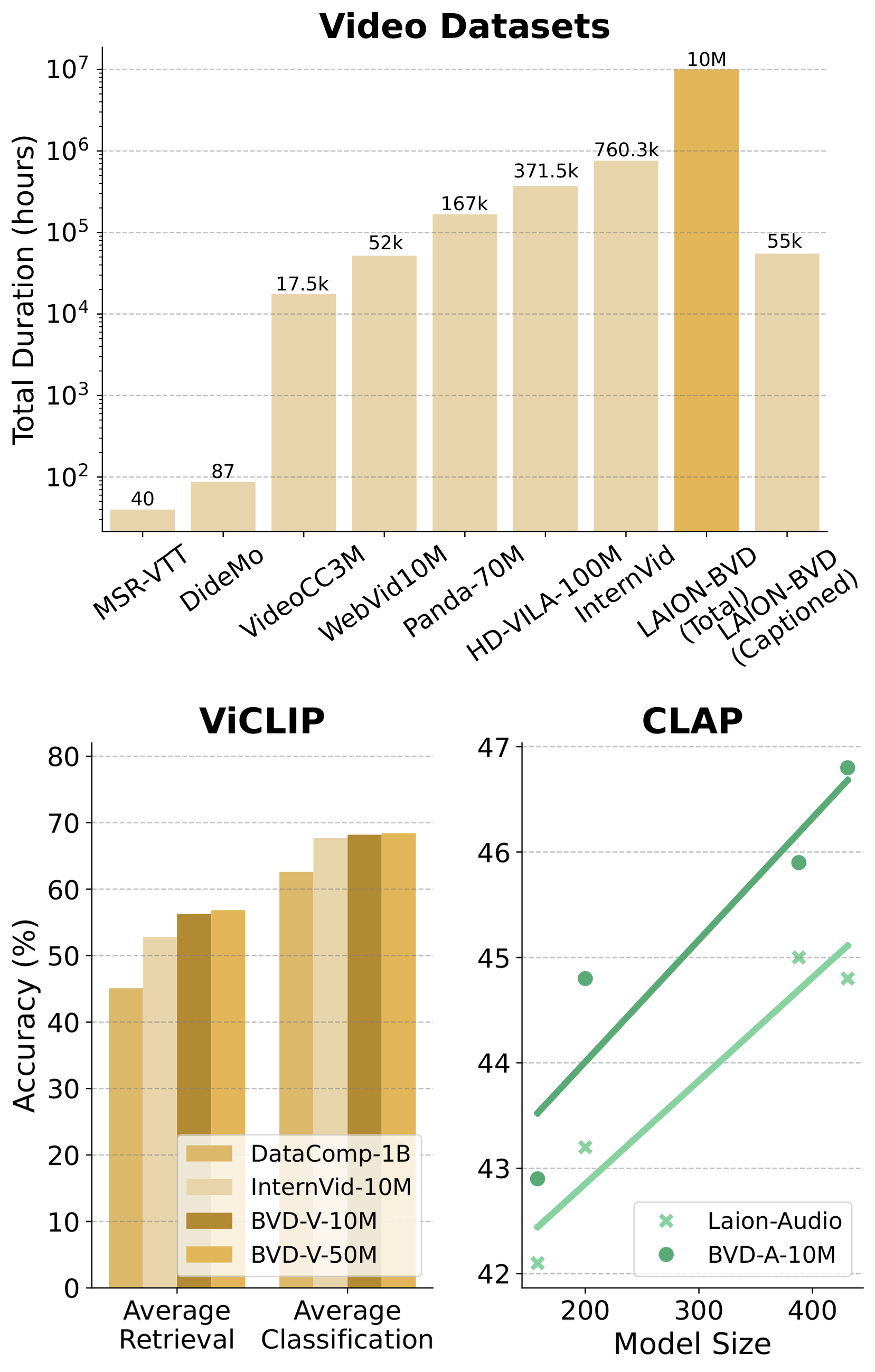
LAION-BVD is an open web video dataset at unprecedented scale. It facilitates strong downstream performance for multimodal pretraining. Left: dataset scale in comparison with existing video datasets. Right: average downstream performance of ViCLIP (video-text, tab:exp_results_wise_ft) and scaling-trends of CLAP (audio-text, tab:exp_results_clap_pure) on standard benchmarks. These results demonstrate that LAION-BVD serves as valuable training data across both video and audio modalities.











评论 (0)