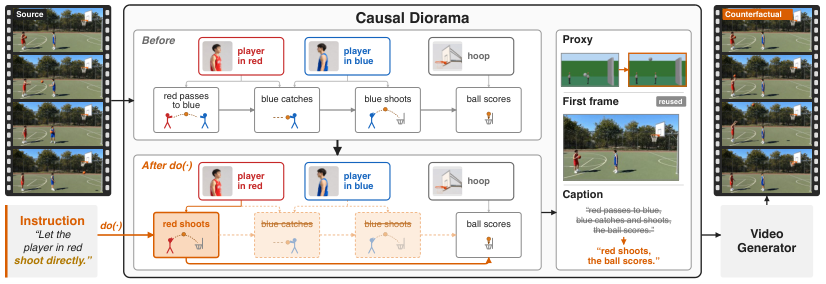
Figure 3 : Overview of the intervention on the Causal Diorama, shown on a real-video edit. The instruction intervenes on an interaction node of the concept graph inferred from the source video, replacing the pass by a shot, and the change propagates to the nodes that depend on it. The connector recomputes the conditions from the intervened graph, from which the generator produces the edited video.
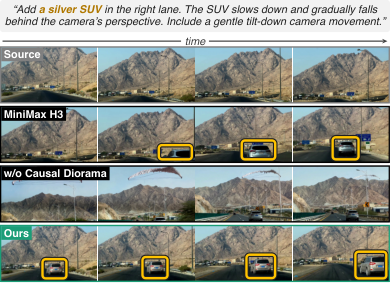
Figure 4 : Qualitative ablation on CoVEBench. With MiniMax H3, the SUV moves in the direction opposite to the instruction, while the variant without the Causal Diorama changes the background. Our method follows the instruction and keeps the rest unchanged.
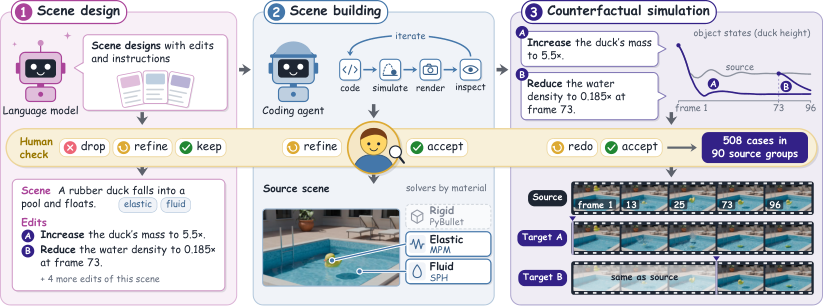
Figure 3 : Construction of the simulated set. A language model proposes scene designs, coding agents build the selected designs into source scenes, we simulate each edit from its execution frame, and humans check the result of every stage.
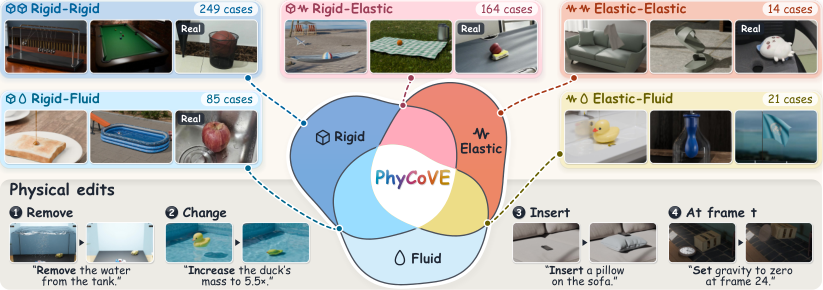
Figure 1 : Overview of PhyCoVE. The three shapes in the center stand for the three materials, an overlap of two shapes marks the interaction pattern of those materials, and the rigid-rigid and elastic-elastic patterns lie in single shapes. The panels show example scenes and case counts of the five patterns, and the bottom row shows the three edit types and an edit at a later execution frame.
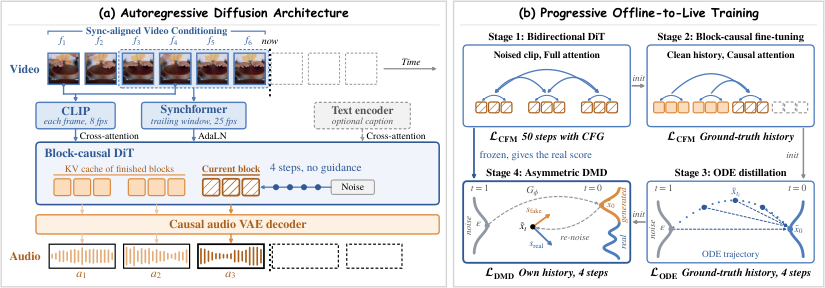
Figure 2 : Overview of LiveAudio. (a) Audio is generated block by block and decoded as soon as it is generated, and sync-aligned video conditioning makes each block depend only on the video played so far. (b) Four progressive training stages turn a bidirectional model into a four-step autoregressive generator without guidance, first making it causal and then distilling it.
实验效果:在 VGGSound 上优于已有流式模型的音质与同步表现,并在同步上超过其起点双向模型;单张 A100 上 real-time factor 为 0.79,time to first frame 为 143 ms。
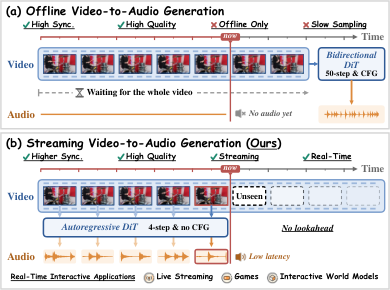
Figure 1 : Comparison between (a) offline V2A generation and (b) streaming V2A generation with LiveAudio at the same moment.
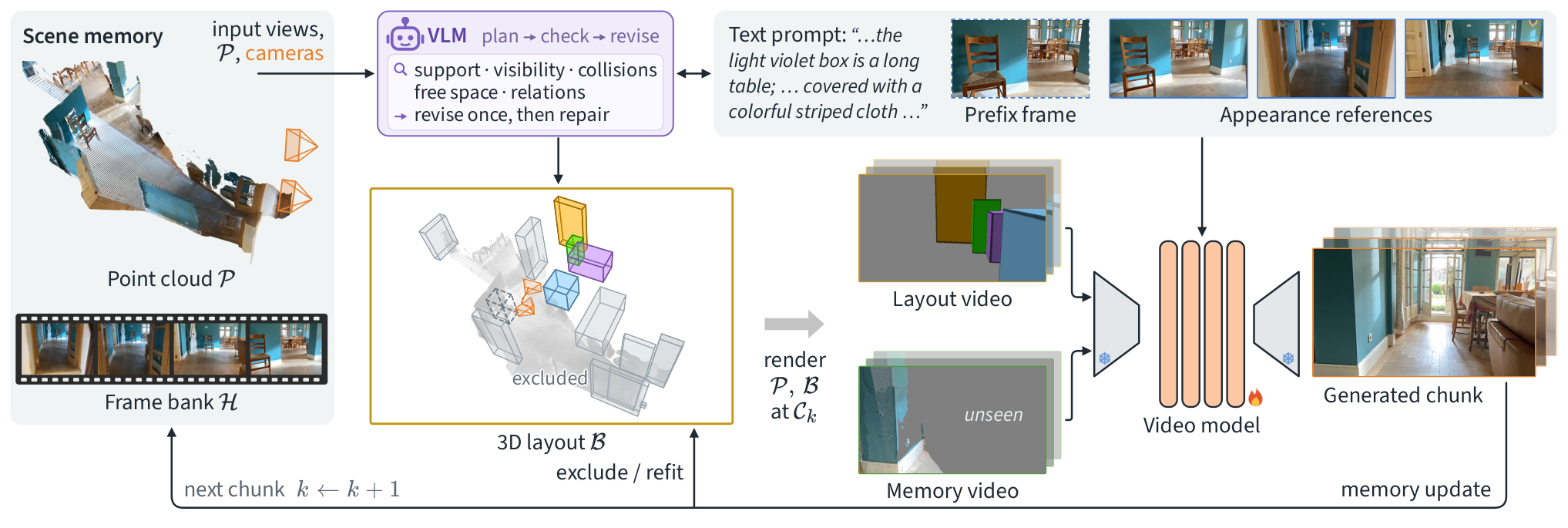
Figure 2 : Overview of Lyris. To decide what lies beyond the input views, we use a vision-language model to plan a 3D layout ℬ \mathcal{B} of labeled object boxes before each chunk k k . We then render this layout and our point-cloud memory \mathcal{P} at its cameras k \mathcal{C}_{k} to guide the video model. The memory video preserves what has been seen, while the layout video specifies what appears where beyond it and anchors the camera to its path. To remain consistent upon return, we reconstruct each generated chunk and write it into the memory.
Figure 4 : Directed round trips. Given the same start frame, cameras, and descriptions ( top ), we plot each method’s rotation error along the way out over the 20 CA-1M scenes ( left ) and show five cameras of one round trip with each frame’s error ( right ). The baselines drift once the path leaves the start view (by roughly 20–40 ∘ at its end), as does our model without its layout (dotted). Lyris is the only method to follow the path throughout, staying within 4 ∘ 4^{\circ} of the requested cameras.
批判点评:3D box 布局由 vision-language model 自动写出,粗布局可能遗漏细节;长视频质量依赖重建、记忆写回和相机路径,摘要没有报告生成成本或失败率。
5. Mass Forcing:动态视频率83%蒸馏
Mass Forcing: On-Policy Mass-Aware Distillation for Autoregressive Video Generation | 香港城市大学;阿里巴巴 AMAP;香港城市大学(东莞) | arXiv:2611.29618
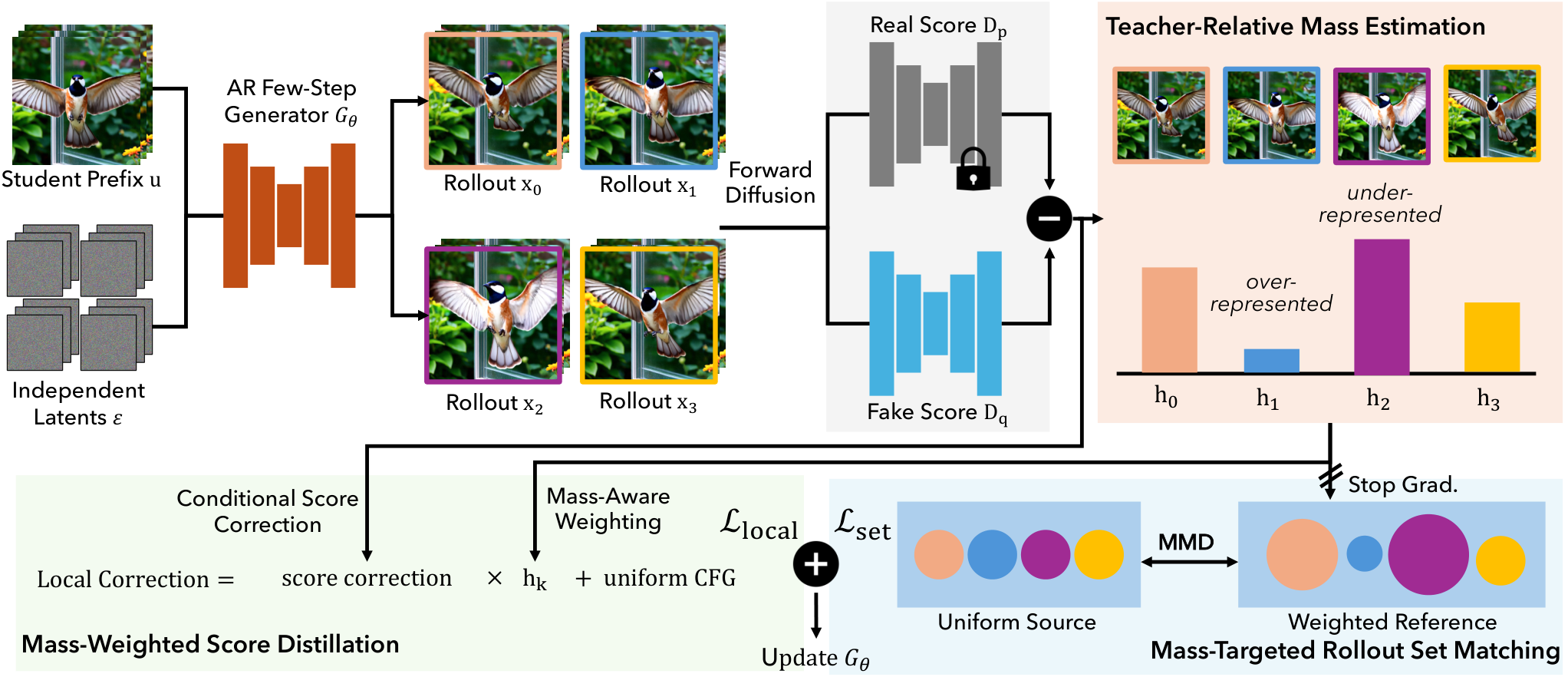
Figure 2 : Mass Forcing training. Each update samples one chunk, generates its prefix with the current student, and draws K K independent rollouts from that shared prefix. Integrating the difference between the frozen teacher score and the fake score along paths between rollouts gives each rollout a teacher-relative mass h k h_{k} , with h k > 1 h_{k}>1 for rollouts the student underrepresents. ℒ local \mathcal{L}_{\mathrm{local}} scales each rollout’s conditional score correction by h k h_{k} and leaves classifier-free guidance uniform, and ℒ set \mathcal{L}_{\mathrm{set}} matches the rollout set to an h k h_{k} -weighted copy of itself.
Figure 4 : Qualitative comparison with Self Forcing and Causal Forcing. Two prompts illustrate character-pose changes and scene evolution, with frames at 0, 2.5, and 5 seconds and methods aligned by row. Mass Forcing preserves detailed appearance as pose and viewpoint change.
批判点评:需要多 rollout、教师 score integration 和训练期集合监督,增加训练计算与实现复杂度;Dynamic Degree 与 Total 的具体测试口径仍依赖论文实验设置,不能直接等同主观质量。
6. NOVA:H100端到端加速1.82倍
NOVA: Normalization-Aware Output-Guided Attention Acceleration for Video Diffusion Transformers | 上海交通大学;华为;中国科学院计算技术研究所;上海启智研究院 | arXiv:2611.28115
关键词:NOVA, 视频扩散加速, 稀疏注意力, vDiT, H100
前序问题:视频扩散 Transformer 的 self-attention 随分辨率和帧数呈二次成本;只保留高 attention 权重却不一定保留最终 value 加权输出。
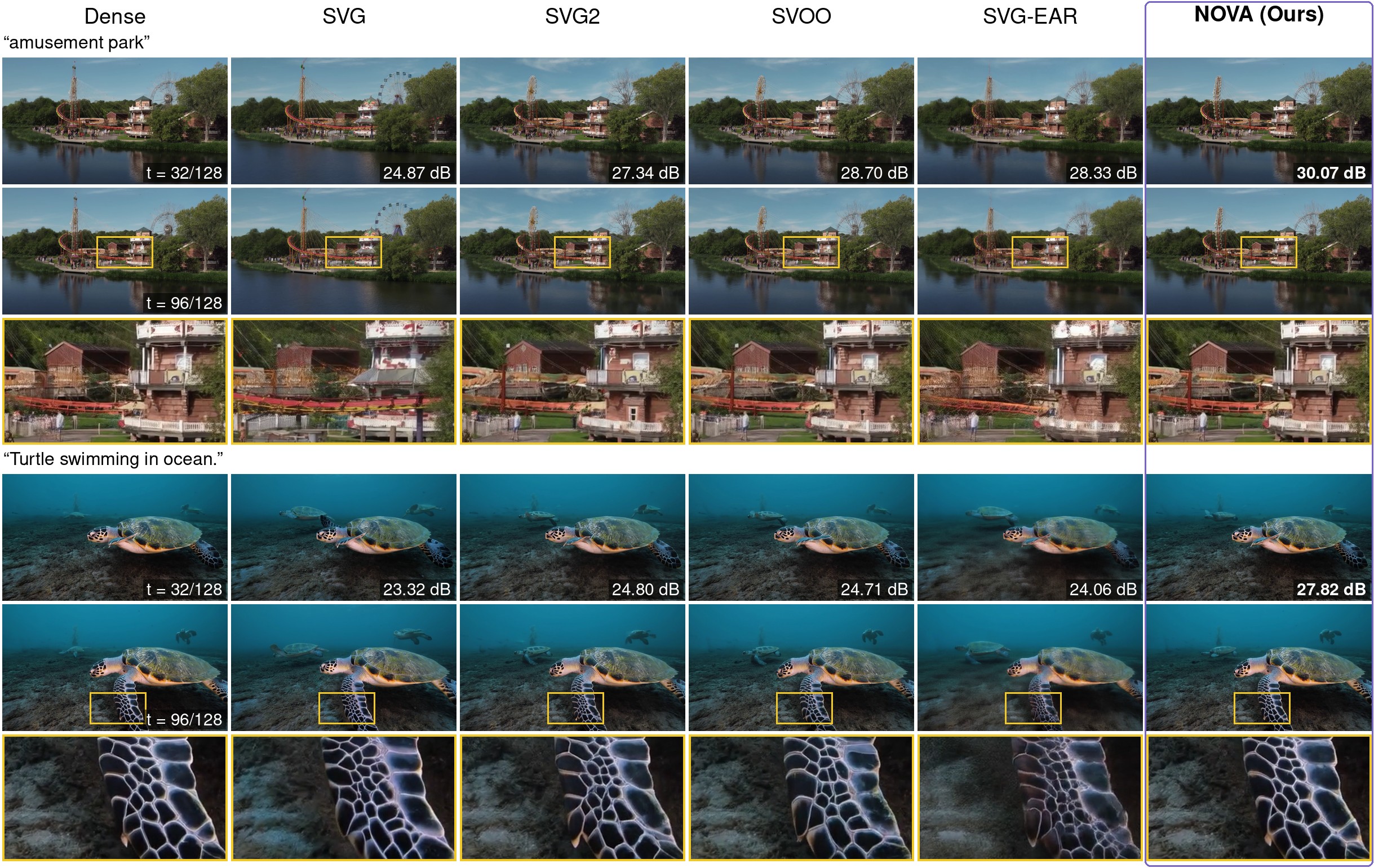
Fig. 6 : Qualitative comparison on HunyuanVideo [ 15 ] . The second row of each example zooms into the yellow box. Nova stays closest to dense attention and preserves fine details such as the hand and the cat’s face, while other sparse attention methods blur or distort them.
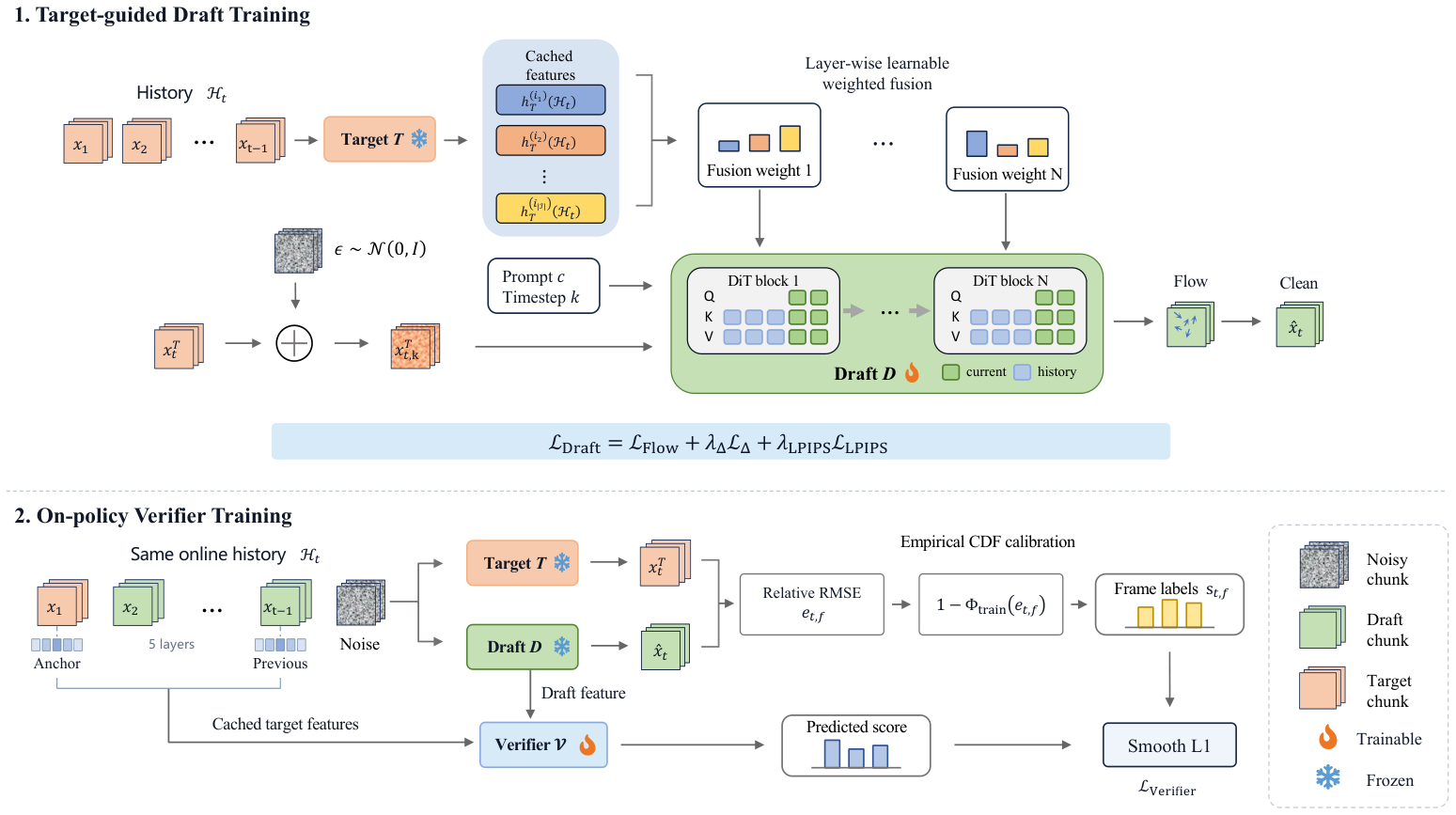
Figure 2 : Training of Draft Forcing . (1) Target-guided draft training fuses cached target hidden states persisted from committed historical chunks and combines flow matching, temporal difference, and LPIPS losses. (2) On-policy verifier training pairs draft and target outputs along speculative rollouts to learn frame-wise CDF-normalized discrepancy scores.
Figure 4 : Qualitative comparison across backbones. Top (a): accelerating the 14B Self-Forcing target against Training-free Draft and Target-only. Bottom (b): cross-backbone acceleration on the RAVEN-H3 target against Target-only. Green “ D D ” badges indicate draft-generated frames.
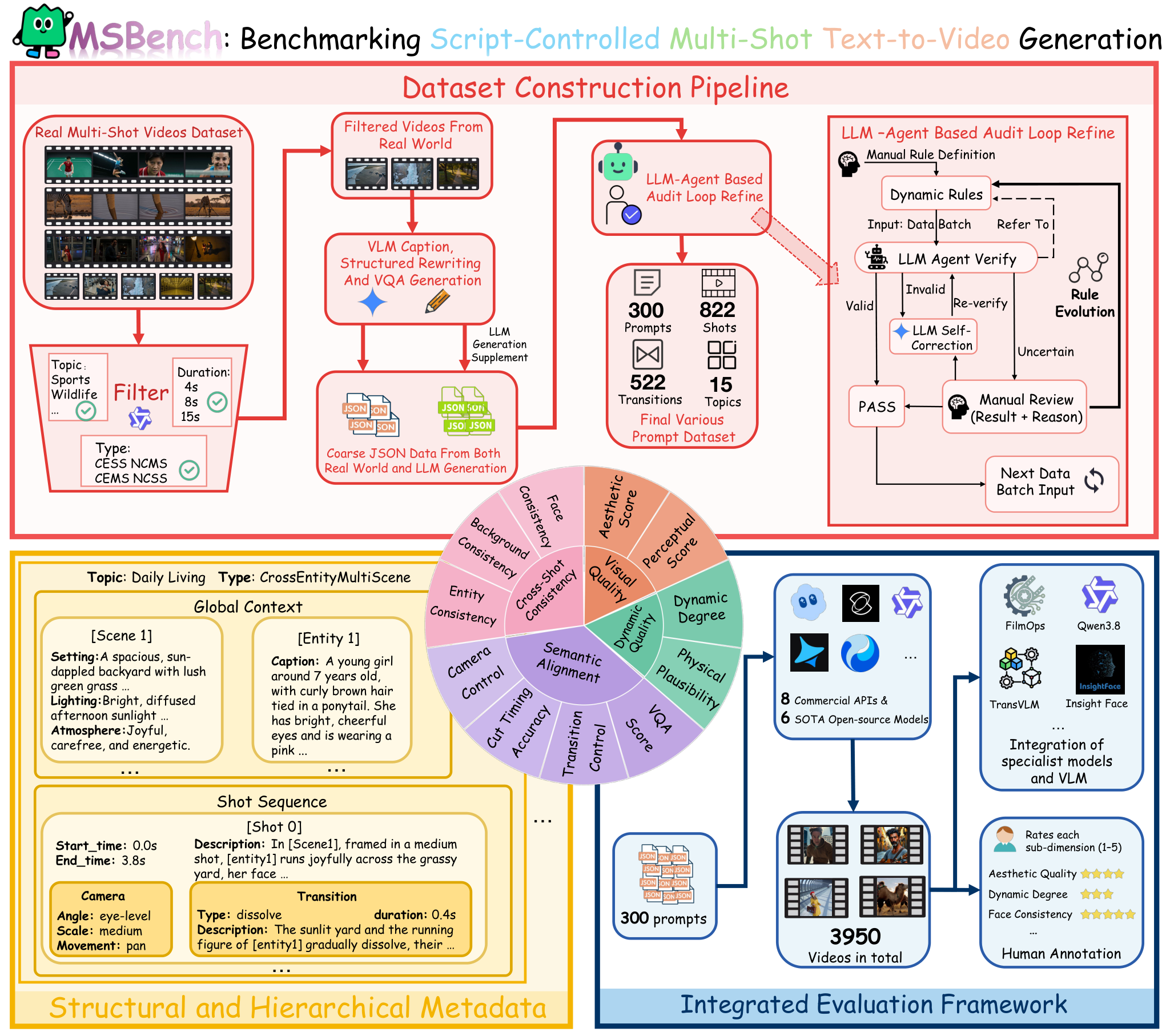
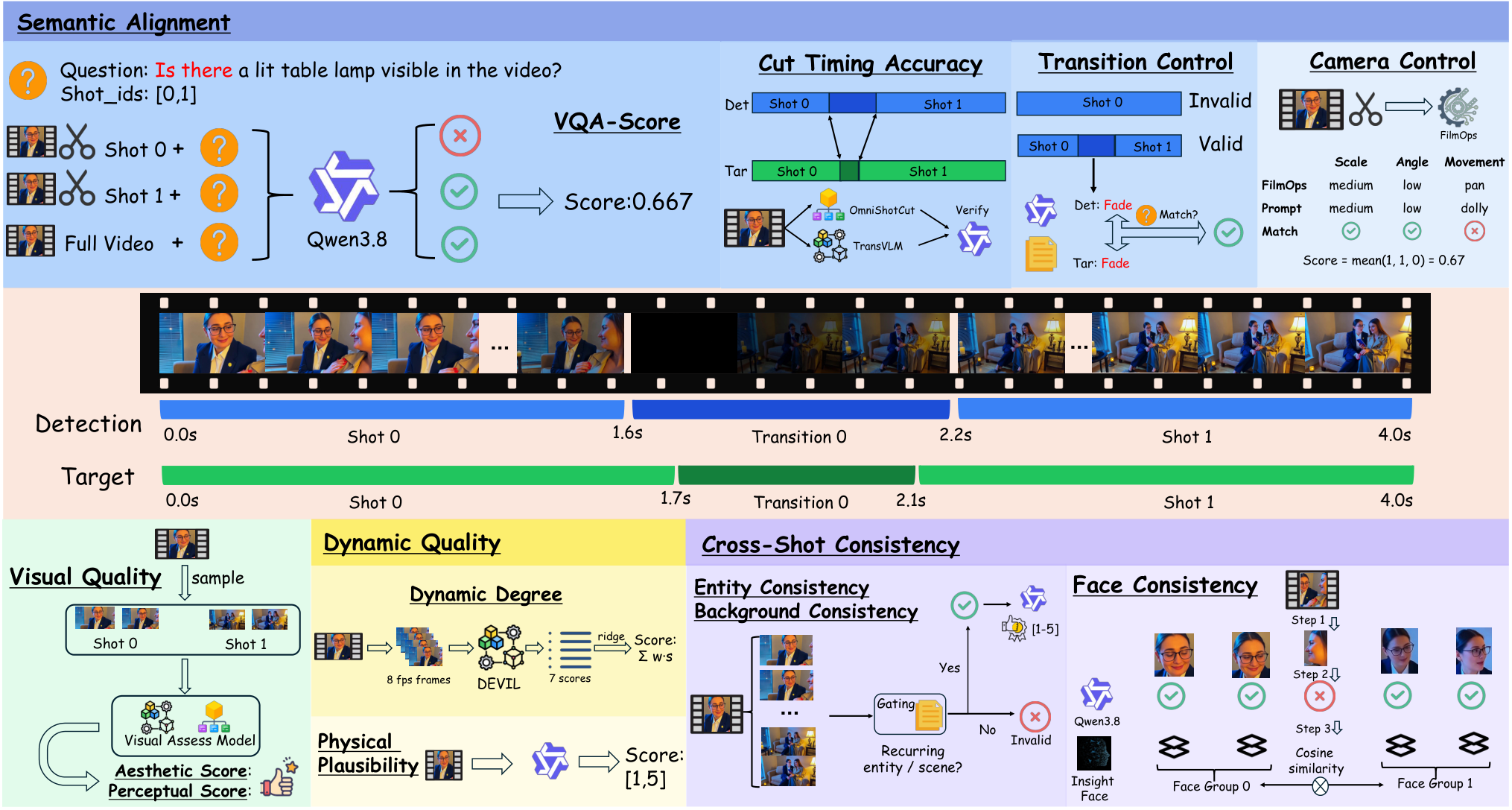
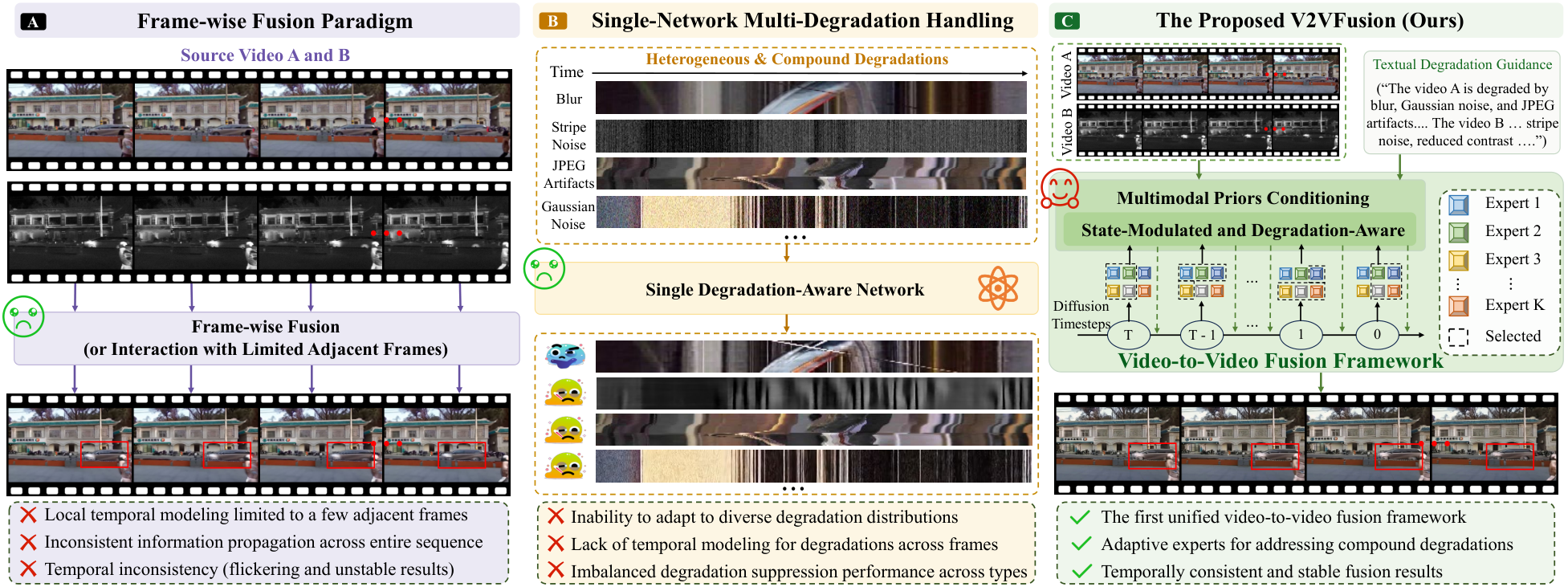
Figure 1 : Overview of MSBench. MSBench is a benchmark for text-to-video multi-shot generation. It constructs hierarchical Scene-Entity-Shot metadata from real-world videos and LLM-generated supplements, then uses a hybrid evaluation framework to assess current T2V systems across visual quality, dynamic quality, semantic alignment, and cross-shot consistency.
实验效果:实验发现视觉质量对系统区分度有限,多镜头控制更能拉开差距;许多模型主要在场景变化时硬切,把渐变转场生成成 hard cut。系统排名与人类偏好的 Spearman 相关为 0.87。
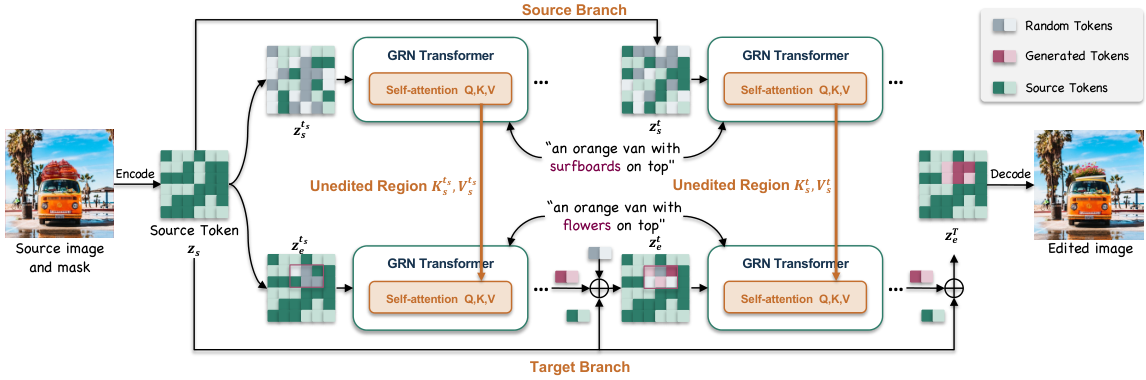
Figure 2: Overview of EditGRN . The source branch (top) corrupts clean source tokens at each refinement stage and extracts unedited-region KV; the target branch (bottom) shares the same corruption schedule and replaces its unedited-region KV with the source ones inside every Transformer layer, generating only within the edit region while protected tokens remain anchored to the source.
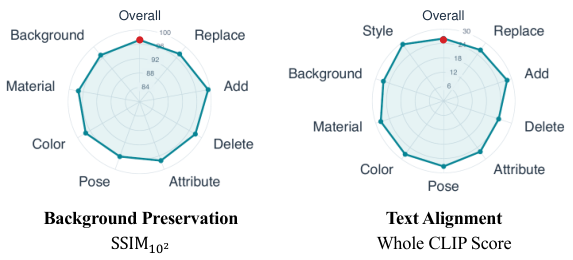
Figure 5: Per-task results on PIE-Bench. EditGRN’s overall score (red dot) already exceeds other methods, and its per-task scores closely track this overall level across all categories.
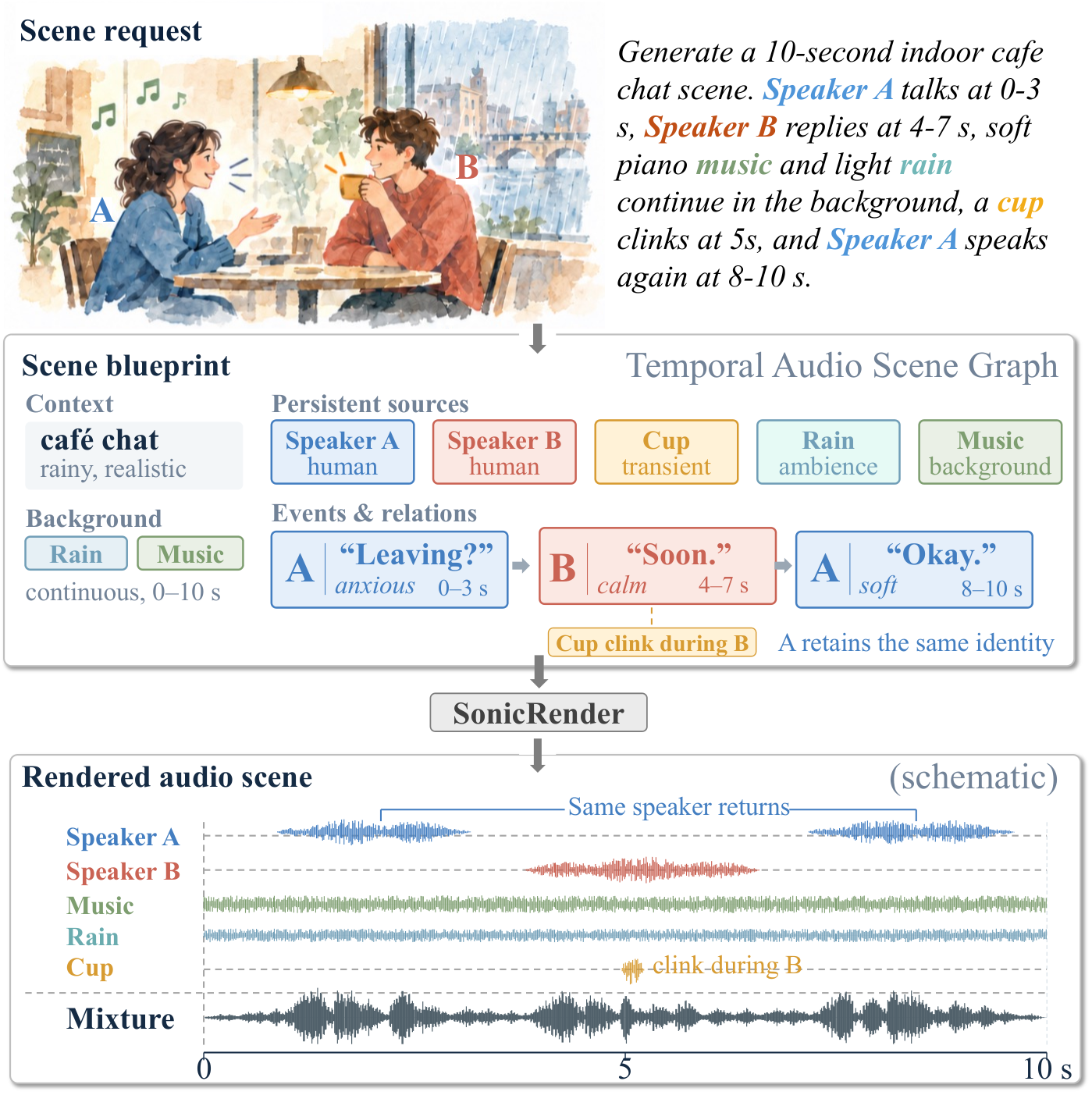
Fig. 1: Overview of SonicRender. A scene request is organized into a TASG blueprint that binds persistent sources to events, relations, and time windows. A unified renderer turns this blueprint into one coherent audio mixture with source continuity and event-level temporal control.
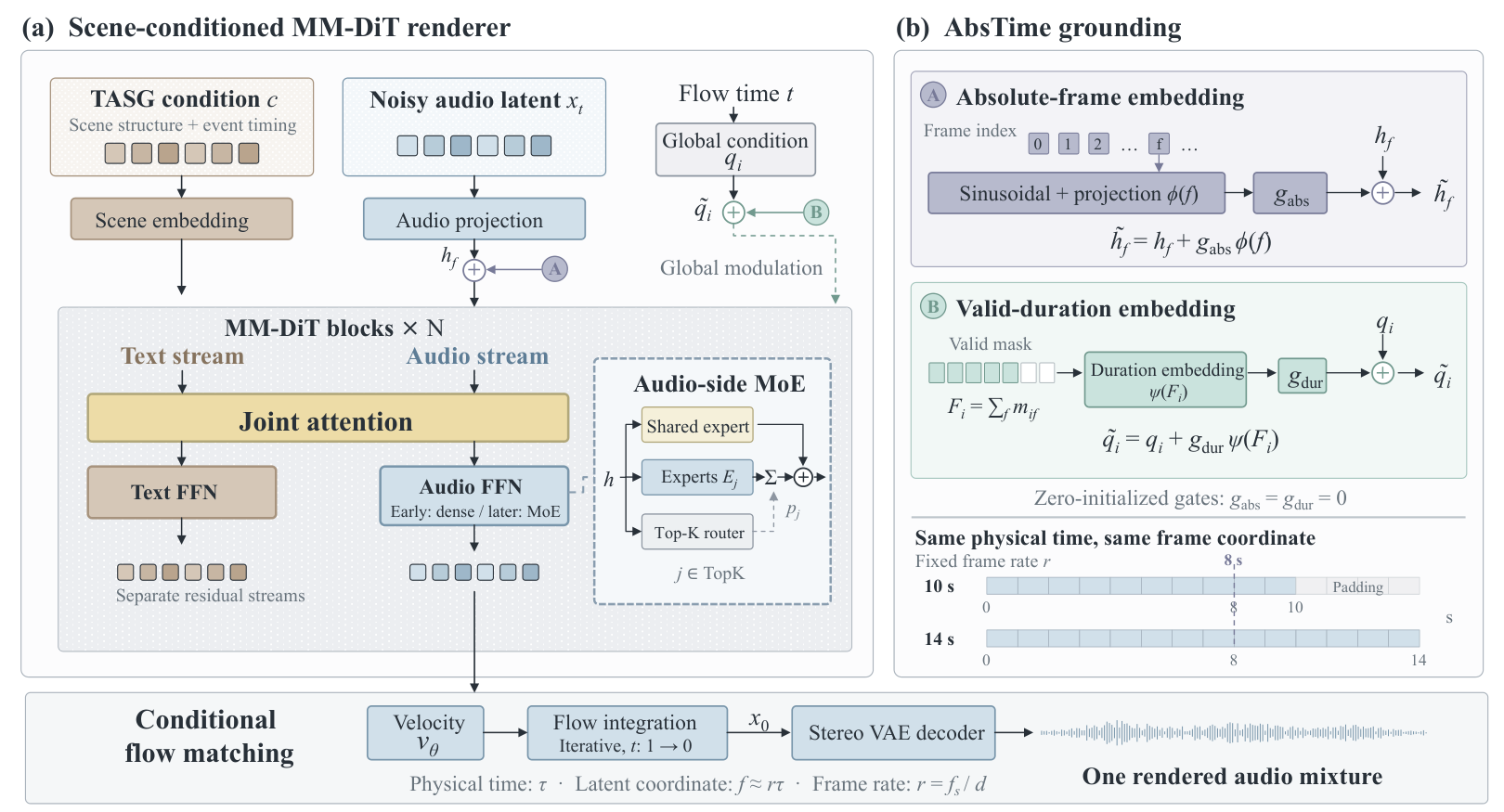
Fig. 3: SonicRender architecture and AbsTime grounding. (a) A dual-stream MM-DiT combines joint text–audio attention with later audio-side MoE blocks to render one mixture. (b) Zero-gated absolute-frame and valid-duration embeddings provide temporal coordinates: the same physical time retains the same frame index across different canvas lengths.










评论 (0)